Thursday, 27 December 2018

Turnover Rate: What It Is & How to Calculate It

Seeing your employees leave for new opportunities can be a bittersweet experience. At first, you’re sad to see them go, especially if you’ve developed a close bond with them. But you also know that they’re moving onto bigger and better things -- and you're excited for them

However, if employee departure starts to become a regular occurrence at your company, the feeling should become more bitter than sweet, and eventually turn into concern.

Having a high turnover rate means your culture might be toxic, or your employees don’t feel fulfilled working at your company. Constantly replacing employees can also skyrocket costs and plummet productivity -- if your company is a revolving door, you not only have to spend money recruiting and interviewing candidates, but you also have to train new hires who need a significant amount of time to be able to tackle a full workload.

Fortunately, there’s a way to determine if your turnover rate and, in turn, your company culture is healthy. Read on to learn how to do it.

To help you calculate your own turnover rate, let’s run through a quick example.

Employees at beginning of the year: 500

Employees at the end of the year: 600

Average number of employees: (500+600)/2 = 550

Number of employees who left this year: 40

Turnover rate: 40/550 = 7.27%

If you want to see the average turnover rate of your industry, LinkedIn analyzed their network of 500 million professionals to compile a report of the industries with the highest turnover rate in 2017. Below, we listed the 10 industries that experienced the highest turnover last year.

Average Turnover Rate By Industry

Technology (Software) 13.4%
Retail & Consumer Products 13.0%
Media & Entertainment 11.4%
Professional Services 11.4%
Government/Education/Non-Profit 11.2%
Financial Services & Insurance 10.8%
Telecommunications 10.8%
Oil & Energy 9.7%
Aero/Auto/Transport 9.6%
Healthcare & Pharmaceutical 9.4%

Remember, the severity of your company’s turnover rate completely depends on your industry. So to accurately gauge the health of your company’s turnover rate and culture, make sure to reference this blog post or keep an eye out for LinkedIn’s industry turnover analysis each year.


from Marketing https://blog.hubspot.com/marketing/turnover-rate

Wednesday, 26 December 2018

When should you consider changing your company’s phone number?

When you set up your business, you might have been preoccupied with so many aspects of getting the company off the ground – such as finding the right funding, staff and office space – that you paid little attention to what phone number the company would take.

This would be understandable.

Fortunately, it isn’t too late to reassess that number in preparation for potentially changing it, if you see fit. Here are example scenarios where a change of phone number could be readily justified…

The company has expanded from its “local” roots

We all have to start somewhere in our business journey – and, in your case, where exactly that “somewhere” is could be betrayed by the company number you chose by default.

Right now, your business might be largely or strictly aimed at local customers or clients – in which case, what we might call a “regional” or “geographic” number could more than suffice. After all, customers sometimes specifically seek a local supplier, as Marketing Donut points out.

However, as your company expands its coverage area beyond local borders, taking up a non-geographic number would help your firm to foster a more professional image, says Startups.co.uk.

You want to spur interest from new customers

There’s a broad range of non-geographic numbers from which you can choose, so be careful which of them you do settle on. After all, different numbers can have different implications for how prospective customers perceive your business.

Imagine, for example, that your business is little-established in either history or reputation – and, for this reason, struggles to attract initial interest. In this situation, opting for a free-to-call number, like the 0800 or 0808 “freephone” numbers in the UK, could incentivise curious people to call.

You are eager to attract repeat calls from customers

What if your difficulty is more in keeping customers rather than getting them? If this worrying development has become a trend, you might be inadvertently leaving those customers with sour experiences and so deterring them from getting back to you.

Maintaining a freephone number might not be financially practical for you in the long term. However, there could be many other numbers that would entail the caller footing more of the bill, if not so much that you don’t appear to be treating their needs as a priority.

Your current number isn’t particularly memorable

If your current company digits look like the kind of thing that a computer might cough out when it goes haywire, this is another possible reason why you might be missing those repeat calls. Fortunately, if your number does seem to slip from people’s minds too readily, there are fixes…

In the UK, the telecoms firm Planet Numbers allows business owners to obtain memorable numbers – including 0800, 03 and “local” numbers. You could even consider an “alphanumeric” number, whereby you can choose a particular word that will directly determine the number. In hitting the letters of that word on aphone’s keypad, the caller can input the number – it’s clever how it works.


Image recommendations:


https://www.pexels.com/photo/top-view-of-man-holding-android-smartphone-near-macbook-and-newspaper-938965/


https://www.pexels.com/photo/woman-in-gray-button-up-long-sleeved-dress-holding-black-smartphone-556068/

The post When should you consider changing your company’s phone number? appeared first on TheMarketingblog.


from TheMarketingblog http://www.themarketingblog.co.uk/2018/12/when-should-you-consider-changing-your-companys-phone-number/

The Ultimate Guide to Cryptocurrency

When I first heard of cryptocurrency, I thought it was similar to PayPal or Venmo … a simple, digital exchange of money. You can imagine my surprise when I learned that cryptocurrency wasn’t only a digital exchange, but an exchange of a completely new currency.

I could hardly wrap my mind around it. I was this emoji personified: 🤯.

How could a brand new (albeit invisible) currency work? What could you buy? Did people actually accept it? What stopped people from not believing in it?

I had lots of questions … and I still do. Cryptocurrency is a complex, ever-changing topic that affects consumers, investors, and business owners alike. Below, we tackle some of those questions and highlight the most important aspects of cryptocurrency. By the end, you should have enough of an understanding to chime into those dinner party conversations with a fact or two.

Bitcoin was the first cryptocurrency. Since its conception in 2009, which occurred in response to the banking crisis and housing market crash, hundreds of other cryptocurrencies have been created … and have failed.

Your Cryptocurrency Dictionary

Before we dive into the world of cryptocurrency, let’s review a few key terms frequently used in this guide and when discussing the concept.

Altcoins

Altcoins is slang for “alternative coins.” Altcoins refer to every other cryptocurrency besides Bitcoin.

Blockchain

All cryptocurrency transactions are recorded on the blockchain, a public record used to verify digital currency transactions and prevent scams. Transactions are recorded on blocks, and a new block is added to the chain roughly every 10 minutes. We explain blockchain further in the video below.

Cryptography

Cryptography refers to the act of writing in or deciphering a code. Cryptography (where we get the “crypto” in cryptocurrency) is a type of mathematics that creates secure transactions and online environments, i.e. “encrypted” accounts or currency.

Fiat

Fiat currency is paper money like the US dollar or Euro.

Mining

Cryptocurrency mining is a proof-of-work (PoW) system where miners solve math problems to validate every cryptocurrency transaction. These minters get cryptocurrency in exchange for their time and resources. These complicated mathematical calculations also increase the security, transparency, and value of cryptocurrency. Mining is only one way — the hardest way — to obtain cryptocurrency. The reward for solving these math problems varies per currency but is more profitable than any other method (besides an outright purchase).

Nodes

Nodes are computers that are part of the global cryptocurrency blockchain network. They serve to verify transactions recorded on the blockchain. Even if one node attempted to validate an incorrect transaction, the transaction wouldn’t go through as they require multiple validations (and that node would be disconnected) … making cryptocurrency a virtually incorruptible network.

Private Key

A private key is a secure “password” that gives cryptocurrency owners access to their wallets. Each wallet has its own private key, and without it, users couldn’t access their coins.

Public Address

A public address is similar to an email or physical house address. (It looks like this: 1GV5Vye4LCfpkM9V5oFSQsZk8kq2vBxvCK.) To send cryptocurrency, you simply need the recipient's public address. It’s the only public-facing piece of data on the blockchain, and each transaction uses a unique address.

Benefits and Drawbacks of Cryptocurrency by Feature

Both support and speculation exist in the world of cryptocurrency. Some hate it, some love it, and most are confused by it. It’s a brand new concept that sparks a whole barrage of questions and concerns.

Below, we explain the core features of cryptocurrency and the positive and negative perspective of each.

Feature

Benefits

Drawbacks

 
Security Cryptocurrency transactions are secure and private, creating valuable anonymity despite their very public (yet non-identifying) validation method on the blockchain. Security, privacy, and anonymity make it easy to use cryptocurrency for less-than-legal purposes.
Affordability Cryptocurrency has low transaction costs and in-between fees you might find at banks or payment gateways. Cryptocurrency isn’t accepted by everyone, which could cancel out its affordability altogether.
Volatility The volatility of cryptocurrency can yield a high-reward (high-risk) investment. Due to its volatility, cryptocurrency turns many people off from investing ... which could lower its value over time.
Decentralization Cryptocurrency isn’t regulated or valued by a financial institution or central government, which eliminates the middleman, a penchant for corruption, and creates a truly global currency. It’s monitored by a peer-to-peer internet protocol. Many people relate cryptocurrency to the Silk Road … such a decentralized, deregulated asset couldbe used for both legal and illegal purposes. There’s also no way to recover lost coin.
Digitalization Cryptocurrency doesn’t deal in physical coin or paper money, leaving little room for loss, theft, or misuse. Cryptocurrency is purely digital, and you can’t recover lost coin or repeal validated transactions. The “invisibility” of cryptocurrency can also make it hard to trust.
Inflation

Cryptocurrency isn’t inflationary — there’s a set amount that can be mined and circulated.

Cryptocurrency will likely never become a central currency because of its non-inflationary, inflexible elements.
Creation Cryptocurrency is released through mining, which anyone can do with the proper resources — a computer and internet. Cryptocurrency mining consumes a ton of energy and resources.. (In fact, miners are on track to use more energy than Argentina.)

How is Cryptocurrency Created?

Cryptocurrency is released into the economy through the process of mining, as we defined above. But how do these digital coins become a legitimate currency in the first place?

Cryptocurrency creation depends on three main things:

  1. A community of people who believe in the purpose of the coin and network … and who will eventually mine and evangelize it
  2. A code to create and encrypt the software and blockchain network on which the currency will operate (which is relatively easy as most cryptocurrencies are based on the open source code of Bitcoin available on Github)
  3. The confidence of merchants to value and do business with the currency, further building trust among consumers, investors, and the general public

There’s obviously a lot more that goes into creating a cryptocurrency, but these are the main three elements that lead to its legitimacy and acceptance. Third parties like WalletBuilders also offer to create cryptocurrency for you.

Creating Your Own Cryptocurrency

Nowadays, a lot of businesses are creating their own cryptocurrencies — through a crowdfunding process known as an initial coin offering (ICO). ICOs are when startups raise money by creating their own digital token that can be spent on current or future products or services.

Companies who participate in ICOs exchange their token for established cryptocurrencies like Bitcoin. Some ICO investors keep their tokens for future use or trade them on cryptocurrency exchanges as they would stock.

To learn more about creating or investing in an IPO, check out our guide here.

Types of Cryptocurrency

As of today, there are over 2,500 active cryptocurrencies, most of which serve as more than a simple payment system. Below we’ll review a four of the most popular, listed from oldest to newest.

1. Bitcoin

Bitcoin (BTC) is the first and most famous cryptocurrency. It’s been around for almost 10 years and has been hailed as the “digital gold” of the industry.

Today, 1 BTC is equal to $4,087.63 USD. There are currently 17,433,962 BTC in circulation, and the max supply is 21 million BTC.

Psst. Read more about Bitcoin in our ultimate guide here.

2. Litecoin

Created in 2011, Litecoin (LTC) was introduced as the “silver” to Bitcoin’s “gold.” It was intended to be used as a lighter, more nimble currency for everyday transactions. Litecoin is a replica of Bitcoin, just on a much smaller scale — it’s faster to mine, holds a smaller value, has a greater market cap, and operates on a much more flexible algorithm.

Today, 1 LTC is equal to $32.42 USD. There are currently 59,665,588 LTC in circulation, and the max supply is 84 million LTC.

3. XRP by Ripple

XRP is the cryptocurrency released by Ripple. Founded in 2012, Ripple was formed to expedite and improve cross-border payment transfers and the global payments system as a whole. The company itself is more of a network to process IOUs, and XRP serves as a currency transfer tool and token against spam — the currency itself holds no real value ( meaning you can’t buy anything with it).

Ripple designed XRP to function on a unique blockchain that validates its transactions over 200 times faster than Bitcoin. XRP also requires no mining — the only way to attain the currency is to purchase it on a cryptocurrency exchange.

Today, 1 XRP is equal to $0.370595 USD. There are currently 40,762,365,544 XRP in circulation, and the max supply is 100 billion XRP.

4. Ether by Ethereum

The Ethereum network hosts both a decentralized computer system and payment system, through its main token, Ether (ETH), along with a handful of others. Ether can be traded as a cryptocurrency, but it’s more commonly used to pay for transaction fees and services on the Ethereum network.

Launched in 2015, Ethereum uses blockchain to replace centralized computing systems (like Google, Apple, and Amazon) that regulate, censor, and control user data on their applications. A decentralized network gives power back to the users and removes the security risk of a centralized system. Along with payment transactions, Ethereum also processes and validates programs and contracts, such as insurance payouts. Ethereum’s average block mining time is 12 seconds.

Today, 1 ETH is equal to $117.59 USD. There are currently 103,925,546 ETH in circulation, with no set limit on its total coin supply.

Other top cryptocurrencies include Bitcoin Cash (price: $207.34 USD), EOS (price: $2.66 USD), Stellar (price: $0.124446 USD), and Tether (price: $1.02 USD).

How to Get and Store Cryptocurrency

Cryptocurrency can either be earned or purchased. You can earn cryptocurrency, by mining it or completing tasks in exchange for it.

You can purchase cryptocurrency in a few different ways. For one, you can invest in an ICO (as we explained above). You can also purchase cryptocurrency from another individual through sites like LocalBitcoins.

The easiest (and arguably most secure) way to buy cryptocurrency, though, is on an exchange like Coinbase or GDAX. Cryptocurrency exchanges simply require fiat money to make the purchase, typically from a debit card. You can also seek out a Bitcoin ATM, which operates just like your typical bank ATM.

So, what do you do with your cryptocurrency after you earn or purchase it?

Well, all cryptocurrency technically lives on the blockchain. But individual owners keep track of and manage their cryptocurrency through wallets.

Your wallet stores your private key and public address. Without your private key, you cannot access or verify purchase of your cryptocurrency, so it’s essentially the most valuable piece of your cryptocurrency ownership.

The most popular type of wallet is a software wallet like Coinspace (which also serves as an exchange). You could also use a desktop or paper wallet, which we explain further in our guide to Bitcoin here.

Note: Cryptocurrency is a largely unregulated and tumultuous market, and it’s notorious for scams. That being said, we highly recommend doing plenty of research before investing in any cryptocurrencies.

Cryptocurrency Resources

This guide simply scratches the surface of the cryptocurrency world. If you want to learn more about mining, purchasing, or investing in cryptocurrency, check out the resources below:

  • Coindesk, a trusted news outlet on cryptocurrencies
  • Coinmarketcap, a live ledger of the current market value of cryptocurrencies
  • The Cryptocurrency Reddit, an online forum discussing cryptocurrency news, trends, and analysis
  • Online Cryptocurrency courses on Udemy and Coursera

Over to You

Between mining, blockchain, and wallets, there’s a lot that goes into cryptocurrency. It’s well-established in our economy, but it sure hasn’t triumphed every marketplace and merchant.

If anything, cryptocurrency is a sign of how advanced and open-minded our economy is. We’re willing to take new risks and try new things in order to businesses, bank accounts, and futures secure. Is cryptocurrency guaranteed? Absolutely not. But it might be something worth exploring you’re looking to spice up your portfolio or try something new.


from Marketing https://blog.hubspot.com/marketing/cryptocurrency

Reminder : A no deal brexit could cause German exports to the UK to plummet by 57%

German economists have warned that no deal could cause German exports to the UK to plummet by as much as 57%. The highly respected IW Economic Institute based in Cologne called for policymakers to take “constructive action” to avoid what they called the “horror scenario” of no deal.

The boss of the BDI – Germany’s equivalent of the CBI – has also warned that a “disorderly Brexit” would be a “massive crisis” for the EU, demanding that political leaders achieve a “breakthrough in the talks” at the next EU summit. As Brexiteers have been saying all along, German industry is desperate for a deal. So why is the UK the only side making serious concessions?

The post Reminder : A no deal brexit could cause German exports to the UK to plummet by 57% appeared first on TheMarketingblog.


from TheMarketingblog http://www.themarketingblog.co.uk/2018/12/119419/

Tuesday, 25 December 2018

The Social Media Content Calendar Template Every Marketer Needs [Free Template]

"We have a 9 a.m. meeting? Hold on -- let me just click around the internet like a maniac to find something for the morning tweet." 

Sound familiar? Scrambling for social content is nothing new. We have meetings. We run late. Things come up. And it's really hard to get any meaningful amount of work done when you have the next social media update looming over your head every 30, 60, or 90 minutes. It all moves so fast that you might periodically feel a case of the vapors coming on, which is why pre-scheduled social media content should be your new best friend.

To make social media content easier for companies to plan and schedule across the accounts they manage, we created a social media content calendar template. And recently, we updated to be better, faster, stronger, and just generally prettier. 

You can fill it in at the same day and time every single week to prep for the following week's social media content. That means when you burst through the office doors at 9 a.m., you won't be in panic mode looking for something to push out to your Facebook fans -- you already took care of that last week.Manage and plan your social media posts with the help of this free calendar template.

This blog post will walk you through exactly how to use the template to stay on top of your social media content planning for Facebook, Twitter, LinkedIn, Instagram, Pinterest, and Google+.

Note: HubSpot customers can also schedule content through Social Inbox, or use this spreadsheet to organize their content and subsequently upload it to Social Inbox. Detailed instructions for doing this exist in the cover sheet of the template.

How to Use the Social Media Calendar Template to Plan Your Content Schedule

When you open up the social media content calendar template, you'll notice the bottom of the Excel spreadsheet has several different tabs, most of which are dedicated to a specific social network.

social-media-calendar-excel-tabs.png

The reason you'll want a different worksheet for every social network is simply that every social network is a little bit different. You can't just craft one, single social media update and use it across LinkedIn, Facebook, Twitter, Instagram, Pinterest, and Google+. You can certainly promote the same piece of content across all six of those networks, but that doesn't mean you'll craft your update in the same way for every single one of them. (In fact, you may even want to add additional tabs if you're active on other networks, like Quora or YouTube.)

This following sub-sections will walk you through how to fill out each of the four tabs you see in this template -- the updates for Twitter, Facebook, LinkedIn, Instagram, Pinterest, and Google+. But before we get to that, let's just walk through the "Monthly Planning Calendar" so you know what that's for.

Monthly Social Media Schedule 

The tab "Monthly Planning Calendar" provides an overall snapshot of your monthly social media campaigns. It'll help you coordinate better with other stakeholders, not to mention keep all the moving parts straight in your own mind. Here's what it looks like:

social-media-calendar-month-view.png

There are three sections to take note of when you edit this template for your own purposes. First, the color-coding key: These are the types of content or campaigns around which you might coordinate, like ebooks, webinars, blog posts, product launches, and so on. Though only some of these might be relevant to you, they're there to indicate what you may want to put in there -- so be sure to edit these categories to align with your own campaigns.

The other two sections you'll need to edit are the Month and Year at the top of the calendar (duh), as well as the cells below each day of the week. In those cells, you should enter the type of content you'll be promoting that day and color-code it to align with the campaign it's supporting.

Instead of deleting all the content in this spreadsheet each month, I recommend copying this worksheet twelve times over, and creating a separate sheet for each month. (If that gets to be too overwhelming, you can always save those tabs as a separate file.)

Planning Your Twitter Content Calendar

Alright, now let's get to the social media content. This section will be the lengthiest, because all subsequent sections will draw on the instructions we go through here. So if you read one section in this whole post, make it this one.

Let's say you want to add some tweets to your scheduling template. Skip over to the "Twitter Updates" tab, where you'll see this:
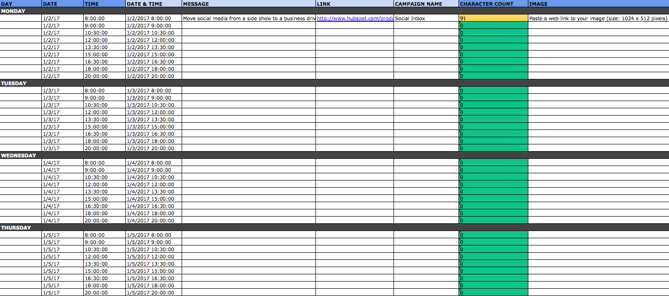
Social media calendar template for Twitter content

The first four columns, "Day," "Date," "Time," and "Date & Time" are there for your convenience, and if you choose to use a third-party app for pre-scheduling your tweets (like HubSpot's Social Inbox), then these columns will be useful. For now, just fill in the date on which you'd like your updates to publish to Twitter, and the time at which you'd like them to go out. The "Date & Time" column will automatically change based on what you input in the previous two columns.

Now, let's move over to the "Message" column. Here, input the copy you'd like to appear in your tweet, bearing in mind you should cap it at 116 characters to allow enough room for a link, and at 115 characters to allow room for an image. (Read this blog post for a full character count guide.) This spreadsheet will auto-calculate the number of characters you've entered to keep you on-point, turning yellow when you've reached 95 characters, and red when you've reached 116 characters.

After you've composed your tweet, paste the URL you'd like to include in your tweet in the "Link" column. Be sure to include UTM parameters so you'll know whether all of these tweets are actually driving traffic, leads, and customers. This is an important step to remember if you'd like to be able to demonstrate ROI from social. You can also use the "Campaign" column to add an associated campaign, which helps which more robust tracking and reporting.

Finally, in the "Image" column, attach the tweet's image (if you have one). For Twitter, we recommend images that are 1024 x 512 pixels. (Click here for a full cheat sheet of social media image sizes.) If you're having trouble attaching your image to the spreadsheet, follow these steps:

Step 1: Right-click the cell in which you'd like your image.

Step 2: Click "Hyperlink," then click the "Document" button, and finally, click "Select" to choose your image.

Step 3: In the "Choose a File" window, select the image from your computer and click "Open."

Step 4: You'll now see the image attached to the "Insert Hyperlink" screen. Feel free to edit the "Display" text to change the file name, then click "OK."

Note: This process is simply for organizational purposes. If you decide to upload the spreadsheet to your social media publishing software, it will not attach -- you'll have to do that with your marketing software. If you're a HubSpot customer, details for how to bulk upload your Twitter content to Social Inbox can be found within the downloaded template.

Planning Your Facebook Content Calendar

Now, let's talk about how to plan your Facebook marketing in advance with the template. Navigate on over to the tab in your template labeled "Facebook Updates."
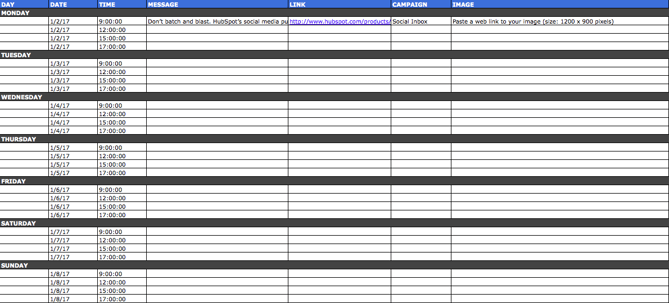
Social media calendar template for Facebook content

Facebook updates work similarly to Twitter updates, with the exception being bulk uploading your content is not possible in Social Inbox.

The first three columns, "Day," "Date," and "Time" are there for your convenience. Head on over to the column labeled "Message" and input the copy you'd like to appear in your status update, corresponding to the days and times you'd like those updates to run. Then, move to the "Link" column and input the link you'll be, you know, linking to in the update. (Don't forget that tracking token.) If you'd like the update to be tagged to a certain campaign, include this in the "Campaigns" column. Finally, attach an image just like you did with your Twitter updates -- if you're using one, we suggest you edit it to be 1200 x 900 pixels. (Click here for a full cheat sheet of social media image sizes.)

Planning Your LinkedIn Content Calendar

LinkedIn updates are the most unique, because you have both Company Pages and Groups to consider. To demonstrate the difference between Company Page updates and Group updates, let's navigate over to the column labeled "Title (For Group Discussions Only)."
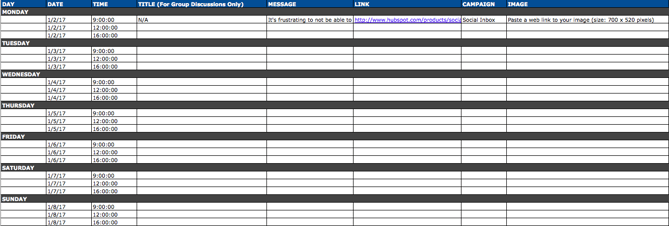
Social media calendar template for LinkedIn content

LinkedIn Groups let you post a few kinds of updates, one of which is called a "Discussion." You will only fill out the "Title (For Group Discussions Only)" column if you're looking to post a Discussion to your LinkedIn Group -- because Discussions are the only update you'll be posting that requires a title. If you're not posting a Discussion to a LinkedIn Group, you don't need to fill out this field, because your update will not have a title.

You'll fill out the next column, "Message," for every type of update you post, whether it's for a Company Page or a Group. Simply input your copy into this column, and then navigate to the next two columns, "Link" and "Campaign" to input the URL to which you're directing readers with the tracking token you'll use to track activity, and the associated campaign if one exists. If you'd like to use an image for an update, attach it per the instructions laid out in the "Twitter" section. We recommend editing the image to 700 x 520 pixels.

Planning Your Instagram Posting Calendar

Now, let's move on to how to set up your Instagram photos and videos in advance with the template. Navigate on over to the tab in your template labeled "Instagram Updates."
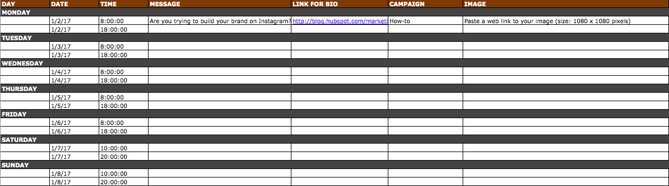
Social media calendar template for Instagram content

Instagram updates work similarly to Facebook updates, in that content can't be uploaded in bulk to Social Inbox like it can with Twitter.

The first three columns, "Day," "Date," and "Time" are there for your convenience. Head on over to the column labeled "Message," and input the copy you'd like to appear in your post's caption, corresponding to the days and times you'd like those updates to run. Keep in mind that although Instagram captions can be up to 2,200 characters long, they cut off in users' feeds after three lines of text. The exact length of these three lines depends on the length of your Instagram handle. (Read this blog post for a full character count guide.)

Next, move to the "Link for Bio" column and input whichever link you plan to put in the bio when you publish the accompanying Instagram post. (The reason you'd put a link in your bio and not the photo caption itself is because clickable URLs aren't allowed anywhere except the single "website" box in your bio. See #13 in this blog post for more on how that works.) Oh, and don't forget that tracking token.

If you'd like the update to be tagged to a certain campaign, include this in the "Campaigns" column. Finally, attach an image just like you did with your other social media updates -- we suggest you edit it to be 1080 pixels x 1080 pixels. (Click here for a full cheat sheet of social media image sizes.)

Planning Your Pinterest Content Calendar

Alright, now let's go over how to set up your Pinterest pins in advance with the template. Navigate on over to the tab in your template labeled "Pinterest Updates."
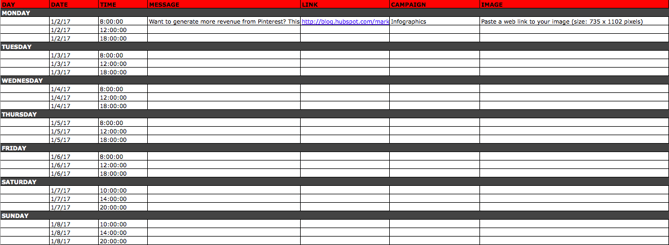
Social media calendar template for Pinterest content

Pinterest updates work similarly to Facebook and Instagram updates, in that content can't be uploaded in bulk to Social Inbox like it can with Twitter.

The first three columns, "Day," "Date," and "Time" are there for your convenience. Go to the column labeled "Message," and input the copy you'd like to appear in your pin's description, corresponding to the days and times you'd like those updates to run. Then, move to the "Link" column and input the link you'll be, you know, linking to in the update. (Don't forget that tracking token.)

If you'd like the update to be tagged to a certain campaign, include this in the "Campaigns" column. Finally, attach an image like you did with your other social media updates -- we suggest you edit it to be 735 pixels x 1102 pixels.

Planning Your Google+ Posting Calendar

Finally, we come to Google+.
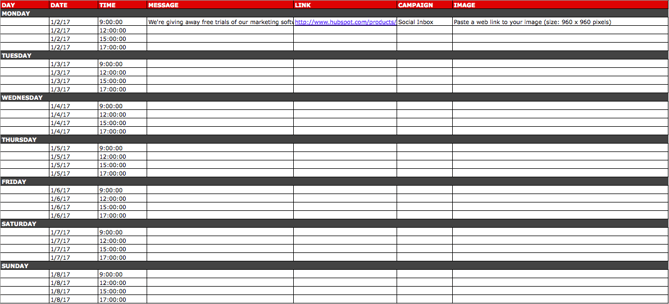
Social media calendar template for Google+ content

Update: Google recently announced it is shutting down its Google+ platform. Please consider using the template and instructions below for any potential social networking platform Google launches in the future, and check back with us for an updated template that reflects this rollout.

Start in the "Message" column, and input your status update. Then move over to "Link" column, where you'll input the link to which you're directing readers. If you'd like the update to be tagged to a certain campaign, include this in the "Campaigns" column. If you're attaching an image, you could use multiple different sizes, but 960 pixels x 960 pixels works best. (Click here for a full cheat sheet of social media image sizes.)

Content Repository (Or, Where to Source Social Media Content)

This template also provides you with a tab called "Content Repository," which should help you keep track of all your content and maintain a healthy backlog of fodder to make sourcing social media content easier.
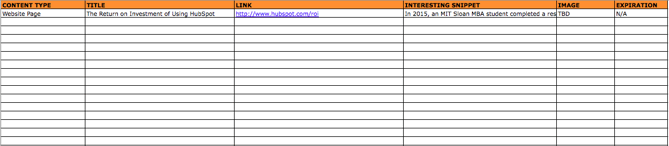
social-media-calendar-content-repository.png

As you create more assets, you'll likely want to resurface and re-promote those pieces down the line, too. To ensure you don't lose track of all of that content, record it on this tab so you're never at a loss for what to publish on social. If the content you're promoting isn't evergreen, be sure to include an expiration date in the column marked "Expiration" so you don't promote it when it's jumped the shark.

This tab will also help you maintain a healthy balance of content: A mix of your own content and others', a mix of content formats and types, and mix of lead generation content vs. MQL-generating content vs. traffic-friendly content.

Don't Forget to Interact With Your Followers

Whether you use this spreadsheet to plan your content out in advance or upload to a third-party app, you'll still need to supplement these updates with one the fly content. Breaking news hits? Whip up a quick update to share it with your network. Someone in your network tweets something interesting? Give it a retweet with some commentary. Got a fascinating comment on one of your updates? Respond with a "thank you" for their interaction or an additional follow-up comment.

Coming up with and scheduling your social media content in advance is a huge time-saver, but it should go without saying that you still need to monitor and add to your social presence throughout the day.

Finally, we encourage you to experiment with your social media publishing. This template provides publishing dates and times for each social network, but you may find those are way too many updates for you to fill, or perhaps too infrequent for your booming social presence. You should adjust your social media publishing frequency as needed.

Free Template Social Media Content Calendar

from Marketing https://blog.hubspot.com/blog/tabid/6307/bid/33415/the-social-media-publishing-schedule-every-marketer-needs-template.aspx

Monday, 24 December 2018

Movers and Groovers : onebite appoints Chris Thornett

onebite, a marketing and communications firm, today announced the appointment of Chris Thornett from respected technology magazine Linux User & Developer where he was Editor. Chris brings more than 19 years’ experience in journalism, 14 of which have been focused on technology to the company.

In his new role, Chris will focus on expanding and enhancing client activity across a number of key technology accounts at onebite. As Technology Content Manager for the company’s PR and communications team, he will support content services and media activity delivery team.

Chris commented, “Having worked with onebite in the past, I was familiar with the company’s approach to technology and open source in particular. I am excited to be joining a team that is so focused on delivering interesting and engaging content for their clients.

Content has always been my lifelong passion and I am hooked on conveying complexity in an approachable form, so the chance to collaborate effectively with companies on their content strategies and media support projects was a great one for me.”

Karen Cooper, Managing Partner at onebite, said: “Our approach as a team is based on building up a deep understanding of the sectors where our clients operate, developing relationships with key influencers in those markets, and providing value in every interaction that we have with clients, journalists and analysts.

Chris’ experience around open source, software and technology fits really well with our approach. We are really pleased to have a talent like Chris joining our team.”

The post Movers and Groovers : onebite appoints Chris Thornett appeared first on TheMarketingblog.


from TheMarketingblog http://www.themarketingblog.co.uk/2018/12/movers-and-groovers-onebite-appoints-chris-thornett/

Saturday, 22 December 2018

‘Double Laughter Spot’ : Staying in a hotel and the afterlife

Winner, winner, winner – One of our most read topics at theMarketingblog is our famous ‘Laughter Spot.

Send us a great ‘Laughter Spot’ and win a £25 gift card. Send your gem to

will@themarketingblog.co.uk

Check all our great ‘Laughter Spots’ HERE >>>>

I was staying in a hotel last night.
Before I went to bed, I phoned down to reception.

“Hi, this is room 317. Can I have a wake-up call, please?”

The receptionist replied, “Yes. You’re fat, in your 40′s and given you’re staying in such a cheap hotel probably haven’t achieved much in your life.”

 ………………………..

Boss: Do you believe in the afterlife?

Employee: No I don’t, because there’s no proof.

Boss: So if I could prove to you that there is life after death, would you believe in the afterlife?

Employee: If you could prove it 100%, then I would believe in life after death.

Boss: OK. Here’s the proof. After you left early yesterday to go to your Uncle’s funeral, he came here looking for you to go and play golf.

The post ‘Double Laughter Spot’ : Staying in a hotel and the afterlife appeared first on TheMarketingblog.


from TheMarketingblog http://www.themarketingblog.co.uk/2018/12/double-laughter-spot-staying-in-a-hotel-and-the-afterlife/