Thursday, 5 January 2017

13 Things to Start, Stop & Keep Doing With Your Email Marketing in 2017

email_marketing_2017.jpg

If you’re reading this blog post, there’s a good chance you arrived here by clicking on a link in an email we sent to you.

Email marketing is a powerful tool to encourage your audience to engage with content and to nurture leads in your database along the buyer’s journey.

And despite what you may think, email marketing is still growing: Gmail alone has 1 billion users worldwide, and The Radicati Group predicts that there will be 3 billion email users worldwide by 2020 (that’s almost half of the world’s population). Reap the positive ROI benefits of email marketing with the help of this 14-point checklist for optimizing your emails. 

Certainly email is not dead, but it is getting harder to do well. HubSpot Postmaster and Email Engineering Director Tom Monaghan distilled his wisdom into a set of guidelines for email marketing for growth in 2017 at INBOUND last year. Read on to learn what strategies you should start implementing, absolutely avoid, and keep up in 2017 and in years ahead.

How to Improve Your Email Marketing in 2017

1) Send emails to lists that want to hear from you.

If you have email lists with low rates of engagement activity, stop sending to them. Every time you send to a list with low open and engagement rates, it hurts your domain reputation and your chances of connecting with other potential customers.

Monaghan said it best in his talk: “You are what you eat, and so is your marketing.” When you receive tons of emails from brands you don’t engage with, constantly deleting them or marking them as “read” is most likely tiresome. Empathize with your subscribers and treat their inbox the way you would want your inbox treated.

2) Have a goal for each email before you press “send.”

If you don’t have a goal in mind for the emails you’re sending, the recipients won’t know what the goal is, either. Once you define a goal for your email sends, you can define success and build a list to make that happen.

Goals for your emails could include a contact filling out a longer form for a gated content offer to provide your team with more information about their organization, or redeeming a promo code for a purchase on your website.

Give recipients options in your messages, such as calls-to-action and links in text, so they have multiple avenues to achieve your goal. Everyone’s behavior is different, so make your emails flexible.

3) Personalize and test your emails.

Email personalization really works. For example, back in 2014, we found that emails with the recipients’ first names in the subject lines had higher clickthrough rates than emails that didn’t.

When it comes to personalizing your emails, stick with the basics. Personalize according to recipient names and company names, but to avoid being creepy, leave it at that, urges Monaghan.

Nothing is less personal than receiving a “Dear Customer” or “Dear First Name” email, so test every email to make sure you’re sending to recipient names.

4) Send emails from a personalized account.

Don’t send emails from a “noreply” email account. Personalization works on your end, too. Boost your engagement by personalizing the “from” email address to drive replies from subscribers to a real person instead of “noreply@company.com.”

5) Experiment with sending emails on different days of the week.

Stop sending emails on Tuesdays. Seriously, stop.

Tuesdays, Wednesdays, and Thursdays are the most popular days to send email, but they’re oversaturated with messages that might be overwhelming your subscribers. If you want your emails to be opened, try sending them on Mondays and Fridays. Emails with calls-to-action perform well on Saturdays, so don’t be afraid to send emails on the weekend, either.

In any case, try experimenting with your approach to lessen your subscribers’ email load Tuesday through Thursday, when most business emails are sent.

6) Engage with contacts who've submitted forms, not contacts whose information you’ve imported.

When someone fills out a form and provides their email address, their engagement rates are typically higher than cold contacts you’ve imported from a list. That’s because they want to hear from you and chose to engage with your content -- they’ve told you this by filling out a form. This is evidence that the inbound marketing methodology is working for email marketers.

And by the way, don’t buy email lists -- you’re only hurting your credibility and annoying people who haven’t asked to hear from you.

7) Suppress your unengaged subscribers to avoid sending graymail.

You may be sending spam without knowing it, and that’s because the definition of spam has changed. Graymail refers to bulk email messages that aren’t technically spam because the recipients gave you their information, but the fact of the matter is, they get your emails and don’t touch them. Engagement rates plummet if recipients don’t open your first email, so if they continue ignoring you, the probability of them ever opening your messages is going way, way down.

Stop sending graymail, and listen to what people are telling you by not opening your emails. Start suppressing your unengaged subscribers. That way, your open rates will increase, and inbox providers will see that you’re responding to subscriber behavior.

8) If people are unsubscribing, don’t worry too much (yet).

You can’t please everyone, and unsubscribes will happen. Luckily, your subscribers didn’t mark you as spam -- they simply told you, in the nicest way possible, that they’re not interested in hearing from you anymore.

Don’t be too worried yet, but if more people keep unsubscribing, try to identify the potential cause. Consider suppressing or sending fewer emails to subscribers who aren’t engaging as much.

9) If people stop opening your emails, figure out what’s going wrong fast.

If your email open rate is falling, it means you’re missing the expectations of your recipients and that you should prepare for worse outcomes. It’s a leading indicator that spam complaints and unsubscribes are coming, and you should immediately suppress your unengaged subscribers to show email providers that you’re responding to feedback. Test different emails to see if you can improve your open rates.

10) If people mark you as spam, immediately stop sending email and identify the source of the complaints.

If you’re being marked as spam, your domain reputation is at risk, and you could become blacklisted by email providers. Whether the spam complaints are caused by a new source, bad forms, or you missing expectations of your list, slow or completely stop sending emails until you figure it out.

If you aren’t getting unsubscribe or spam complaints, that doesn’t necessarily mean you’re in the clear -- the messages could be going straight to recipients’ junk folders.

11) If you want to learn more about email marketing, take the free email marketing certification course.

Learn more about email marketing with Monaghan right now by taking HubSpot Academy’s Email Marketing Certification course. In only 3.5 hours, you'll learn about lifecycle marketing, email list segmentation, design, deliverability, and more skills to help you cultivate a strong strategy for 2017 and beyond.

12) Be thoughtful about your subject line.

Don’t write clickbait email subject lines. When people click on your email and then immediately bounce away when they realize your subject line wasn’t genuine, your clickthrough rates will suffer.

For best results, customize and personalize email subject lines and experiment with emojis. Pro tip: Read subject lines out loud before sending. Would you open that email if you received it?

13) Remember: Email is getting harder, but it’s still working.

Every year, engagement rates start to slip, and it gets harder to reach people’s inboxes. This doesn’t mean that email marketing is losing its efficacy, it’s just getting more competitive. The divide is growing between email marketers who know what they’re doing and those who don’t, so make sure to put in effort to test different strategies and keep your subscribers engaged.

The theme of all of these email marketing guidelines? Testing. Every audience and contacts database is different, so make sure you’re testing the implementation of new strategies and tailoring them according to how your subscribers engage. And when you’re ready to hit “send,” here are some lead nurturing email examples to inspire your creativity.

Before you go, you can watch Monaghan’s INBOUND 2016 talk in full below:

How will you be changing your email marketing strategy in 2017? Share with us in the comments below.
write the perfect email

from HubSpot Marketing Blog https://blog.hubspot.com/marketing/email-marketing-2017

7 Resolutions Your School's Marketing Department Should Make

Resolutions_Education_2017.png

It's once again that time of year for taking a good look at the lessons we've learned from our marketing efforts and resolving what we will, or won't, do again in 2017:

1) Less Bulk Email

Your prospects want to know you see them. Personalized emails provide 6x the transaction rates as generic email. Yet the bar for what qualifies as "personalized" is getting higher. Personalization no more precise than segmenting your list into prospects and parents of prospects doesn't meet expectations. Your prospects want to feel that you see them as an individual. That means knowing what questions they have, whether they prefer Instagram to Twitter, or even Facebook, and send them videos, not reports. When you collect information through their digital behavior and optimized online forms, put that intel to use when customizing the content you email individuals.

2) Better communication with Enrollment/Admissions

This is a symbiotic relationship. The stronger the relationship between Marketing and Admissions, the more effective both departments are. Admissions folks are great sources of intel regarding what current prospects' pressing questions are, or understanding why applicants do and don't enroll. Their frontline knowledge on these issues can help you craft a topic list that will have traction. Work together to define what is an admissions qualified lead (AQL). If you don't already have an service level agreement (SLA), 2017 is the year to put one together with your colleagues. It provides the framework for mutual support, open communication, and shared goals.

3) Stop posting just for the sake of posting

You have a blog to keep fresh and an extensive editorial calendar to execute! The drive to publish often leads to publishing whatever you can think of. But guess work is so 2013.

You need to publish new posts regularly. The more you publish blog posts, the more traffic and leads you drive to your website. Here's the critical caveat: are you attracting traffic and leads that fit your personas? You don't want just any old eyeballs. If you want to attract your ideal students and their parents, you must publish posts they actually want to read. You need to address their most pressing concerns, answer their burning questions, be a resource for the information they seek. Revisit your keyword research to reflect those burning questions, and what words they're using to ask them. Analyze your internal data to see which blog post topics are attracting the types of prospects you want. Freshen those up and use them as a starting point to brainstorm new post topics.

For more info on how to create content for schools check out ->> How to Use Blogging to Attract Students to Your School

4) It's not all about you

Not that your school isn't fabulous. It is. But the hard truth is that most people aren't terribly interested in your school. Their single focus is making sure they get the best education for themselves or their kids. In the early stages of their enrollment journey, when they're researching, they only have a sketchy idea of what the "best education" means to them. Questions about their educational future are at a much higher level. Even when they've moved to their consideration and decision-making phases, their main interest is still: what about this school suits me, meets my needs, will get me where I want to be. If you want people to continue to visit your blog or follow your school's social media profiles, the content there needs to provide pure value to prospects and their parents. It's not about you. It's about them.

5) Stop relying entirely on the written word

It's easy to think of blog posts as written articles, but what if you posted a video interview with someone from your career office on your blog? Or an infographic showing the breakdown of the collegiate and professional paths of your alumni?

Don't overlook video, podcasts, and other visual content. Infographics are liked and shared on social media 3x more than any other type of content. That's just one jaw-dropping stat on the power images have in your content. People are also watching more digital video, especially video messaging apps like Facebook Messenger and Snapchat. Don't just think verbally. Think visually. Start with some of your best-performing written content and repurpose it into a visual format. That will give you a reason to promote both formats, so both the readers and the visual folks can connect with it.

6) Do more on social

Social engagement can't be an afterthought. It must be a strategic piece of your marketing plan. From deciding which social platforms to focus on (don't waste resources using them all), to determining how your school will use the different channels. Social media is a distribution channel that drives traffic back to your blog and landing pages. It can also be the delivery channel for your content, like your YouTube channel or Instagram account. It can also be the most direct, personal means you have to talk directly to your prospects, like Twitter. Specify each platform's role for your school so you're incorporating them effectively in the planning for all your campaigns and community-building activities.

7) Keep learning

The principles of inbound marketing never change. Build trust and credibility with your target personas by publishing awesome, informative content they can't ignore. The best strategies, tactics, and tools are another story. Options to try to new things, or using tools in new ways, is constantly growing. Keep reading your favorite marketing blogs (thank you very much!). You might even consider getting inbound certified!

Work these resolutions into your planning for next quarter and next year. They'll become good habits soon enough. Then you can start working on your personal batch of resolutions. And our best wishes for a happy holiday season!

Efficient Education Marketing Machine - Free Ebook


from HubSpot Marketing Blog https://blog.hubspot.com/marketing/7-resolutions-your-schools-marketing-department-should-make

Research : Marketers spend almost one day a week grappling with data information

A survey of senior marketers has revealed that the vast majority (96%) find improving data analysis processes a significant challenge. This is despite devoting an average of five hours and 36 minutes a week to the cause. The Data Dilemma study of 151 UK senior marketers, commissioned by Callcredit Information Group, also found that 80% [more…]

from TheMarketingblog http://www.themarketingblog.co.uk/2017/01/research-marketers-spend-almost-one-day-a-week-grappling-with-data-information/?utm_source=rss&utm_medium=rss&utm_campaign=research-marketers-spend-almost-one-day-a-week-grappling-with-data-information

Why You Need to Focus on Video Marketing in 2017 [Infographic]

2017-year-of-video-compressor.jpg

2016 saw a surge in the popularity of video as a content marketing format. From 360-degree videos to Facebook Live, marketers are responding to audiences' shorter attention spans by making content more interactive and visual -- and it's paying off.

Video is growing to dominate your audience's online activity: 78% of people watch videos online every week, and 55% watch videos online every day. If you don't already have a video marketing strategy in place for your website and social media, you're missing a tremendous opportunity to reach and engage with your audience. Check out our interactive guide to creating high-quality videos for social media here.

HighQ created the following infographic that illustrates why 2017 will be the year of video marketing. Learn about just how many videos are watched on social media every day (hint: it's a lot) and how other marketers are using video to achieve their goals.

2017-The-Year-of-Video-Marketing-infographic-HighQ.png

free guide: how to use facebook live


from HubSpot Marketing Blog https://blog.hubspot.com/marketing/2017-year-of-video-marketing

3 Traits That Separate the Best Leaders from Average Ones

The best leaders seem to possess an elusive mix of qualities that resist precise categorization.

It feels like every week there's a new study or book discussing what the best leaders do and don't do, but what if there was a more data-driven approach to identifying pivotal indicators of successful leadership?

New data from Russell Reynolds Associates and Hogan Assessment Systems sheds some light on what separates the best leaders from average ones. By analyzing interviews, resumes, and multiple personality assessment questionnaires, researchers constructed in-depth psychometric profiles of 200 CEOs from around the world. They then validated the trends in an additional sample of 700 CEOs from Hogan's global database.

The final results, published in Harvard Business Review, reveal three major indicators of successful CEOs. Although there is no single perfect profile of a successful leader, the following qualities are usually associated with high-performing chief executives. Check them out below to see where you stand. 

3 Successful Leadership Indicators

1) They have a strong sense of purpose, passion, and urgency.

The worst thing a CEO can do, according to a related study on CEO transitions by McKinsey & Company, is "sit on their hands." The best CEOs move swiftly and decisively towards their personal and professional goals, never losing sight of their organization's core purpose or wavering in their desire for change. 

Let's break these specific qualities down to examine each individually:

Purpose

Think of purpose like an internal compass, guiding a leader's actions and keeping them focused on the big picture objectives that impact their organization's bottom line. The best leaders have an innate ability to understand how different components of their organizations contribute to long term goals, and they're comfortable taking ownership of those larger missions. 

Passion

How do you measure passion? It's tricky, but researchers found that leaders who worked towards their organizational goals with intensity and genuine excitement were more successful overall.

Passion keeps leaders personally invested in the success of their organizations. It helps foster a profound sense of ownership over the changes they initiate, and motivates them to nurture those initiatives with enthusiasm and conviction. 

Urgency

Researchers found that urgency often manifested in successful CEOs as impatience and a consistent eagerness to drive progress. Most quality leaders are experts at mobilizing their teams, but the very best leaders are driven by a constant and deeply personal need to move things forward and seek new developments.

They aren't satisfied with moving slowly or with too much caution -- they understand the importance of staying nimble and pushing their organizations towards transformative change. It's important to note, however, that the best leaders don't just make unreasonably impulsive decisions -- they take measured risks to move their organizations into the future and keep ahead of the competition. 

2) They know how to sift through information and find the most important parts.

Leaders are responsible for managing potentially overwhelming amounts of information on a daily basis. Their responsibilities are broad and widely varied, requiring them to simultaneously oversee a number of initiatives and projects without losing focus on their organization's core objectives.

With so many moving parts to keep track of, leaders need to make tough decisions about what to prioritize. And this requires an innate ability to sift through information and make firm, confident choices about how to move their organizations forward.

The most successful leaders have an elevated capacity to "separate the signal from the noise," as the Russell Reynolds Associates study summarized it. "Great CEOs have a 'nose' for what are the most significant issues, challenges, threats, and opportunities facing an organization," Dean Stamoulis, the leader of Russell Reynolds Associates, wrote in Harvard Business Review.

While it might seem like it sometimes, successful leaders don't exactly have a psychic power that enables them to make the best decisions -- but they do know how to examine many different sources of information and make clear, largely independent decisions they can proudly stand behind. The best leaders navigate the complex demands of their roles with a heightened decisiveness that sets them apart from the pack.

3) They are humble, always learning, and master collaborators.

This might conflict with the conventional view of the chief executive as an extroverted and wildly independent commander, but the Russell Reynolds Associates study found that these leadership qualities were related to favorable organizational results.

The best leaders are more than capable of acting independently, but they are self-aware enough to know that they can't possibly know or do everything. To compensate for the gaps in their knowledge, they aren't afraid to turn to advisors and employees to seek new ideas and points of view. They are constantly in pursuit of the best new ideas, and they don't care if those ideas come from themselves or from someone else.

Coupled with this open mindedness is a desire to always be absorbing new information, honing new skills, and bettering their own abilities through constant learning. The best leaders are not content to operate solely on what they currently know -- they recognize that the demands of their position are always changing, and they need to better themselves to keep their organizations successful.

So what does constant learning look like? It's more than just reading new books and listening to podcasts. The most successful leaders learn from the people around them by engaging with projects at every level and surrounding themselves with people who aren't afraid to challenge even their most closely held ideas.

It's this consistent intellectual immersion that keep leaders on their toes, forcing them to reevaluate, defend, and question what they know.

What traits do you look for in a leader?

client-intake-download


from HubSpot Marketing Blog https://blog.hubspot.com/marketing/best-leader-traits

Movers and Groovers :

The Internet Advertising Bureau UK has named Jon Mew as its new chief executive. Mew has been the IAB’s Chief Operating Officer since September 2014. He joined in November 2008 as the first Head of Mobile, before moving into the role of Director of Mobile and Operations which involved merging mobile into the core part [more…]

from TheMarketingblog http://www.themarketingblog.co.uk/2017/01/movers-and-groovers-6/?utm_source=rss&utm_medium=rss&utm_campaign=movers-and-groovers-6

27 Big Updates & A Peek at the Future: Moz Pro's 2016 Retrospective

Posted by adamf

Another year has slipped by, and while we had our ups and downs, returning to our SEO roots has given us greater focus and renewed purpose. We've redoubled our efforts with the goal of building the best SEO product in the industry. We know it's a lofty goal with so many great competitors out there, but this is the target that served as our north star in 2016 and continues to get us out of bed each morning.

Our increased focus on SEO translated to a big increase in the number of new features and improvements we were able to add to Moz Pro in 2016. In fact, we shipped more significant updates in 2016 than 2014 and 2015 combined, and we already have a lot in the works for 2017.

We also collected and surfaced a huge amount of data in 2016. A few notable examples:

  • Customers created 141,000 new campaigns for their websites
  • 4.6 million tracked keywords were added to campaigns
  • 1.8 million keyword queries were run in Keyword Explorer
  • 25 million URLs were researched in Open Site Explorer

Such ever-increasing demand keeps us on our toes and we continue to invest in scaling our infrastructure to keep the data flowing smoothly.

Without further ado, here's a rundown of some of the noteworthy updates you may have missed in 2016 and a sneak peek at some exciting updates coming in 2017.


Keyword Explorer: Redefining keyword research

Okay, I'm sure you've heard us mention Keyword Explorer once or twice. More than twice? Alright, we do like to talk about it. Building Keyword Explorer was a huge effort and our biggest release of the year. Keyword Explorer was a passion project for Moz's co-founder, Rand, and it shows in the quality of the data and thoughtful workflow. If you do keyword research for SEO or content creation, check out this tool.

1. We launched Keyword Explorer with a rich set of capabilities

Keyword Explorer launched during the first half of the year, and offered some cool benefits right out of the gate:

  • Keyword Explorer takes you all the way through the keyword research process. Save time and simplify your keyword research process, from discovering keyword ideas to getting metrics to building a list. Once you've built a list, filter and prioritize which keywords to target based on the numbers that matter.
  • Keyword Explorer features metrics essential to the SEO process: two you're familiar with — Volume and Difficulty — and three that are less familiar: Opportunity, Importance, and Potential. Use these comprehensive metrics to prioritize more effectively and focus your time on the best opportunities.
  • We built a keyword volume score that goes beyond what AdWords reports with ~95% accuracy. Accurate, trustworthy keyword volume data is getting harder to obtain, but we're here for you.
  • Keyword Explorer gathers keyword suggestions from a broad variety of sources, so you can gather a greater variety of keyword ideas from one source.
  • We invested in strong import and export capabilities, so it's easy to incorporate Keyword Explorer into your existing keyword research process.

Rand even created a quick demo video to introduce the new capabilities:

And we didn't stop there. We collected a whole bunch of feedback after launch and built in a ton of new features to make the tool even better:

2. Automatically group Related Keywords

Rather than wading through large volumes of similar keywords and adding each variation to a list, we've added auto-grouping as atop any list of keyword suggestions. This is helpful for discovering and focusing on themes, and adding a whole group of related keywords to your own research lists.

3. Check page-one rankings in Keyword Explorer research lists

See if you already rank on page one for they keywords in your lists. This is a hugely valuable data point for prioritizing which keywords to target.

4. Add keywords from your list to a campaign for rank tracking

This was at the top of the list of feature requests at launch. Now you can take the keywords in your carefully cultivated list and add them directly to a campaign for ongoing rank tracking.

5. View improved and expanded keyword volume data

Clickstream-based search behavior, plus data from other sources, combined with our modeling against AdWords' impression counts on real campaigns, has given us higher accuracy, more coverage, and faster recognition of volume trends than ever before. It also allowed us to calculate search volume data for more countries, with significant coverage for the UK, Canada, and Australia, more moderate data for other Western languages and countries, and a small amount in regions and languages beyond those.

6. Find questions people are asking in search engines

This is great for content ideas, refining existing content, and finding featured snippets you might want to try and win.

*Further reading: Get even more out of your keyword research

Whether you're using Keyword Explorer or just doing keyword research in general, we've posted a few articles this year that can help you improve your research, especially as Google gets more sophisticated:

Try Keyword Explorer free now


Huge improvements to Rankings: SERP Features, historical timeframes, algo updates, and more!

7. Discover and track SERP features

Dr. Pete has been pushing the industry (and us internally) to think beyond 10 blue links. While organic rankings remain a core SEO focus, Google has been adding more and more SERP features to a large proportion of search queries, and as an SEO, you just can't ignore them anymore. To help provide more visibility to the SERP features and related opportunities, we've integrated in-depth SERP feature analysis into the rankings section of your campaigns. Highlights include:

  • View which SERP features show up for the keywords you track, and whether you or your competitors show up in them.

  • See how different SERP features have trended for the keywords you track. You may find that a certain type of search feature is trending up and is worth attention.
  • Discover when we think you have an opportunity to show up in a SERP feature and how best to approach it.

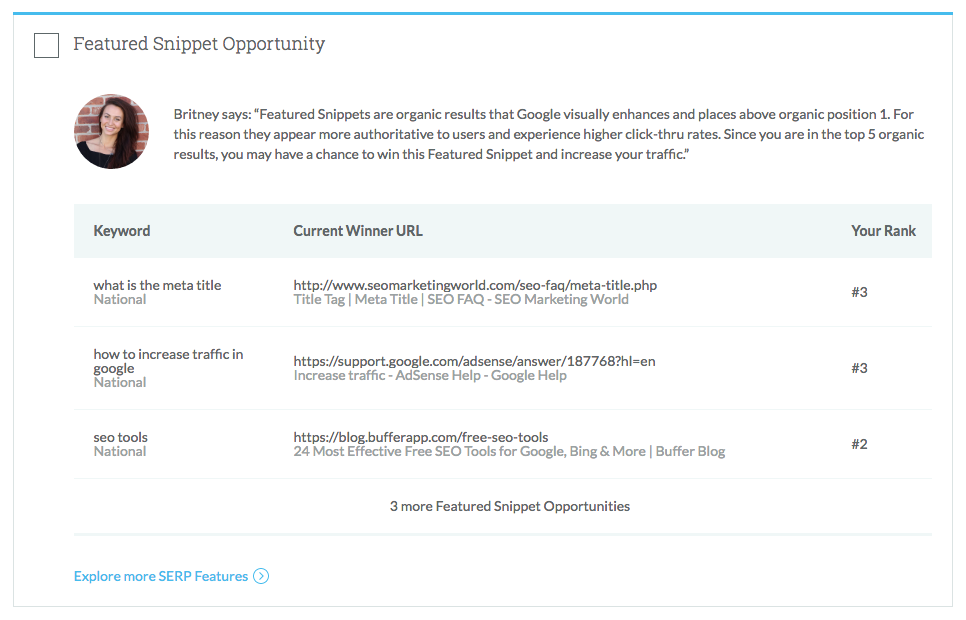
8. Get alerted to featured snippet opportunities

Featured snippets appear above organic position #1 and can improve click-through rates for keywords you already rank in the top 10 for. Find the most lucrative opportunities for them in your Campaign Insights list.

*Further reading: Win those featured snippets

If you are interested in featured snippets, I'd recommend a couple of great posts from Dr. Pete:

And SERP Features is just the tip of the iceberg. Almost everything else you see in campaign rankings is new or overhauled.

9. See all of your historical rankings data

We started the year with a significant architectural overhaul of our rankings system. Aside from a faster and more streamlined interface, this also allowed us to support one of our biggest customer requests, and present all historical rankings data. Choose any timeframe to see and report on how your rankings have changed within that period.

10. Overlay Google algo updates on your rankings graphs

See a dramatic change in your rankings overnight? We now leverage the great data from MozCast to show any Google algorithm changes that might be affecting your search presence. Just hover over the little Google "G" to see major and minor update details.

11. Get more from your data with advanced filtering and improved sorting

Easily filter down your long list of rankings by keyword, label, location, or brandedness, and sort them accordingly to get a handle on your data.

12. See search volume data alongside your rankings

This had been a frequent request. We baked in the same powerful search volume data from Keyword Explorer alongside your rankings.

13. View detailed keyword analyses in your campaigns

Our keyword analysis page was completely rebuilt, with some great new additions:

  • Flexible timeframes, including the ability to view a keyword's performance at any time in the history of your campaign
  • Volume and Difficulty scores, powered by Keyword Explorer's data
  • Four beautiful graphs: Search Visibility, Highest Ranking Position, Keyword Performance, and SERP Features
  • An easy-to-read SERP report with callouts for pages on your domain, and those on your competitors' domains
  • Faster page loads and improved performance

Intrigued? Take a trial of Moz Pro, free for 30 days


Page Optimization improved again

We made some big upgrades to this section late in 2015, but we weren't quite done.

14. Discover topics related to your page content

This new tab shown with Page Optimization reports lets you see the topics that your SERP competition is writing about. This can help you understand what kinds of keywords signal topical relevance to Google and provide good ideas for how you can make your content more robust and relevant to searchers. I’m not going to go too deep here, but check out Jon White’s fantastic post for some great tips and examples to get the most from this feature. Rand also shares some great tips in this Whiteboard Friday, Using Related Topics and Semantically Connected Keywords in Your SEO.

15. Dive right into on-page optimization from your rankings

Quickly run page optimization reports and view page optimization scores right from your rankings.


We’ve made Insights better

Our Insights dashboard also underwent some solid improvements in 2016. We continue to surface new insights in this section as we add more capabilities across Moz Pro. Our aim is to make this a powerful section that surfaces new problems and opportunities that we discover as we collect and analyze your data every week.

16. Mark completed insights as "Done"

We heard feedback that many of you were attempting to use Insights as a to-do list, but we didn't make that very easy. Now you can check off insights from your list once you've read or acted upon them. They will then be moved to your Done list, where you can track your completed work.

17. Add tasks to Trello

If you need a more robust workflow, we’ve added a way to quickly add insight tiles to Trello. Trello is a power task management solution, which also happens to be free. I’ve used it quite a bit myself, and happily recommend it.

18. Enjoy a better summary of your weekly rankings

We updated the rankings summary tile to give you a clearer look at your most important ranking changes from week to week.


Reporting got some needed attention

Outside of the more obvious features I’ve shared, we’ve also been working quietly behind the scenes to make our reporting and exports better.

19. Generate "real" PDF reports

Our old PDF export solution was functional, but clunky. It converted page modules into images and then encapsulated them in a PDF. We rebuilt our PDF engine so that PDFs created in Moz Pro include text as text and images as images, offering better editing, copying, and image quality.

20. Customize your rankings CSV exports

We launched updated CSVs for campaign rankings that respect filters as well as time frames. Now you can export just the data you need rather than poring through a massive historical rankings export.

21. Build custom reports more easily with a revamped interface

Adding and managing custom reports is easier to use and easier on the eyes.

22. Get regular insights directly in your inbox

We revamped our weekly email updates, making them cleaner and more informative. They now include both ranking updates and important insights that we discover for you each week. We plan to add more timely information to these as we continue to improve our datasets and refine the logic behind Insights.


The Mozbar got some love

If you can believe it, the Mozbar recently surpassed 400,000 installs. It was due a little bit of attention.

23. Breath easier, we've improved Mozbar stability and reliability

Unfortunately, our most beloved tool ran into some stability and login challenges when some unfriendly folks started abusing the service behind it. We invested some quality time to fix up the authentication issues and data inconsistency that were becoming a real frustration for customers.

24. Get On-Page Content Suggestions for any page on the web (brand new!)

We haven't officially announced this one yet, but if you are a Pro customer and using the Mozbar, you can click on the little analysis icon:

When you enter a keyword, you will now see content suggestions just to the right of the on-page analysis. You can dig in just like in the page analysis section of your Moz Pro campaigns. Use this to beef up your relevance or find new topics to write about.

Start using MozBar for Chrome free today


Even Fresh Web Explorer got an update

Fresh Web Explorer continues to collect syndicated content from across the Web, making it easy to see where and when fresh content has mentioned a specified brand or linked to a domain. On top of that, Fresh Web Explorer's alerts serve as a great alternative to Google Alerts, sending you an email anytime we see your target brands or keywords mentioned.

25. Show only Google Verified News Sources to reduce noise in your results

Filter your searches and/or alerts to show only those sources/domains we've observed in Google News. E.g. here's a search for Amazon.com with news filtering on (3,067 results in the last 4 weeks) vs. the same search with news filtering off (28,798 results). This can save a lot of time when you're looking for the most important results.


Beyond these features, there was a lot more going on behind the scenes

26. We made significant performance improvements

Our hard-working engineering team rebuilt a lot of the scaffolding behind campaigns, making them much snappier to load. This work continues into 2017. They also squashed dozens of bugs and made myriad small improvements across out tools and campaigns. If you are interested in keeping tabs on new features, fixes, or updates, you can find them all on our Moz Pro Updates page.

27. We now offer free product demos to customers and trialers

The friendly faces now helping you navigate Moz Pro

Another important addition we've made to our product isn't in the product at all. We've quietly built out a Customer Success team. This cadre of product experts provide custom demos for new customers that are looking for an overview of Moz Pro, as well as long-time customers that are interested in learning more about new features. If you are interested in a refresher or a full walkthrough, schedule one here!

Also, if you're looking to level up your SEO skills or get some deeper support in using Moz tools to tackle your SEO strategy, we're actively working on more paid training options. Stay tuned!


So, what's up next?

I hope you're still with me, because I've got a bit more to share. Here are some of the big things to expect in 2017.

A rebuilt and re-imagined Custom Crawl

One of the big projects that our team has been busy with in 2016 is a total rewrite of our custom crawler. This is already being looked at by a few customers in a very limited alpha release. We still have a lot to add to it before it's ready to go, but here are some of the benefits that we've already baked in:

  • A much faster and more resilient crawler. Whether your site is hundreds or millions of pages, expect your crawls much more quickly and reliably.
  • The ability to compare one crawl to the next and see what new issues have cropped up and which were confirmed as fixed.
  • A much simpler interface to access your data quickly and easily.
  • A bunch of other features are in the works to support deeper analysis and customization. More to come soon!

"Keyword Universe"

Cool code name, but what the heck is it?

Do you ever wonder which keywords you already rank for? Which ones your competitors rank for? Who are your SEO competitors? Answer these questions and more with this new data set, which we plan to expose in a number of different ways throughout Moz Pro and in our data products. If you're curious about accessing this sort of data, please let us know!

What about links?

We've got some improvements in the works here too, but we're keeping this under our hats for now.

And much more...

Beyond these large efforts, we will continue to make updates and improvements large and small throughout the year.


Please let us know what you need most!

We are constantly collecting feedback and looking to solve the most challenging problems that our customers face. Please let us know what's working for you, what isn't, and what you need most to be successful with your SEO efforts. You can add your thoughts in the comments here, or message me directly. While we can't get to everything right away, we are always listening and prioritizing what to work on next.

Thanks for reading. I hope you all have a fantastic 2017!


Sign up for The Moz Top 10, a semimonthly mailer updating you on the top ten hottest pieces of SEO news, tips, and rad links uncovered by the Moz team. Think of it as your exclusive digest of stuff you don't have time to hunt down but want to read!


from The Moz Blog http://tracking.feedpress.it/link/9375/5083769