Tuesday, 26 February 2019

YouTube SEO: How to Optimize Videos for YouTube Search in 2019

As recently as a decade ago, inbound marketing was a brand new idea. Marketers were learning that they couldn't just publish a high volume of content -- it also had to be high-quality and optimized in ways that made it as discoverable as possible through search engines.

That content was once largely limited to the written word. Today, that's no longer the case.

Today, a comprehensive content strategy includes written work like blogs and ebooks, as well as media like podcasts, visual assets, and videos.

That last part -- video -- continues to be on the rise. According to the 2018 State of Inbound report, 45% of marketers are investing more in YouTube over the course of this year -- more than any other marketing channel available to them.Unlock the one resource you need to start growing your YouTube business channel.

And with the rise of other content formats comes the need to optimize them for search. One increasingly important place to do that is on YouTube, a video distribution website used by the masses -- HubSpot included.

But how does YouTube SEO work? What are the steps you need to take to optimize your YouTube channel for search? We've outlined some major tips and tools below.

1. Rename your video file using a target keyword.

Just like you would when optimizing written content, you'll use an SEO tool to first identify keywords you'd like your video to focus on (you can browse popular YouTube SEO tools below these tips, or just click that link earlier in this sentence).

With a keyword identified, the first place you should put it is your video file -- before you even upload it to YouTube. Why? YouTube can't actually "watch" your video to see how relevant it is to your target keyword, and as you'll learn in the tips below, there are only so many places you can safely insert this keyword on your video's viewing page once it's published. But, YouTube can read your video's file name and all the code that comes with it when it's uploaded.

With that in mind, replace the "business_ad_003FINAL.mov" file name (don't be embarrassed ... we've all been there during post-production) with your desired keyword. If your keyword is "house painting tips," for example, your video's file name should be "house-painting-tips" followed by your preferred video file type (MOV, MP4, and WMV are some of the most common that are compatible with YouTube).

2. Insert your keyword first in the video title.

When we search for videos, one of the first things that our eyes are drawn to is the title. That's often what determines whether or not the viewer will click to watch your video, so the title should not only be compelling, but also clear and concise.

Although your keyword plays a big part in your video title, it also helps if the title closely matches what the viewer is searching for. Research conducted by Backlinko found that videos with an exact keyword match in the title have a slight advantage over those that don’t. Here's a linear representation of those findings:

exact-match-title.png Source: Backlinko

So, while "using your target keyword in your title may help you rank for that term," report author Brian Dean explains, "the relationship between keyword-rich video titles and rankings" isn't always a strong one.

Lastly, make sure to keep your title fairly short -- HubSpot campaigns manager Alicia Collins recommends limiting it to 60 characters to help keep it from getting cut off in results pages.

3. Optimize your video description.

First things first: According to Google, the official character limit for YouTube video descriptions is 1,000 characters. And while it's okay to use all of that space, remember that your viewer most likely came here to watch a video, not to read an essay.

If you do choose to write a longer description, keep in mind that YouTube only displays the first two or three lines of text -- that amounts to about 100 characters. After that point, viewers have to click "show more" to see the full description. That's why we suggest front-loading the description with the most important information, like CTAs or crucial links.

As for optimizing the video itself, it doesn't hurt to add a transcript of the video, especially for those who have to watch it without volume. That said, Backlinko's research also found no correlation between descriptions that were optimized for a certain keyword and the rankings for that term.
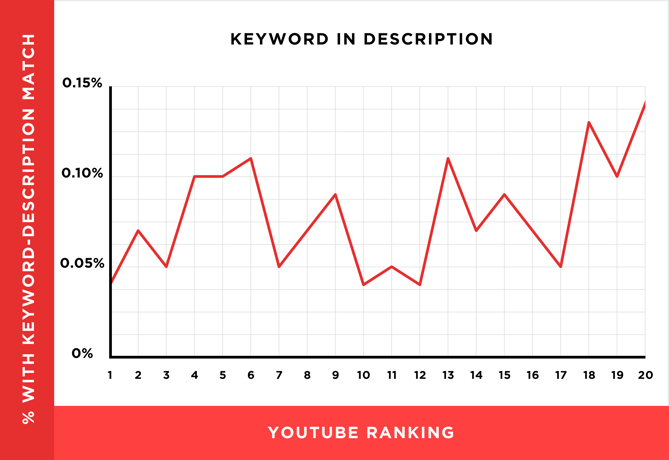
keyword-in-description.png Source: Backlinko

Dean is careful not to encourage ditching an optimized description altogether, though. "An optimized description helps you show up in the suggested videos sidebar," he writes, "which is a significant source of views for most channels."

4. Tag your video with popular keywords that relate to your topic.

YouTube's official Creator Academy suggests using tags to let viewers know what your video is about. But you're not just informing your viewers -- you're also informing YouTube itself. Dean explains that the platform uses tags "to understand the content and context of your video."

That way, YouTube figures out how to associate your video with similar videos, which can broaden your content's reach. But choose your tags wisely. Don't use an irrelevant tag because you think it'll get you more views -- in fact, Google might penalize you for that. And similar to your description, lead with the most important keywords, including a good mix of those that are common and more long-tail (as in, those that answer a question like "how do I?").

5. Categorize your video.

Once you upload a video, you can categorize it under "Advanced settings." Choosing a category is another way to group your video with similar content on YouTube so it winds up in different playlists and gains exposure to more viewers who identify with your audience.

It might not be as simple as it looks. In fact, YouTube's Creator Academy suggests marketers go through a comprehensive process to determine which category each video belongs in. It's helpful, the guide writes, "to think about what is working well for each category" you're considering by answering questions like:

  • Who are the top creators within the category? What are they known for and what do they do well?
  • Are there any patterns between the audiences of similar channels within a given category?
  • Do the videos within a similar category have share qualities like production value, length, or format?

6. Upload a custom thumbnail image for your video's result link.

Your video thumbnail is the main image viewers see when scrolling through a list of video results. Along with the video's title, that thumbnail sends a signal to the viewer about the video's content, so it can impact the number of clicks and views your video receives.

While you can always pick one of the thumbnail options auto-generated by YouTube, we highly recommend uploading a custom thumbnail. The Creator Academy reports that "90% of the best performing videos on YouTube have custom thumbnails," recommending the use of images that are 1280x720 pixels -- representing a 16:9 ratio -- that are saved as 2MB or smaller .jpg, .gif, .bmp, or .png files. If you follow those parameters, it can help to ensure that your thumbnail appears with equally high quality across multiple viewing platforms.

It's important to note that your YouTube account has to be verified in order to upload a custom thumbnail image. To do that, visit youtube.com/verify and follow the instructions listed there.

7. Use an SRT File to add subtitles & closed captions.

Like much of the other text we've discussed here, subtitles and closed captions can boost YouTube search optimization by highlighting important keywords.

In order to add subtitles or closed captions to your video, you'll have to upload a supported text transcript or timed subtitles file. For the former, you can also directly enter transcript text for a video so that it auto-syncs with the video.

Adding subtitles follows a similar process, however, you can limit the amount of text you want displayed. For either, head to your video manager then click on "Videos" under "Video Manager." Find the video you want to add subtitles or closed captioning to, and click the drop-down arrow next to the edit button. Then, choose "Subtitles/CC." You can then select how you’d like to add subtitles or closed captioning.

Find out how to add closed captions to your YouTube video in the video below.

8. Add Cards and End Screens to increase your YouTube channel's viewership.

Cards

When you're watching a video, have you ever seen a small white, circular icon with an "i" in the center appear in the corner, or a translucent bar of text asking you to subscribe? Those are Cards, which Creator Academy describes as "preformatted notifications that appear on desktop and mobile which you can set up to promote your brand and other videos on your channel."
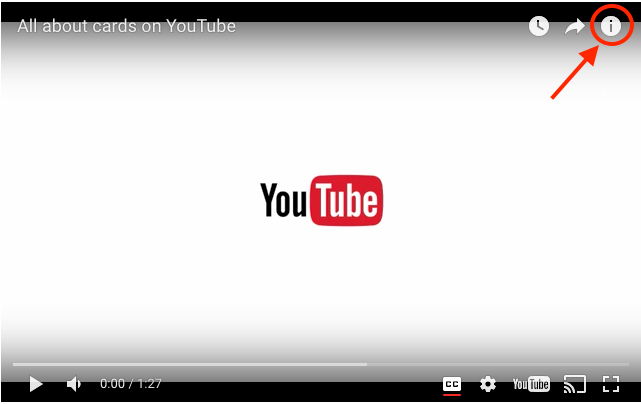
"i" icon to create End Cards in YouTube video Source: Google

You can add up to five cards to a single video, and there are six types:

  1. Channel cards that direct viewers to another channel.
  2. Donation cards to encourage fundraising on behalf of U.S. nonprofit organizations.
  3. Fan funding to ask your viewers to help support the creation of your video content.
  4. Link cards, which direct viewers to an external site, approved crowdfunding platform, or an approved merchandise selling platform.
  5. Poll cards, which pose a question to viewers and allow them to vote for a response.
  6. Video or playlist cards, which link to other YouTube content of this kind.

For detailed steps on adding a card to your video, follow these official steps from Google, or check out the video below.

End Screens

End screens display similar information as cards, but as you may have guessed, they don't display until a video is over, and are a bit more visually detailed in nature. A good example is the overlay with a book image and a visual link to view more on the video below:

End screens displayed on a YouTube video Source: Jamie Oliver on YouTube

There are a number of detailed instructions for adding end screens depending on what kind of platform you want to design them for, as well as different types of content allowed for them by YouTube. Google outlines the details for how to optimize for all of those considerations here.

It's important to note that YouTube is always testing end screens to try to optimize the viewer experience, so there are times when "your end screen, as designated by you, may not appear." Take these factors into account as you decide between using either cards or end screens.

These factors may seem a bit complicated and time-consuming, but remember: The time people spend watching YouTube on their TV has more than doubled year over year. There's an audience to be discovered there, and when you optimize for YouTube, your chances of being discovered increase.

Now, most of the SEO tips above rely on you identifying a keyword and promoting your video correctly. And not all of those tips can be carried out through YouTube alone. To get the most bang for your videography buck, consider some of the tools below to optimize your video for search.

1. Ahrefs Keywords Explorer

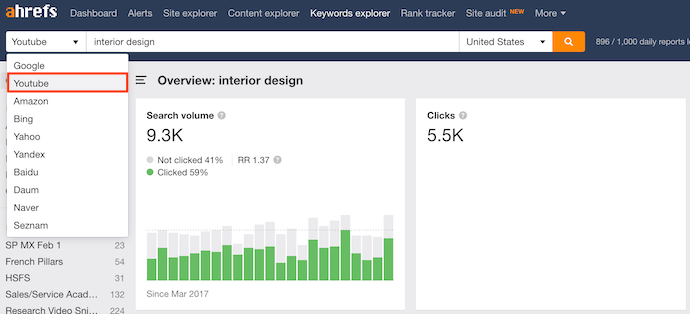
ahrefs-keyword-explorer-youtube

Ahrefs is a comprehensive SEO platform that allows you to monitor a website's ranking, estimate the organic traffic you'd get from each keyword, and research keywords for which you might want to create new content.

One popular feature of Ahrefs is Keywords Explorer, which allows you to look up numerous details related to a keyword you're interested in. And as you can see in the screenshot above, you can filter your keyword results by search engine -- including YouTube.

Ahrefs Keywords Explorer gives you a keyword's monthly search volume, how many clicks received by videos ranking for that keyword, related keywords, and more.

2. Canva

canva-youtube-thumbnail-designer

You might know Canva as a design template for creating all kinds of cards, photos, logos, and more. It just so happens this popular product has a Thumbnail Creator just for YouTube videos.

As stated in the tips above, thumbnail images are critical to promoting your content in YouTube search results and enticing users to click on your video. Using Canva's Thumbnail Creator, you can create the perfect preview image for your video in 1280 x 720 pixels -- the thumbnail dimensions YouTube requires.

3. HubSpot Content Strategy
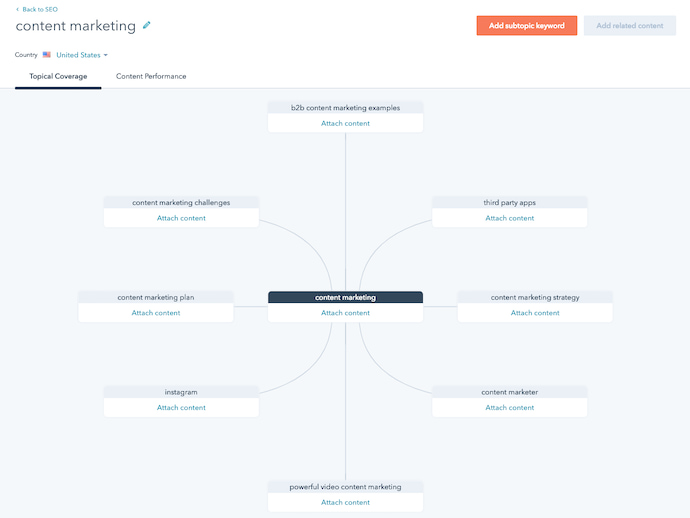
hubspot-content-strategy-toolOur content strategy tool, developed here at HubSpot, allows you to find popular keywords for which to create content and then organize these keywords into groupings -- what we call "topic clusters." By sorting your content into topic clusters, you can oversee which pieces of content are related to one another, which types of content you have planned, and what you've already created.

While the keywords you discover in HubSpot reflect their popularity in a standard Google search, many of these topics will also produce videos on Google's search engine results pages. In those cases, you can create topic clusters that have both blog and YouTube content belonging to them.

Clustering your content -- and linking from videos to blog posts, and vice-versa -- can give you more authority in the eyes of Google and YouTube, while giving you more ways to capture traffic from the people searching your topic.

4. vidIQ Vision
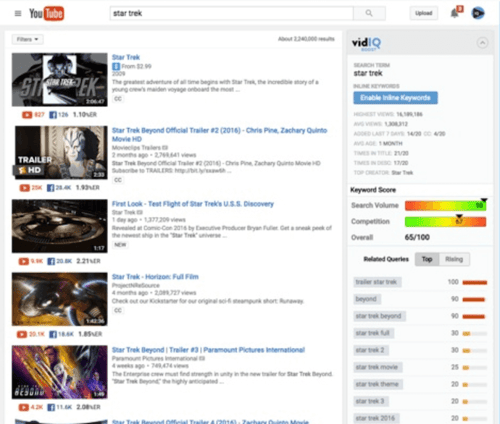
vidiq-vision-for-youtubeThis is a Chrome extension, available through Chrome's web store in the link above, that helps you analyze how and why certain YouTube videos perform so well. This includes the tags a video has been optimized for, its average watch time, and even how quickly that video might be gaining traffic.

The vidIQ tool then provides an SEO "score" you can use to create content that performs (or outperforms) the results you already see on YouTube.

5. TubeBuddy
tubebuddy-youtube-seo-tool

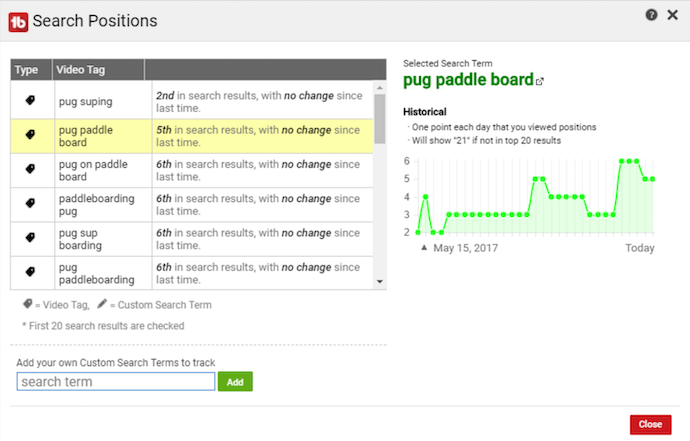
TubeBuddy is an all-in-one video platform that helps you manage the production, optimization, and promotion of your YouTube content. Its features include an automatic language translator (which helps you rank for non-English keywords), a keyword explorer, tag suggestions, a rank tracker for your published videos, and more.

6. Cyfe
cyfe-web-analytics-tool

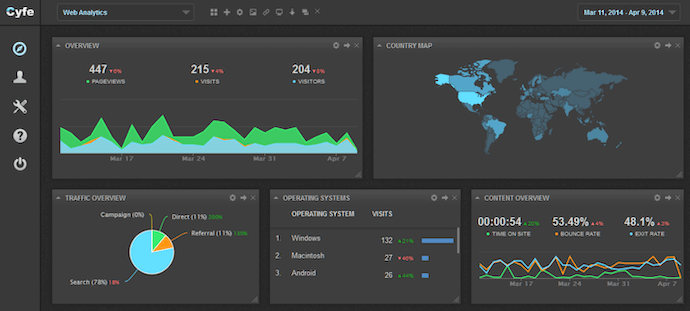
Cyfe is a large software suite that offers, among other things, a web analytics platform. On this platform, you can track page performance across every website property you have content on -- including YouTube -- and where each page's traffic is coming from.

In addition to traffic analytics, Cyfe can show you which keywords you're ranking for and which ones are most popular across various search engines. Sounds a lot like Google Analytics or Moz, right? That's because Cyfe has data from both of those tools, and more, built into it.

No matter what SEO tip or tool you start with, a successful YouTube channel begins with good content. Make sure your viewers have something high-quality and relevant to watch when they find you. Want step-by-step help? Download our free guide on YouTube for Business below.

YouTube for Business

YouTube for Business


from Marketing https://blog.hubspot.com/marketing/youtube-seo

PR stunts .. Clareville PR

The post PR stunts .. Clareville PR appeared first on TheMarketingblog.


from TheMarketingblog http://www.themarketingblog.co.uk/2019/02/pr-stunts-clareville-pr/

How to repurpose content in content marketing

The post How to repurpose content in content marketing appeared first on TheMarketingblog.


from TheMarketingblog http://www.themarketingblog.co.uk/2019/02/how-to-repurpose-content-in-content-marketing/

Pros and cons of technology in businesses today

Humanity has made significant leaps in the modernization of tools and continuous improvement of processes in business. Now, customers can enjoy shopping for products online and have their packages delivered right at their doorstep.

Meanwhile, entrepreneurs can take advantage of collaboration software such as Google Drive, Slack, and Skype to boost the growth of their companies.

As with everything else, technology has its advantages and disadvantages. Here are the pros and cons of using digital tools in the business world:

Pros

  1. Automation

The primary benefit of using tools such as point of sale or POS systems and customer relationship management or CRM software for your business is that it eliminates the need for manual computing.

With this, there are fewer errors made during each transaction with the customer. It saves you money and time as these programs streamline your processes for better efficiency.

These are other tools that can help you automate specific tasks for your company:

  • HootSuite – This app is beneficial for your social media marketing as it allows you to schedule posts ahead of time and publish them on various platforms including Facebook, Twitter, and Instagram.

  • HubSpot – Aside from being a digital marketing resource, you can also create workflows in HubSpot to automate your campaigns and track their development.

  • Slack – Slack enables you to streamline communication between your team. No project gets forgotten because you can assign one channel for each one and create conversations from there.

  • Trello – This project management app helps simplify delegation of tasks using boards, where you can assign team members for that project and notify them of the deadlines and other details.

  • Calendly – This software makes scheduling meetings with your employees or clients much more manageable. You simply need to set your availability and send a link invitation where the recipient can choose the time that they prefer. Afterward, the program automatically adds the event to your calendar.

  • Xero – Xero is an online accounting program that lets you view and manage your cash flow in real time. It also has features like automated invoices and scheduled payments to cut down your accounting workload.

  1. Workforce Empowerment

By automating tedious, repetitive tasks such as manually searching the database for an invoice number or going through the inventory one by one, you let your employees focus on higher-level activities that make the most of their strengths.

You empower your workforce when you entrust to them tasks that require their critical thinking and analyzing skills.

  1. Mobility

The workplace is becoming digital. More and more necessary business operations can be done remotely. As a business owner, modernization poses a significant advantage as you can recruit the best talents wherever they are in the world and have them work for you without needing to uproot themselves from their hometowns.

There’s more freedom nowadays to structure your organization according to how you want it because physical limitations like distance are reduced with modern technology.

  1. Global Opportunities

As mentioned above, distance is no longer a substantial issue for businesses. The invention of drones and other transportation equipment reduce the challenge of shipping and delivering your products.

Today, you can promote your goods to customers from different countries and not worry about your profits getting lost along the way as payment methods have also been digitized through credit cards and electronic wallets.

Cons

  1. Threats of Cyberattack

Technology is a neutral medium that can be used for the advantage of society or a handful of people only. Some abuse it by taking advantage of its efficiency and utilizing sophisticated tools to steal data.

A major hurdle to using computers and cloud services for your business is that there’s the possibility of hackers taking financial and other important information from your website. They can infiltrate unprotected systems and use your customers’ credit cards to buy stuff for themselves or transfer money to their accounts.

  1. Substantial Investment

Modernizing your business entails buying up-to-date software and tools that cost a considerable sum, particularly for specialized equipment.

Plus, once you start going digital for your files and processes, you can expect to continue spending money on upgrades every few months or years to ensure that your data stays safe from hackers. There’s also the increasing cost of compliance as the government keeps on adding regulations to protect consumers’ information.

  1. Risks of Distraction

Having most of your processes online can expose your employees to distractions from social media and other personal activities online. Interruptions hurt productivity and can result in losses on your company resources.

Udemy, a digital learning company, conducted a survey where a majority of workers admitted that they feel distracted while at the office, which can lead to stress and unhappiness at work.

Other facts emphasized in the study are:

  • People who lose their focus at one point of the workday tend to make up for it by working faster. However, they experience higher stress levels from the time pressure and more frustration.

  • Around 36% of younger professionals spend two or more hours on their phone for personal activities each workday.

  • Around 66% admitted that they have never talked with their boss about their struggles with distractions.

  • Around 70% concurred that training could alleviate the problem by teaching employees how to block out distractions and concentrate on the tasks they need to finish.

  1. Health Problems

Aside from interruptions to your team’s thought processes, technology has also paved the way for humans to live a sedentary lifestyle.

Because most files are on the computer and almost all information is searchable on the Internet, there seems to be no need for your employees to get up from their desks, except for having to respond to nature’s call.

Physical inactivity is detrimental to their health because it increases the risk of cardiovascular ailments, anxiety, and depression. Some companies offer standing desks for their workers to encourage activity. Others also require the members of their staff to take snack breaks and eat their lunch away from their work stations.

Conclusion

Technology has made life comfortable for workers. Using digital tools for your business enables you to finish more tasks without exerting too much effort.

Nonetheless, you should put a lot of thought before deciding to integrate new software into your company or overhauling your processes. Always consider the advantages and disadvantages of the changes you want and assess if these facilitate the growth of your enterprise.

The post Pros and cons of technology in businesses today appeared first on TheMarketingblog.


from TheMarketingblog http://www.themarketingblog.co.uk/2019/02/pros-and-cons-of-technology-in-businesses-today/

The Ultimate Guide to G Suite

As both an employee and small business owner, I adore G Suite. I’d consider it one of the best tools I have at my disposal, mainly because it’s so easy to use and incredibly multi-functional.

Whether I’m collaborating with my editor on a new HubSpot blog piece, scheduling time to chat with a new client, or emailing my friends a funny dog GIF, G Suite comes in handy for almost anything you’re doing on your computer — productive or otherwise.

Google entered 2019 with 5 million paying G Suite customers — a number that’s increased by 25% since the beginning of 2017. I’ll let that statistic speak for itself: G Suite is a highly valuable tool for individuals and businesses worldwide. Notable G Suite customers include Uber, BuzzFeed, PwC, and, of course, HubSpot.

If you haven’t tapped into the G Suite platform for your business, we encourage you to check it out. Read through this guide to better understand the G Suite platform, how you can optimize your account, and how you can use the tool to grow better. Better yet, bookmark this so you can reference it later.

G Suite was released 12 years ago as “Google Apps for Your Domain”. The initial launch included Gmail, Google Talk, Google Calendar, and Google Page Creator (now known as Sites). Google Apps for Education followed two months later.

Over the last 10 years, Google released various tools and updates as part of its application suite. Google Apps was rebranded to G Suite in September of 2016, and not long after, the company launched its first hardware product: Jamboard.

The G Suite platform also includes the G Suite Marketplace (which was originally released in 2010), through which you can install third-party cloud applications to use as part of your collection of G Suite tools.

Who uses G Suite?

Both businesses and individuals use G Suite.

Consumer accounts aren’t necessarily called “G Suite,” though. For example, when I’m signed into my personal Google account, the top right corner of the screen looks like this:

guide-to-g-suite

Alternatively, when I’m signed into my personal business Google account, the top right corner reflects this:

guide-to-g-suite

While G Suite services are free for consumers, businesses have to pay for enterprise features such as a custom email domain, unlimited cloud storage, additional administrative and marketing tools, and 24/7 support. (We’ll get into the G Suite pricing structure later.)

If businesses have multiple users on their G Suite, they also have to pay per person. Here’s what Google looks like when I’m signed into my HubSpot employee account:

guide-to-g-suite

Unlike other free consumer software, though, free G Suite users don’t see ads while using the services. Bonus: Google doesn’t use the information stored in G Suite applications and accounts for advertisement purposes.

guide-to-g-suite

The G Suite Products

Google offers a wide variety of products for both personal and enterprise use. Most are accessible with a Google account (by tapping the menu in the top right corner), though some need to be installed as Google Chrome extensions to gain full functionality.

guide-to-g-suite

Later, we’ll walk through how to set up and manage your G Suite account, but for now, let’s review the different tools available in your G Suite.

Gmail

Gmail is the G Suite email software. It was released in 2004 and now has over 1 billion users worldwide.

With a G Suite plan, businesses enjoy 30GB of storage space, custom company email addresses (yourname@company.com), unlimited Google Group email addresses, 24/7 phone and email support, and compatible add-ons available through the G Suite Marketplace.

Know the second a lead opens an email, send a perfectly timed follow-up, and close deals faster than ever with HubSpot’s Email Tracking — compatible with Gmail.

Drive

Google Drive is the G Suite cloud storage platform and was launched in 2012. Drive manages all of your company’s content and supports collaboration across your entire organization. It also allows you to view various file formats so you don’t have to download additional software to your devices.

Depending on the G Suite plan, businesses enjoy 30GB, 1TB, or unlimited storage per user and audit and reporting insights for Drive content.

Docs, Sheets, and Slides

Google Docs, Google Sheets, and Google Slides are the G Suite word processor, spreadsheet, and presentation programs, respectively. They were added to the platform in 2006.

These programs allow real-time collaboration, save changes automatically, and track revision history. Users can insert comments, suggest edits, communicate through a built-in chat, and create templates for future use.

With a G Suite plan, businesses enjoy unlimited revision history among other perks.

Forms

Google Forms is the G Suite web form and survey tool. Also launched in 2006, Forms shares many of the same features as Docs, Sheets, and Slides, such as automatic saving, real-time collaboration, and template creation. To collect data through Forms, users can personalize surveys or quizzes, send respondents the URL, and review the data (that’s automatically collected in Sheets).

Download HubSpot’s Free Online Form Builder to convert your visitors into leads and start growing your business faster.

Calendar

Google Calendar is the G Suite online calendar. It was launched in 2006 and integrates with Gmail to manage schedules, appointments, meetings, and tasks (via Google Tasks).

With a G Suite plan, businesses enjoy smart scheduling (where employees can see open windows of time on coworkers’ calendars), calendars for Google Groups, calendars for meeting rooms and shared resources, public calendars so customers can view company events, and easy migration from external calendars (e.g. iCal, Outlook, or Exchange).

Google+

Google+ is the G Suite social network. It was launched in 2011, and as of October 2018, Google is planning to sunset Google+ for consumers in April 2019.

But, with a G Suite plan, businesses can still enjoy the service as well as restricted communities and enhanced privacy controls.

Sites

Google Sites is the G Suite website builder. It was added to the platform in 2008 and allows users to create websites with little to no coding knowledge or design skills. Landing page and project websites can be created using pre-made templates and published internally or publicly.

Hangouts

Google Hangouts is the G Suite communication and messaging tool. Originally launched in 2006 as Google Talk, Hangouts supports text, voice and video conversations (for up to 25 participants) and can be used between desktop and mobile devices. It’s also a common alternative to Slack.

With a G Suite plan, businesses enjoy a seamless integration with Calendar, screen sharing for participants, auto focus and intelligent muting features, public livestreams automatically saved in YouTube, and custom administrative controls.

Keep

Google Keep is the G Suite note-taking tool. The newest addition to the G Suite platform, Keep can be used to create, organize, and share memos, lists, images and voice notes across multiple devices. It’s available as a Chrome download and mobile application.

With a G Suite plan, businesses enjoy a seamless integration with Google Docs among other perks.

Need more hours in the day? Download our complete workplace productivity guide here.

G Suite for Business

There’s no doubt G Suite is a valuable tool for businesses of all sizes. It’s the digital equivalent of a pocket knife — it supports collaboration, organization, productivity, marketing, and sales.

Do you think G Suite would be a great addition to your company? Follow along this section as we discuss how to set up G Suite for business.

G Suite Pricing

Over the last ten years, G Suite has grown and expanded tremendously … without changing their prices. (How crazy is that?)

Since day one, Google has offered two G Suite business offerings: the G Suite Basic Edition (at $5 per user per month) and the G Suite Business Edition (at $10 per user per month). Read more about the G Suite Editions here.

On January 16, 2019, Google announced that, for the first time in a decade, they’d be raising the prices of G Suite (albeit by a fraction). Starting on April 2, the Basic Edition will increase to $6 per user per month, and the Business Edition will increase to $12 per user per month. Pricing for G Suite Enterprise Edition customers won’t change.

Despite the incremental increase, G Suite is still a fantastic investment for your business. The per-user pricing model presents a cost that’s proportionate to each business, regardless of size. Also, with the G Suite Flexible Plan, businesses can pay monthly and avoid long-term commitment.

Setting Up Your G Suite Account

Creating a G Suite account is simple. Head to the G Suite homepage and click “Get Started.”

Enter your company name and indicate how many employees you have. You can always change this number as your team grows.

Next, enter your contact information (or the information for whoever will be managing the G Suite account). Google will send a confirmation to the email address you insert here, so be sure it’s accessible.

guide-to-g-suite

The next screen will ask if you have a business domain name. If you already have one, insert it here. If you don’t, Google will help you find and purchase one — most domains are $12/per year if purchased through Google.

guide-to-g-suite

Enter your business address and contact information on the next screen.

Finally, choose a username and password for your G Suite account. You’ll use these credentials to sign into any G Suite tools in the future. Note: Your username will also be the first part (or local-part) of your business email.

guide-to-g-suite

To complete your account set up, you’ll be asked to review your account and check out. On this screen, you’ll see a summary of your monthly charges (after your 14-day trial) and any other one-time charges, such as a domain name. You’ll also be asked to review your account information and enter your payment method.

guide-to-g-suite

Lastly, you’ll see two choices to automatically renew your domain and keep your domain information private — we encourage you to keep those checked to simplify the domain purchase process.

Managing Your G Suite Account

Once you create your G Suite account, you’ll be directed to your G Suite Admin panel. This is arguably the most important part of your G Suite account — you’ll manage all of your settings from this page.

guide-to-g-suite

Let’s break down the sections and what you can do within each.

Users

This is where you add new users to your G Suite account. You can also manage your users and assign them various attributes, like Job Title and Department, as well as track their Last sign in and Email usage.

Company profile

This is where you update information about your company and personalize your G Suite account with your company logo. You can also create custom URLs to your various G Suite services for your users.

guide-to-g-suite

Billing

This is where you view your account charges and manage your G Suite license(s). You should see whichever Edition (plan) you chose for your business reflected here.

guide-to-g-suite

Reports

This is where you track the usage of your G Suite services and apps as well as user activity. Under Highlights, you’ll see an overview of usage activity per app, user status, storage statistics, and security. Under Reports, you’ll see options to run reports on specific services, devices, and users. You can also run audits to see what users are accessing what services and tools.

Apps

This is where you manage your G Suite services and their settings. Here, you’ll see how many G Suite core apps you’re using, what additional Google services you’re using, and any Marketplace or Security Assertion Markup Language (SAML) services you’ve connected to your account.

guide-to-g-suite

Device management

This is where you secure your company data on all devices connected to your G Suite account. You’ll see how many mobile and Chrome devices are connected as well as how many Google devices (like Jamboard) are linked to your account. There’s also a handy screen on which you can manage all your company-owned devices.

guide-to-g-suite

Security

This is where you manage all security features for your G Suite account. From password management and monitoring to setting up single sign-on (SSO), this page equips you to keep your G Suite account and users secure.

Support

This is where you access G Suite support, which is available 24/7 over phone or email. Before being directed to a live support line, though, you’ll be shown a Help for Admins pop-up box with recommended help content.

Data migration

This is where you import your company email, calendar, and contact data. Google makes it easy to bring over any company data you need to successfully organize and use your G Suite. You’ll need to run this tool for each type of data you migrate. To run a migration, you’ll need the migration source, connection protocol, and the credentials of an account to verify that you own the data.

guide-to-g-suite

Dashboard

This is where you see relevant insights about any business domains connected to your G Suite account.

Buildings and resources

This is where you manage and monitors any buildings, rooms, and company resources connected to your G Suite account. Here, you’ll plug in any meeting and conference rooms that you want to be available for your users to schedule on their Calendar. You can also access insights that tell you how and when your rooms are being used.

Groups

This is where you create groups and mailing lists. Groups are handy for communicating with entire teams or parts of your organization at once. You can also give each group its own calendar for scheduling events and managing team meetings.

guide-to-g-suite

Admin roles

This is where you add new admins and manage current admin roles and permissions for your G Suite account. You can also set admin permissions for specific groups, services, and devices. You’ll see what admins have what permissions, and you can change those accordingly.

Domains

This is where you can add or remove domains associated with your G Suite account. You can add a new domain or domain alias on this page, as long as you can verify ownership. You can also manage where your visitors are redirected when they visit your domain.

guide-to-g-suite

Note: I used my personal business G Suite account to pull example images for this section. You’ll see that there’s only one user on my account (me 🙋🏻‍♀️) … your account and admin panel will likely look much different if you have multiple users, groups, admins, and domains.

Six Ways to Use G Suite to Grow Better

G Suite is a valuable platform for your company. But how can you use it to grow your business better? Below, we cover seven specific strategies for making the most of your G Suite account.

Check out the G Suite + HubSpot integration today and see how it can benefit your business growth.

1. Create On-Brand Templates with Drive

Brand identity is crucial, and the cost of branding and logo design can be costly. Who wants to see their marketing dollars go to waste (i.e. see employees using off-brand documents, presentations, and graphics)? I sure wouldn’t.

Use your G Suite services to simplify the process of staying on-brand. Google Docs, Sheets, Slides, and Forms all have template capabilities — have a designer create on-brand design templates and save them to your Drive. Then, encourage your employees to use these templates instead of starting from scratch.

2. Collect Customer Feedback with Forms

Customer feedback is the lifeblood of a healthy, growing business. If you don’t know what you’re doing right, you can’t do more of it. If your don’t know what you’re doing wrong, you can’t fix it. Customer feedback should be a high priority for your company.

Google Forms makes it easy to gather and analyze data from customers and clients. Use the tool to create simple surveys that collect customer feedback, market research, your Net Promoter Score®, and more. You can also use Forms to conduct internal research or gather information from peers and coworkers.

3. Empower Remote Employees with Calendar

Take it from me — as awesome as remote work can be, there’s something to be said about working alongside your team every day. For one, it can be easier to collaborate if you see each other in person. But that’s not always possible for those who work remotely or internationally.

If you have remote employees, Google Calendar can help them feel connected and included in what’s going on at work. Calendar makes it easy to see coworkers’ schedules and book time in an open room by their desk — without ever having to step foot in the office. You can also set up dedicated calendars for company-wide events or extracurriculars like the gym or after-work book clubs. Employees can simply subscribe to those calendars to stay up-to-date.

4. Manage Team Tasks with Keep

The internet keeps us connected, but it can still be hard to collaborate remotely. If you’ve ever wanted a place to digitally jot notes, make lists, draw sketches, and save images, all while working in tandem with multiple people, Keep is the solution for you. Keep is a common Evernote alternative that’s super helpful even if you’re not using G Suite.

Use Keep to manage team tasks, outstanding projects, and ongoing collaborations. Create checklists to stay on top of assignments, and link a Collaborator so they can see what’s due. You can also save articles and websites to your Keep folder and add notes with important thoughts and ideas — making online research even easier.

5. See How Employees are Using G Suite with Reports

Not everyone uses G Suite equally. The Reports panel on your Admin Console can tell you how and how often your team is using the G Suite tools and apps. Use this insight to better educate your team on what G Suite has to offer. Also, the Reports panel can provide valuable security information — like what devices have been used to login and which users might need to install updates — so you can keep your team and data safe and secure.

6. Leverage New Tools on the G Suite Marketplace

The G Suite Marketplace is one of my favorite places to shop. Google has integrated literally hundreds of third-party tools that only serve to make your and your employees lives easier. Choose from tools for business, productivity, communication, education, and utility. Download apps like Zoom, Xero, Google Analytics, and Asana to link seamlessly to your G Suite account and integrate with other apps like Sheets, Calendar, and more.

Tip: Keep an eye on how your employees are using any new tools to see if they’re benefiting your business or not.

Check out and install the HubSpot app on G Suite Marketplace today.

Take Your Business to the Next Level with G Suite

For the last decade, G Suite has been helping businesses collaborate, communicate, and grow. Through simple tools and an even simpler on-boarding process, G Suite has become an indispensable tool for companies worldwide. Regardless of what industry you’re in, G Suite can only serve to help you improve your business processes, inside and out.

G Suite equips your employees to complete hundreds of tasks with ease — productive or otherwise. 😉


from Marketing https://blog.hubspot.com/marketing/google-suite

How to Become an SEO Expert, According to HubSpot’s SEO Team

Braden Becker’s journey to becoming an SEO specialist at HubSpot is a slightly unconventional one. In college, he studied Writing & Rhetoric, which helped him land his first job as a copy editor at a B2B trade publication. As he progressed through his career, Braden pivoted to content marketing, where he worked as an editor at a SaaS company and then as a content manager at the world’s largest environmental services firm.

You might think someone like Braden would continue to climb the creative career ladder in content marketing. But today he actually spends more time in SEMrush than he does in Google Docs. As the Historical Optimization Lead on HubSpot's Blog Team, Braden’s main responsibility is to identify blog posts that are falling in organic traffic and optimize them for search engines to rank higher on Google. He’s even sharpened his SEO chops enough to co-create the SEO strategy for all of HubSpot’s blogs.

As a writer and editor for most of his career, SEO had always been in the periphery of Braden’s work -- as it was a subject he had a solid grasp on but not necessarily a lot of expertise in. Today, though, SEO is his central focus. And he’s developed a reputation of being HubSpot’s own version of Rand Fishkin.

“Getting a job in SEO ideally requires two things: content creation skill and analytical skill. Most SEO professionals today have one of those and develop the other,” Becker says. “My background in writing and editing helped me get my foot in the door, but a willingness to focus on the structure, mechanics, and intent behind my writing is what I think secured my role as an SEO specialist for HubSpot.”

Braden’s story of pivoting from a creative career in content marketing to an analytical one isn’t as rare as you might think. Before Aja Frost became a Senior SEO Strategist at HubSpot, she was the Editor of HubSpot’s Sales Blog. And, similar to Braden, she credits her time spent in a more creative role as a crucial factor in transitioning to an analytical marketing role.

“I taught myself how to do keyword research and competitive analysis as an editor for HubSpot's Sales Blog. The Sales Blog's traffic had been flat for a year and a half -- I noticed that the only posts that consistently generated views for us were getting all of those views from search. So I began looking for sales-related keywords we could rank for that would help boost organic traffic,” she says. “This led me to experiment with SEMrush, AnswerThePublic, Google Analytics, Google Search Console, and of course, HubSpot's own SEO tools. I read a ton of blog posts and eventually got my Google Analytics certification.”

Braden and Aja have spent their entire careers in content marketing, so it makes sense that they could seamlessly transition from a role in content creation to SEO, especially since the two disciplines go hand-in-hand. But if you don’t have any experience working in the two departments or even in marketing, don’t fret. To build his fundamental knowledge of SEO, Victor Pan, the Head of Technical SEO at HubSpot, cites reading as one of the best habits he got into.

“I used to be a voracious reader on all publicly available information on SEO. I had an RSS feed of search-related blogs and news websites I would go through for a whole hour every day,” he says. “Mere exposure to ideas makes unknown problems in SEO easier to tackle when you have other people's experiences or frameworks to build off from.”

For Victor, reading was one of the best ways to develop his SEO fundamentals. But even as an established SEO, the activity can still refine your expertise. According to Aja Frost, it’s how she hones her technical SEO skills.

“To refine my SEO expertise, I constantly read. I'm really interested in technical SEO so I look for blog posts, white papers, and research about site architecture and navigation, website speed and everything that goes into that, like structured data,” she says. “SEO by the Sea, Sistrix, and Blind Five Year Old are all great technical SEO resources, along with (unsurprisingly) the Google Webmaster Blog. I'm a member of a few SEO subreddits (/seo and /bigseo are the most active). And I follow a ton of SEOs on Twitter -- they drop random factoids or insights all the time.”

To stay ahead of the curve in any industry, reading the latest news and research is hugely beneficial. But as an SEO, when everything is constantly changing, reading isn’t enough. To gain the practical experience that’ll truly take your SEO skills to the next level, you need to put theory into practice and constantly test industry assumptions and your new ideas.

“I test a lot of things to refine my SEO expertise. Should your brand be in your title tags? Are internal anchor text worthwhile to still do in 2019 to move rankings? What happens when you purchase fake social "signals" -- do you see an increase in organic traffic?” says Victor Pan. “Failed experiments taught me just as much as successful ones, and it made me a much more confident SEO whenever I would make any improvements to content. What's an improvement here could be worse off there -- and that's why we have to test and grasp causation over just correlation.”

Based on Braden’s, Aja’s, and Victor’s stories, becoming an SEO expert doesn’t mean you have to start and finish your career as an SEO. Pivoting from one role to an SEO role and developing your expertise from then on is entirely possible -- you just need to be willing to learn and adapt.

How to Become an SEO Expert

To start developing your SEO expertise today, here’s a recap of the tips from HubSpot’s SEO team.

1. Read. SEO is always changing, so it’s crucial to keep updating your knowledge on the topic. Some of the best SEO resources recommended by Senior SEO Specialist, Aja Frost, are SEO by the Sea, Sistrix, Blind Five Year Old, Google's Webmaster Blog, and the subreddits /seo and /bigseo.

2. Hone your creative and analytical skillsets. SEO is not only an analytical profession where you do ton of keyword research, competitive analysis, and run experiments, but it’s also a creative profession where you need to optimize your content for people just as much as Google’s search algorithm.

3. Test. Putting theory into practice arms you with the practical knowledge and experience needed to level up as an SEO. In this way, SEO is kind of like playing a sport. You can read all about hitting a baseball or throwing a football, but if you never practice, you’ll never reach your potential.


from Marketing https://blog.hubspot.com/marketing/become-seo-expert

What Is a Blog, & Why Should You Create One

Even if you're not sure what a blog is, you've no doubt come across one at some point in time. Perhaps you've stumbled across a blog when you've searched "healthy dinner recipes".

Alternatively, maybe you used a blog to get more information on SEO strategies.

In fact, if you're reading this, guess what? You're on a blog. (Very meta, I know.)

If your business doesn't have a blog, you might want to reconsider -- B2B marketers who use blogs receive 67% more leads than those who do not, and blogs have been rated the 5th most trusted source for accurate online information.

At its most basic, blogs can help you develop an online presence, prove yourself an expert in an industry, and attract more quality leads to all pages of your site.

If you're contemplating creating a blog for your business, or simply want to know what one is, keep reading.

Click here to download our free ebook on how to start a successful blog for your business or project.

What is a blog?

First, let's go over a brief history -- in 1994, Swarthmore College student Justin Hall is credited with the creation of the first blog, Links.net. At the time, however, it wasn't considered a blog … just a personal homepage.

In 1997, Jorn Barger, blogger for Robot Wisdom, coined the term "weblog", which was meant to describe his process for "logging the web" as he surfed the internet. The term "weblog" was shortened to "blog" in 1999, by programmer Peter Merholz.

In the early stages, a blog was a personal web log or journal in which someone could share information or their opinion on a variety of topics. The information was posted reverse chronologically, so the most recent post would appear first.

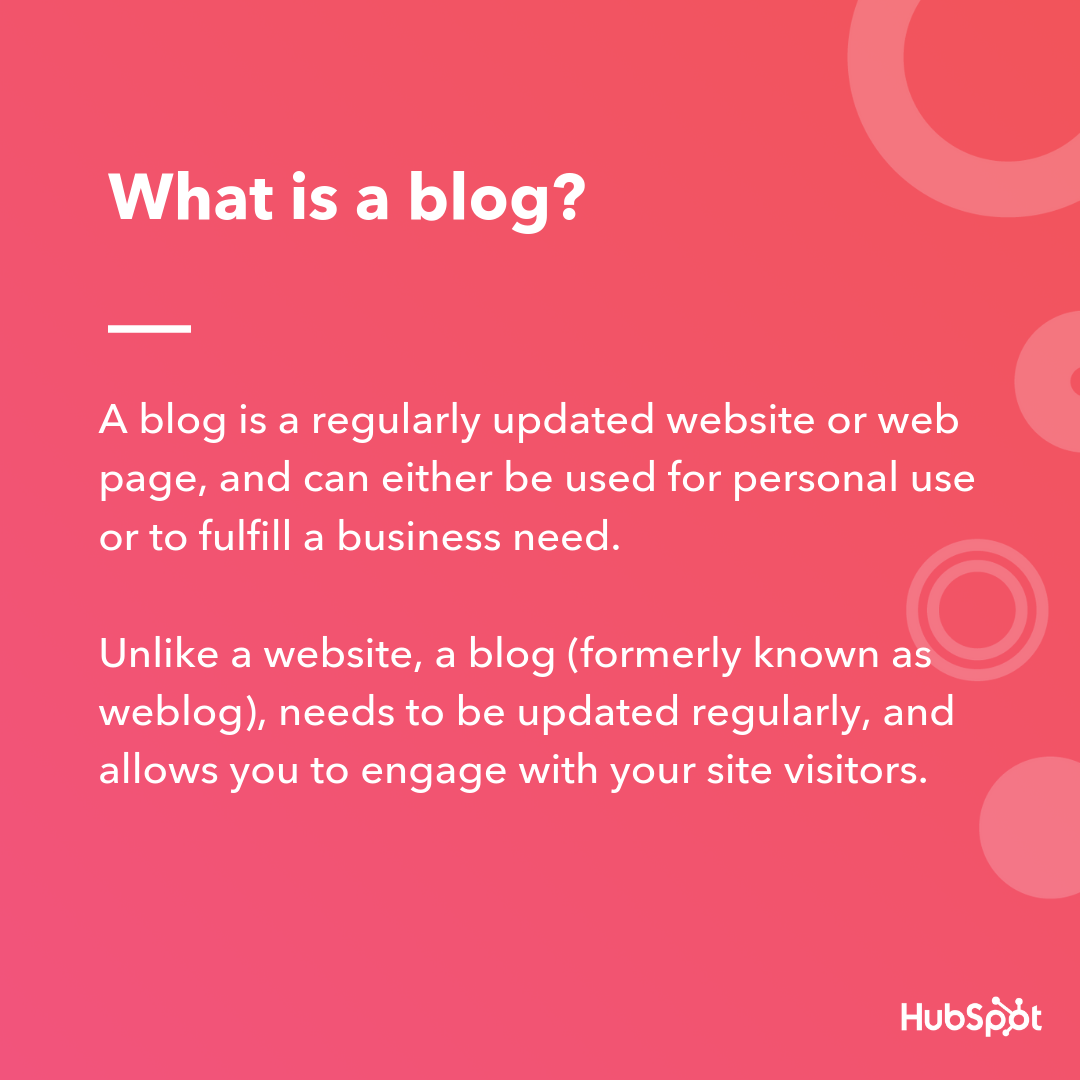
Nowadays, a blog is a regularly updated website or web page, and can either be used for personal use or to fulfill a business need.

For instance, HubSpot blogs about various topics concerning marketing, sales, and service because HubSpot sells products related to those three subjects -- so, more than likely, the type of readers HubSpot's blog attracts are going to be similar to HubSpot's core buyer persona.

Alternatively, a woman named Kiki started a personal travel blog, called The Blonde Abroad, to document her travel experiences and provide readers with helpful tips and travel recommendations. Her blog doesn't serve a larger company, but it does help her create a personal brand.

If a personal blog is successful enough, the writer can also make money off of it via sponsorships or advertisements. Take a look at 5 Strategies to Monetize a Blog to learn more.

There are plenty of benefits to blogging -- it helps drive traffic to your website, it enables you to better convert that traffic into leads, it allows your business to establish authority in an industry, and it continues to help your business grow and attract new customers months and even years after publication.

To learn more about the benefits of blogging, check out Why Blog? The Benefits of Blogging for Business and Marketing.

What is a blog post?

A blog post is an individual web page on your website that dives into a particular sub-topic of your blog.

For instance, let's say you start a fashion blog on your retail website. One blog post might be titled, "The Best Fall Shoes for 2019". The post ties back to your overall blog topic as a whole (fashion), but it also addresses a very particular sub-topic (fall shoes).

Blog posts allow you to rank on search engines for a variety of keywords. In the above example, your blog post could enable your business to rank on Google for "fall shoes". When someone searches for fall shoes and comes across your blog post, they have access to the rest of your company's website. They might click "Products" after they read your post, and take a look at the clothing items your company sells.

A blog post links back to your overall blog site. For instance, right now, you're on hubspot.com/marketing/what-is-a-blog. The "what-is-a-blog" section of the URL is tied back to /marketing/, which is the blog as a whole.

1. To help your company rank on search engines.

Typically, a business will use a blog to help the business's website rank on search engines. You can absolutely employ SEO tactics, or use paid ads, to help your company homepage rank on page one of Google -- but a more effective, long-term solution is blogging.

To consider how your company can rank on search engines via a blog, we'll start with an example -- let's say you work for a web design start-up with very little online presence.

You decide to spend the first year writing and posting regular blog content that strongly relates to web design. Over time, your traffic increases and other companies link to your site for information regarding web design. When this happens, Google recognizes your company as a legitimate source for web design information. Eventually (with a lot of trial and error), your blog posts begin ranking on page one of Google for terms like "web design", "website builder", and "e-commerce website".

Then, one day, you search "web design companies in X city" and find your company is now on page one. This is likely due, in large part, to your consistent blogging efforts.

Take a look at How HubSpot Uses Blogging to Rank #1 on Google to learn more about specific strategies you can implement to rank on search engines.

2. To share information about a given topic and become an expert in an industry.

In 2006, Boston-native Matt Kepnes quit his job and began traveling the world. He documented his travels in his now infamous blog, NomadicMatt.com.

After about a year, thanks to tireless blogging efforts and SEO strategies that enabled him to rank on Google, he began pulling in $60,000. Matt also created e-books, and used sponsorships and affiliate marketing to make money. Additionally, he wrote a New York Times best-seller, "How to Travel the World on $50 a Day."

Now, Matt's blog attracts 1.5 million visitors a month and grosses about $750,000 a year -- and he's become a well-known expert in the travel space.

If you want to become known as an expert in a topic that interests you, from fashion to blogging to fitness, you can -- and, oftentimes, it starts with a blog.

3. To attract visitors to your site, and turn those visitors into leads.

There's only so much traffic you can get from the homepage or About Us page of your company's website. Of course, those pages are critical for leads who are already interested in your products -- but they often won't attract traffic from top-of-the-funnel. That's where your blog comes into play.

Your blog can be a general resource to help your website visitors even before those visitors are ready to purchase from you. For instance, let's say you sell products for e-commerce stores. You might attract some e-commerce owners who are already searching online for your products, but in most cases, the e-commerce owner isn't going to be ready to buy right out of the gate.

Alternatively, if you begin blogging about tips to help the retail owner who is just starting out -- like "How to start a retail website", or "Benefits of e-commerce vs. physical store" -- you'll slowly attract an audience who enjoys your content and finds it useful. Then, when those site visitors' e-commerce stores begin growing (thanks, in part, to your blog), they'll already know about your brand and already trust it as a helpful source. That's when they'll check out your product pages.

4. To cultivate an online community and engage with an audience.

At the very least, you might create a blog to engage with an online community of readers with similar interests. Maybe you start a food blog and ask readers to share their own recipes with you.

Alternatively, perhaps you start a blog that focuses on DIY projects. You post the fun, DIY projects you've completed in your own home, and you ask your readers to share their own DIY tips in exchange.

With a blog, the sky's the limit -- and so are the benefits for your business. If you're officially ready to get started with your own blog, take a look at How to Create a Successful Blog Strategy: A Step-by-Step Guide.

Alternatively, if you're starting at the beginning and anxious about your first post, read How to Write a Blog Post: A Step-by-Step Guide [+ Free Blog Post Templates].

what-is-a-blog

New Call-to-action

from Marketing https://blog.hubspot.com/marketing/what-is-a-blog