Monday, 4 March 2019

The Ultimate Guide to Google Ads for 2019

If you’re considering spending any amount of money on ads to reach your target audience, then you’d better spend it in the right place. That is, somewhere with over 246 million unique visitors, 3.5 billion daily interactions, and an estimated 700% return on investment.

Somewhere like Google Ads.

Google Ads was launched just two years after what has become the most popular website in the world: Google.com. The advertising platform came on the scene in October 2000 as Google Adwords, but after some rebranding in 2018, it was renamed Google Ads.

Google Ads is a paid advertising platform that falls under a marketing channel known as pay-per-click, where you (the advertiser) pays per click (PPC) or per impression (CPM) on an ad. The better your ad campaign, the more clicks you generate, and the greater your probability of obtaining a new lead or customer. (And, yes, this guide will show you how to create an optimized ad campaign.)

Brush up on your PPC knowledge with our guide to PPC advertising.


Ads from the platform span several channels, including Google, YouTube, Blogger, and millions of other websites known as the Google Display Network. Given Google’s expansive reach, chances are you’ve seen (and probably clicked on) a Google ad … and so have your potential customers.

This guide will teach you what you need to know to get started advertising on Google. We’ll cover features specific to this platform and teach you how to optimize your paid campaigns to achieve the best results with your ads.

Why advertise on Google?

Google is the most used search engine, receiving 3.5 billion search queries a day. Not to mention, the Google Ads platform has been around for nearly two decades, giving it some seniority in the area of paid advertising. Google is a resource used by people around the world to ask questions that are answered with a combination of paid advertisements and organic results. And, according to Google, advertisers make $8 for every $1 they spend on Google Ads. So, there are a few reasons why you’d want to consider advertising on Google.

Need another reason? Your competitors are using Google Ads (and they might even be bidding on your branded terms). Thousands of companies use Google Ads to promote their businesses, which means that even if you’re ranking organically for a search term, your results are being pushed down the page, beneath your competitors.

If you’re using PPC to advertise your product or services, Google Ads should be a part of your paid strategy — there’s no way around it (except maybe Facebook Ads, but that’s another article).

Reasons Why Your Google Ads Aren’t Working

If you’ve tried unsuccessfully to advertise on Google, don’t give up. There are many reasons why your Google Ads could be underperforming. Let’s cover some common offenders.

  1. Broad Keyword Terms. You really need to nail it when it comes to your keywords, which is why testing and tweaking should be a part of your strategy. If your keywords are too broad, Google will be placing your ad in front of the wrong audience which means fewer clicks and a higher ad spend. Review what’s working (i.e. which keywords are generating clicks) and adjust them to best match your ads with your target audience. You likely won’t get the mix right the first time but you should keep adding, removing, and tweaking keywords until you do.
    How to fix it: Review the keyword strategies that we cover below.
  2. Irrelevant Ads. If your ad doesn’t match the searcher’s intent, you won’t get enough clicks to justify your ad spend. Your headline and ad copy need to match the keywords you’re bidding on, and the solution your ad is marketing needs to solve whatever pain point that searcher is experiencing. It’s a combination that will yield the results you’re looking for, and it may just be a few tweaks away. You have the option to create multiple ads per campaign — use this feature to split test which ads work best. Or, better yet, use Google’s Responsive Search Ads feature.
    How to fix it: Read our best practices for ad copy.
  3. Low Quality Score. Your Quality Score (QS) is how Google determines how your ad should rank. The higher your rank, the better your placements. If your quality score is low, you’ll have fewer eyeballs on your ad and fewer chances to convert. Google will tell you your Quality Score, but improving it is up to you.
    How to fix it: Keep reading to learn how to improve your QS.
  4. Poor Landing Page. Your efforts shouldn’t stop with your ad — the user experience after a click is equally important. What does your user see once they click your ad? Is your landing page optimized for conversions, meaning does it use the same keywords? Does the page solve your user’s pain point or answer their question? Your user should experience a seamless transition through to the conversion.
    How to fix it: Review landing page best practices and implement them to increase your conversion rate.

These common terms will help you set up, manage, and optimize your Google Ads. Some of these are specific to Google Ads, while others are related to PPC in general. Either way, you’ll need to know these to run an effective ad campaign.

AdRank

Your AdRank determines your ad placement. The higher the value, the better you’ll rank, the more eyes will fall on your ad, and the higher the probability that users will click your ad. Your AdRank is determined by your maximum bid multiplied by your Quality Score.

Bidding

Google Ads is based on a bidding system, where you as the advertiser selects a maximum bid amount you’re willing to pay for a click on your ad. The higher your bid, the better your placement. You have three options for bidding: CPC, CPM, or CPE.

  • CPC, or cost-per-click, is the amount you pay for each click on your ad.
  • CPM, or cost per mille, is the amount you pay for one thousand ad impressions, that is when your ad is shown to a thousand people.
  • CPE, or cost per engagement, is the amount you pay when someone takes a predetermined action with your ad.

And, yes, we’ll review bidding strategies below.

Campaign Type

Before you begin a paid campaign on Google Ads, you’ll select between one of three campaign types: search, display, or video.

  • Search ads are text ads that are displayed among search results on a Google results page.
  • Display ads are typically image-based and are shown on web pages within the Google Display Network.
  • Video ads are between six and 15 seconds and appear on YouTube.

Click-Through Rate (CTR)

Your CTR is the number of clicks you get on your ad as a proportion of the number of views your ad gets. A higher CTR indicates a quality ad that matches search intent and targets relevant keywords.

Conversion Rate (CVR)

CVR is a measure of form submissions as a proportion of total visits to your landing page. Simplistically speaking, a high CVR means that your landing page presents a seamless user experience that matches the promise of the ad.

Display Network

Google ads can be displayed on either search results pages or a web page within Google’s Display Network (GDN). GDN is a network of websites that allow space on their webpages for Google Ads — these ads can be text-based or image ads and are displayed alongside content relevant to your target keywords. The most popular Display Ad options are Google Shopping and app campaigns.

Extensions

Ad Extensions allow you to supplement your ad with additional information at no additional cost. These extensions fall under one of five categories: Sitelink, Call, Location, Offer, or App; we’ll cover each of these ad extensions below.

Keywords

When a Google user types a query into the search field, Google returns a range of results that match the searcher’s intent. Keywords are words or phrases that align with what a searcher wants and will satisfy their query. You select keywords based on which queries you want to display your ad alongside. For example, a searcher that types “how to clean gum off shoes” will see results for advertisers that targeted keywords like “gum on shoes” and “clean shoes.”

  • Negative Keywords are a list of keyword terms that you do not want to rank for. Google will pull you from the bid on these keywords. Typically, these are semi-related to your intended search terms but fall outside of the realm of what you offer or want to rank for.

PPC

Pay-per-click, or PPC, is a type of advertising where the advertiser pays per click on an ad. PPC is not specific to Google Ads, but it is the most common type of paid campaign. It’s important to understand the ins and outs of PPC before launching your first Google Ads campaign.

Quality Score (QS)

Your Quality Score measures the quality of your ad by your click-through rate (CTR), the relevance of your keywords, the quality of your landing page, and your past performance on the SERP. QS is a determining factor in your AdRank.

Click to get our free guide on how to use Google Ads.

Many factors impact your ability to create effective and high-performing Google Ads. Let’s cover them below.

AdRank and Quality Score

AdRank determines the placement of your ads, and Quality Score is one of the two factors (the other being bid amount) that determines your AdRank. Remember, your Quality Score is based on the quality and relevance of your ad, and Google measures that by how many people click on your ad when it’s displayed — i.e. your CTR. You CTR depends on the how well your ad matches searcher intent, which you can deduce from three areas:

  1. The relevance of your keywords
  2. If your ad copy and CTA deliver what the searcher expects based on their search
  3. The user experience of your landing page

Your QS is where you should focus most of your attention when you first set up your Google Ad campaign — even before you increase your bid amount. The higher your QS, the lower your acquisition costs will be and the better placement you’ll get.

Ad Campaign Types: Search, Display, and Video

You can select from one of three campaign types on Google Ads: search, display, or video. Let’s cover the optimal uses for each and why you might choose one over the other.

Search Ads

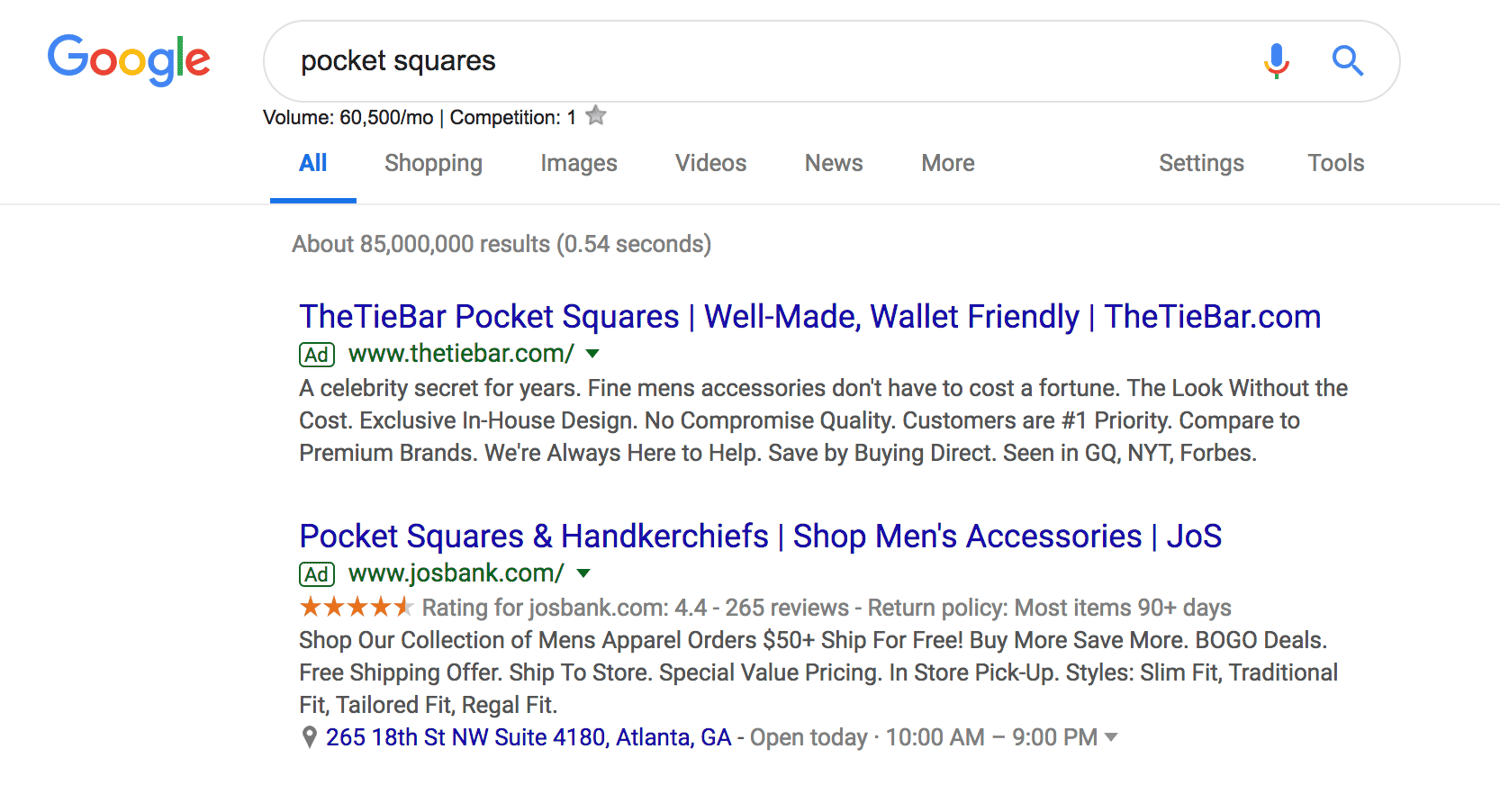
Search ads are text ads that are displayed on Google results pages. As an example, a search for “pocket squares” returns sponsored results, or ads, like these:
google-ads-search-ads

The benefit of search ads is that you’re displaying your ad in the place where most searchers look for information first — on Google. And Google shows your ad in the same format as other results (except for denoting it as an “Ad”) so users are accustomed to seeing and clicking on results.

Responsive Search Ads

Responsive search ads allow you to enter multiple versions of headlines and ad copy (15 and four variations, respectively) for Google to select the best performers to display to users. With traditional ads, create one static version of your ad, using the same headline and description each time. Responsive ads allow for a dynamic ad that is auto-tested until you arrive at the version that is best suited for your target audience — for Google, that means until you get the most clicks.

Display Ads

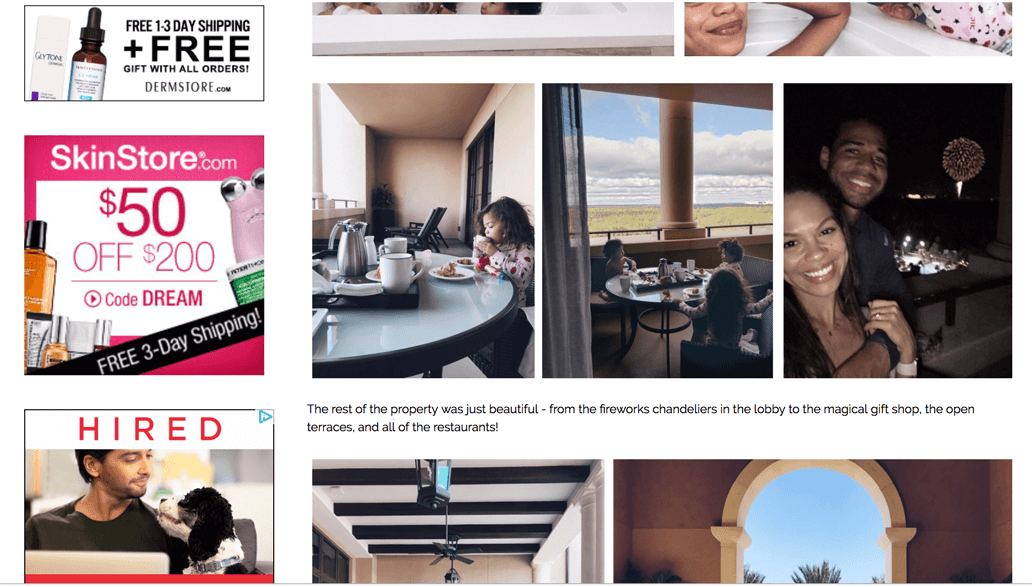
Google has a network of websites in various industries and with an array of audiences that opt in to display Google Ads, known as the Google Display Network. The benefit to the website owner is that they’re paid per click or impression on the ads. The benefit to advertisers is that they can get their content in front of audiences that are aligned with their personas. These are typically image ads that draw users attention away from the content on the webpage.
google-ads-display-ad Source

Additional options for Display Ads include shopping campaigns and app campaigns, which are displayed on search engine results pages.

Video Ads

Video ads are displayed before or after (and sometimes in the middle of) YouTube videos. Remember, YouTube is a search engine, too. The right keywords will place you in front of a video, disrupting the user’s behavior just enough to grab their attention.

Location

When you first set up your Google Ad, you’ll select a geographical area where your ad will be shown. If you have a storefront, this should be in a reasonable radius around your physical location. If you have an ecommerce store and a physical product, your location should be set in the places where you ship. If you provide a service or product that is accessible worldwide, then the sky's the limit.

Your location settings will play a role in placement. For instance, if you own a yoga studio in San Francisco, someone in New York that enters “yoga studio” will not see your result, no matter your AdRank. That’s because Google’s main objective is to display the most relevant results to searchers, even when you’re paying.

Keywords

Keyword research is just as important for paid ads as it is for organic search. Your keywords need to match searcher intent as much as possible. That’s because Google matches your ad with search queries based on the keywords you selected. Each ad group that you create within your campaign will target a small set of keywords (one to five keywords is optimal) and Google will display your ad based on those selections.

Match Types

Match Types give you a little wiggle room when it comes to your keyword selections — they tell Google whether you want to match a search query exactly or if your ad should be shown to anyone with a search query that’s semi-related. There are four match types to choose from:

  • Broad Match is the default setting that uses any word within your keyword phrase in any order. For example, “goat yoga in Oakland” will match “goat yoga” or “yoga Oakland.”
  • Modified Broad Match allows you to lock in certain words within a keyword phrase by denoting them with a “+” sign. Your matches will include that locked-in word at the very least. For example, “+goats yoga in Oakland” could yield “goats,” “goats like food,” or “goats and yoga.”
  • Phrase Match will match with queries that include your keyword phrase in the exact order but may include additional words before or after it. For example, “goat yoga” can yield “spotted goat yoga” or “goat yoga with puppies.”
  • Exact Match maintains your keyword phrase as it is written in the exact order. For example, “goat yoga” will not show up if someone types “goats yoga” or “goat yoga class.”

If you’re just starting out and don’t know exactly how your persona will be searching, move from a broad match to a more narrow approach so you can test which queries yield the best results. However, since your ad will be ranking for many queries (some unrelated) you should keep a close eye on your ads and modify them as you can gain new information.

Headline and Description

Your ad copy can be the difference between a click on your ad and a click on your competitor’s ad. It’s important that your ad copy matches the searcher’s intent, is aligned with your target keywords, and addresses the personas pain point with a clear solution.

To illustrate what we mean, let’s review an example.

google-ads-copy

A search for “baby swim lessons” yielded this result. The copy is concise and uses the limited space wisely to convey their message and connect with their target audience.

The Swim Revolution knew to put the keyword in their headline so we instantly know that this ad matches what we’re looking for. The description tells us why this is the best option for swim lessons because it addresses the concerns of their persona — a parent looking to enroll their baby in a swim class. They use words like “skills,” “fun,” “confidence,” and “comfort in the water” to ease our nerves about putting a baby in a pool and to prove to us that we will get what we want out of this class — an infant that can swim.

This kind of ad copy will get you clicks, but conversions will result from carrying this level of intention into your landing page copy.

Ad Extensions

If you’re running Google Ads, you should be using Ad Extensions for two reasons: they’re free, and they give users additional information and another reason to interact with your ad. These extensions fall within one of these five categories:

  • Sitelink Extensions extend your add — helping you stand out — and provide additional links to your site that offer users more enticing reasons to click.
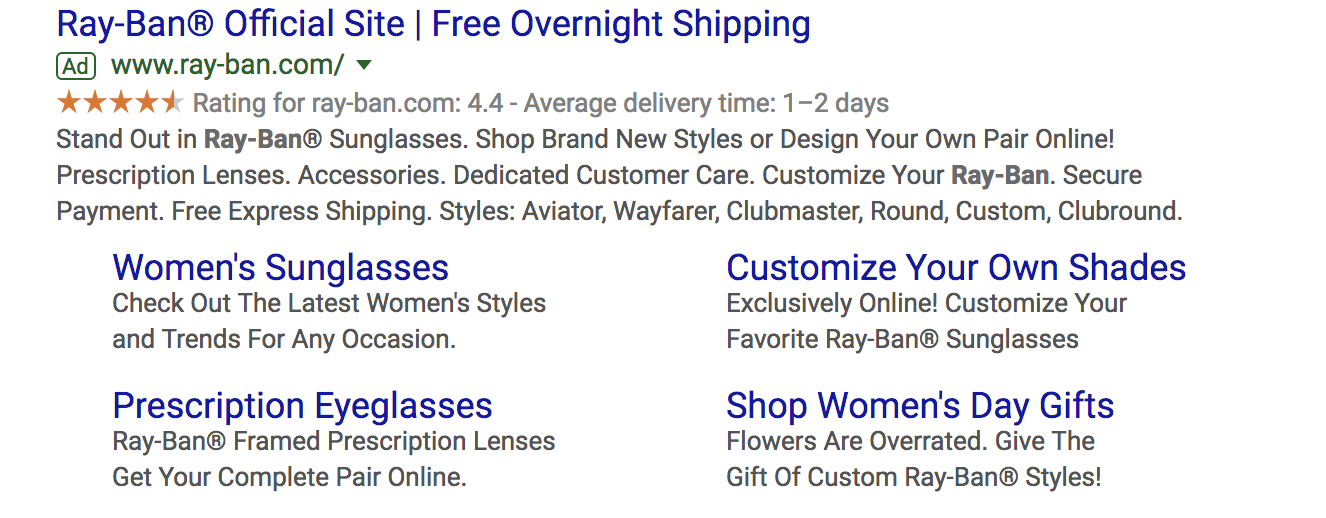
    google-ads-sitelink-extensions
  • Call Extensions allow you to incorporate your phone number in your ad so users have an additional (and instant) way to reach out to you. If you have a customer service team that is ready to engage and convert your audience, then include your phone number.

    google-ads-call-extensions
  • Location Extensions include your location and phone number within your ad so Google can offer searchers a map to easily find you. This option is great for businesses with a storefront and it works well for the search query “...near me.”

    google-ads-location-extensions
  • Offer Extensions work if you’re running a current promotion. It can entice users to click your ad over others if they see that your options are discounted compared to your competitors.
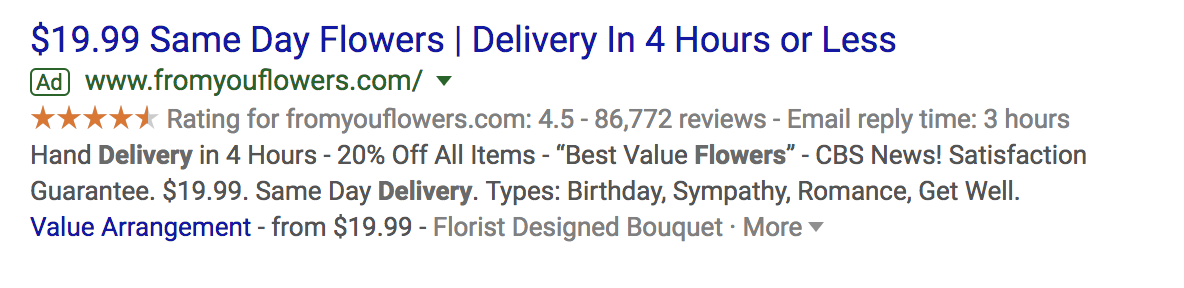
    google-ads-offer-extensions
  • App Extensions provide a link to an app download for mobile users. This reduces the friction from having to perform a new search to find and download the app in an AppStore.
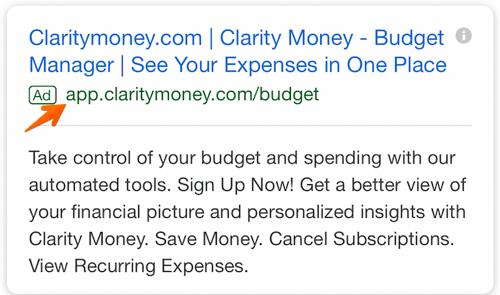
    google-ads-app-extensions

How to Set Up Your Google Ads

Setting up your paid campaigns on Google is relatively easy (and quick), mostly because the platform takes you through the setup and provides helpful hints along the way. Once you visit the Google Ads site and click “Start Now,” you’ll be taken through a series of steps to get your ads up and running. If you have your ad copy and/or images created, set up should take you no more than 10 minutes.

What may be less obvious are all the additional things you need to do to make sure your ads are optimally set up and easily trackable. Let’s cover these together. These are the steps you’ll take once your ads are submitted for review.

Link Google Analytics

You likely have Google Analytics set up on your website so you can track traffic, conversions, goals, and any unique metrics. You also need to link your Analytics account to Google Ads. Linking these accounts will make tracking, analyzing, and reporting between channels and campaigns much easier because you can view these events in one place.

Add UTM Codes

Urchin Tracking Module (UTM) codes are used by Google to track any activity associated with a specific link. You’ve probably seen them before — it’s the part of a URL that follows a question mark (“?”). UTM codes will tell you which offer or ad led to a conversion so you can track the most effective parts of your campaign. UTM codes make it easier to optimize your Google Ads since you know exactly what’s working.

The trick, though, is to add your UTM codes at the campaign level when you set up your Google Ads so you don’t have to do so manually for each ad URL. Otherwise, you can add them manually with Google’s UTM builder.

Set Up Conversion Tracking

Conversion tracking tells you exactly how many customers or leads you’ve acquired from your ad campaigns. It’s not mandatory to set up but, without it, you’ll be guessing the ROI of your ads. Conversion tracking allows you to track sales (or other activities) on your website, app installs, or calls from your ads.

Manage and organize your ads with our free Google Ads Kit and Templates.

Integrate Your Google Ads With Your CRM

There is something to be said about keeping all of your data in one place where you can track, analyze, and report on it. You already use your CRM to track contact data and lead flows. Integrating Google Ads with your CRM gives you the ability to track which ad campaigns are working for your audience so you can continue marketing to them with offers that are relevant.

Google Ads Bidding Strategies

Once you’ve set up your ad campaigns and have tracking in place, it’s time to start bidding. Remember, your ability to rank in Google Ads depends on how you bid. While your bid amount will depend on your budget and goals, there are a few strategies and bid settings you should be aware of when launching your paid campaign.

Automated vs. Manual Bidding

You have two options when it comes to bidding on your keywords — automated and manual. Here’s how they work:

  • Automated Bidding puts Google in the driver’s seat and allows the platform to adjust your bid based on your competitors. You can still set a maximum budget, and Google will work within a range to give you the best chance at winning the bid within those constraints.
  • Manual Bidding let’s you set the bid amounts for your ad groups and keywords, giving you the chance to reduce spending on low-performing ads.

Bidding on Branded Search Terms

Branded terms are those with your company or unique product name in them, like “HubSpot CRM.” There is much debate on whether to bid on your branded terms or not. On one side of the debate, bidding on terms that will likely yield organic results could be seen as a waste of money.

On the other side, bidding on these terms gives you domain over these search results pages and helps you convert prospects that are further along the flywheel. For instance, if I’ve been doing research on live chat tools and am heavily considering HubSpot’s Live Chat, then a simple search for “HubSpot live chat software” will yield exactly the result I’m looking for without the effort of scrolling.

The other argument in favor of bidding on your branded terms is that competitors may bid on them if you don’t, thereby taking up valuable real estate that should belong to you.

Cost Per Acquisition (CPA)

If the idea of spending money to convert prospects into leads makes you uneasy, then you can set a CPA instead and only pay when a user converts into a customer. While this bidding strategy could cost more, you can take comfort in knowing that you only pay when you acquire a paying customer. This strategy makes it easy to track and justify your ad spend.

Additional Resources to Optimize Your Google Ads

Your ad copy and headline is not the only component that will make your paid campaign successful. Getting a user to click is only the beginning … they should arrive on a landing page that’s optimized for conversion and then be taken to a Thank You page that tells them what to do next.

If you want your Google Ads to produce qualified leads and customers, then check out these additional resources and use them as guidelines as you set up your Google Ads campaign.

Start Your Campaign

Given its reach and authority, Google Ads should be a part of your paid strategy. Use the tips we covered to get started, and remember to refine and iterate as you go. There’s no such thing as a Google Ads campaign that doesn’t work — there are only ones that need a bit more work. Using the strategy and information provided above, you have what you need to create a successful Google Ad campaign that drives clicks and converts leads.
free demo of HubSpot's ads product


from Marketing https://blog.hubspot.com/marketing/google-adwords-ppc

The 19 Best Content Marketing Tools in 2019

While no content marketing tool can replace a solid strategy and talented humans, having the right tech stack can certainly help you get the job done better, easier, and more efficiently.

There are hundreds of content marketing tools available, some free or cheap and some very expensive. They also serve tons of different purposes, from content ideation to production to promote, optimization, and more. The content marketing technology landscape is growing every year.

This is exciting, since it means that if you have a problem, you can probably find a software solution to help you solve it. But it’s also overwhelming. How do you know which of the couple hundred tools are worth trying?

This post will help clarify those decisions for you. We’ll outline the top 19 content marketing tools in 2019.

1. HubSpot

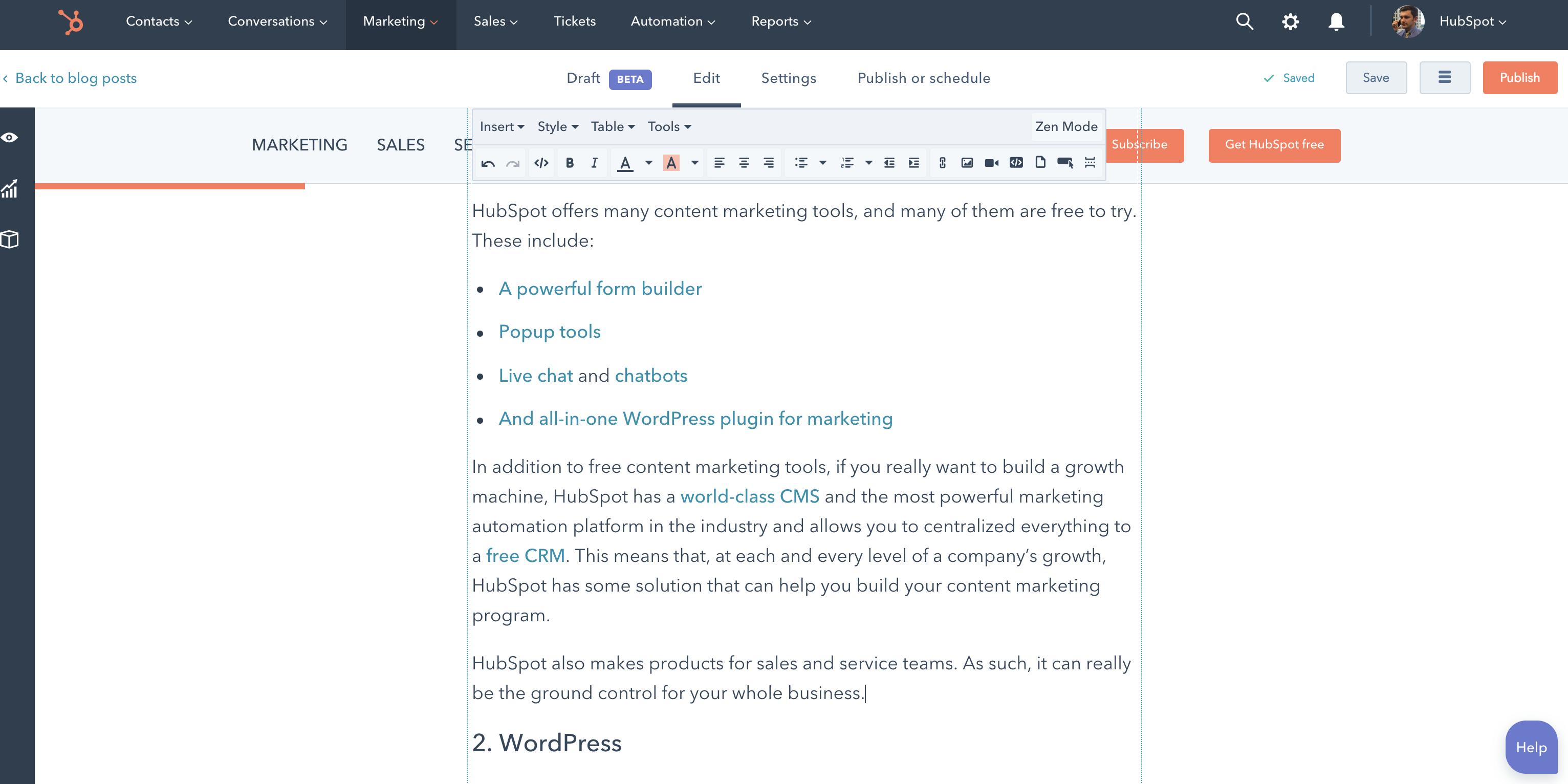
HubSpot offers many content marketing tools, and many of them are free to try. These include:

In addition to free content marketing tools, if you really want to build a growth machine, HubSpot has a world-class CMS and the most powerful marketing automation platform in the industry and allows you to centralized everything to a free CRM. This means that, at each and every level of a company’s growth, HubSpot has some solution that can help you build your content marketing program.

HubSpot also makes products for sales and service teams. As such, it can really be the ground control for your whole business.

Screen Shot 2019-03-01 at 12.53.22 PM

Meta, right?

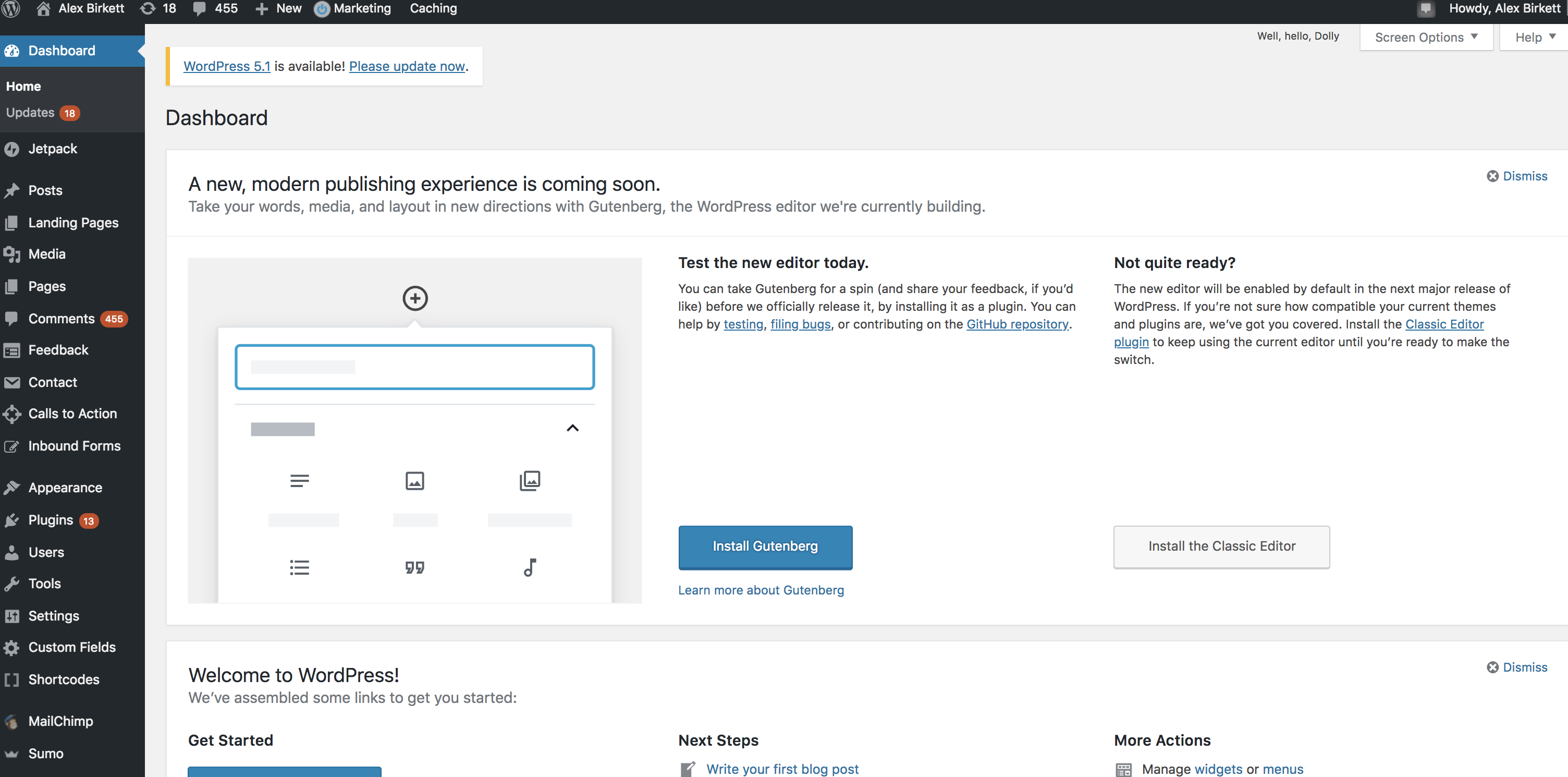
2. WordPress

WordPress is the most widely used CMS in the world. As of August 2018, VentureBeat reported that WordPress powers about 30% of the internet in general.

Social proof can sometimes lead us astray, but in this case, it turns out that WordPress is a pretty powerful tool, both at the beginning stages and as your grow your content marketing program (it’s used by sites like The New Yorker and The Next Web)

At its core, WordPress is an open source CMS that allows you to host and build websites. You can self-host or host your site via WordPress.com. WordPress contains plugin architecture and a template system so you can customize any website to fit your business, blog, portfolio, or online store.

It’s a highly customizable platform and is widely used by bloggers.

Screen Shot 2019-03-01 at 12.56.13 PM

3. Google Docs

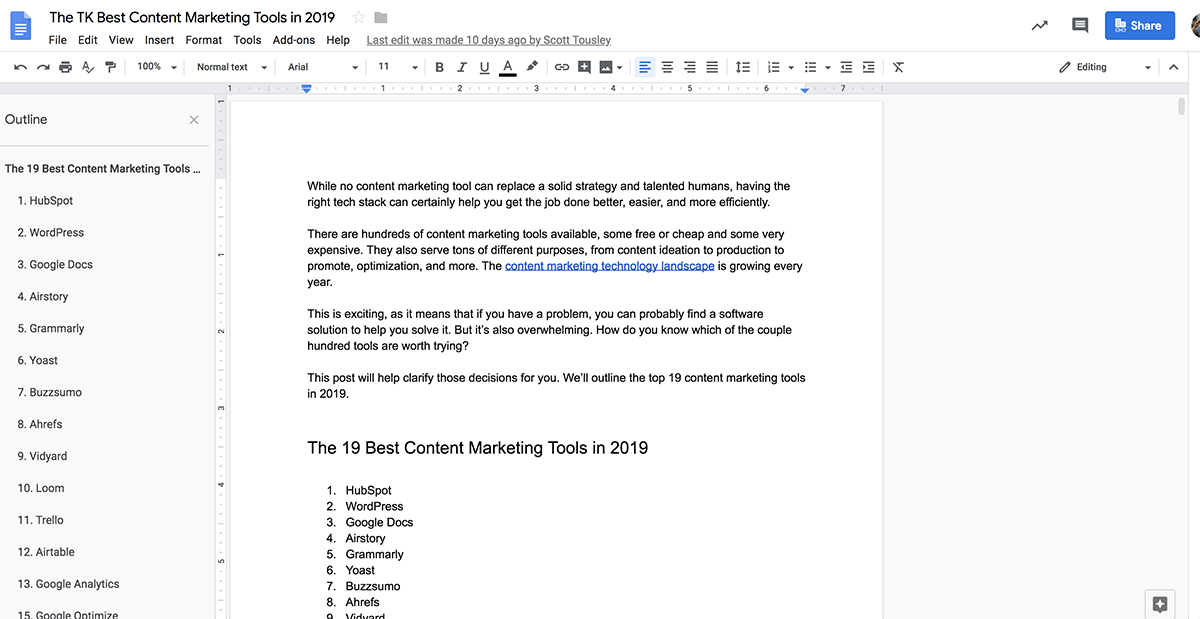
Google Docs is to content marketing what a kitchen is to chefs: it’s where all of the work gets done before the final presentation.

Personally, I don’t know any content marketers who don’t use Google Docs to draft their articles. It’s the best platform for collaboration by a long shot, but it’s also easy to use has a pleasant user experience.

In addition, you can usually find a way to upload Google Docs directly to your CMS. In the case of HubSpot, you can do that by default. If you use WordPress, you can use a tool like Wordable to help you out.

Google Docs is free, quite ubiquitous, and pleasant to use. Not many reasons not to use it.

Screen Shot 2019-03-01 at 12.50.39 PM

4. Airstory

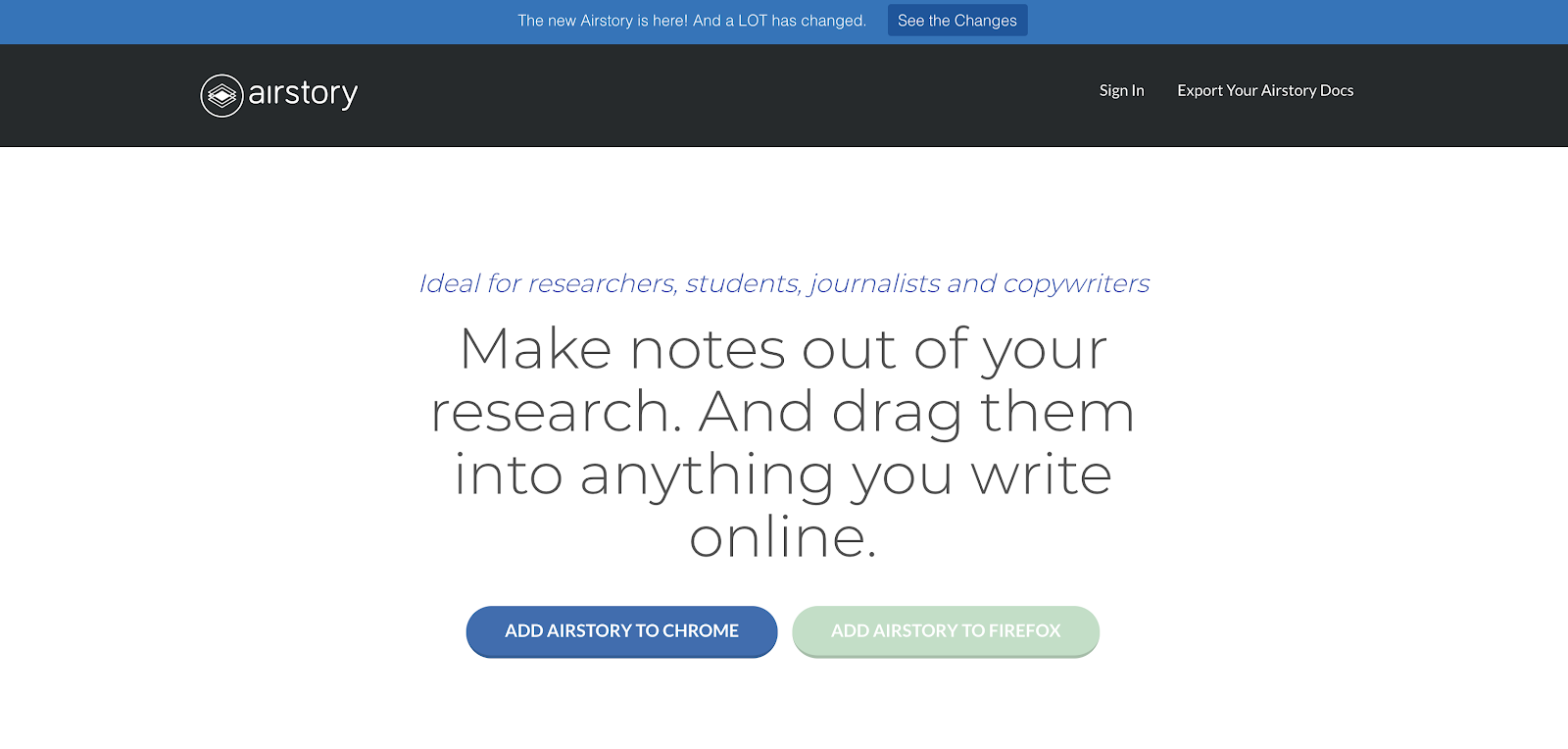
If you do want to step up your writing and collaboration game, Airstory is a more powerful platform for writers. If you find yourself moving too often between Evernote, Google Docs, Google Drive, and you always seem to have a hundred tabs open for research, it might be time to look into Airstory.

It helps you save quotes, images, and multimedia and drag and drop it into any application where you do writing. As such, it’s an incredible tool for collaboration, but also for writers who are working on longer form content (such as books or ebooks).

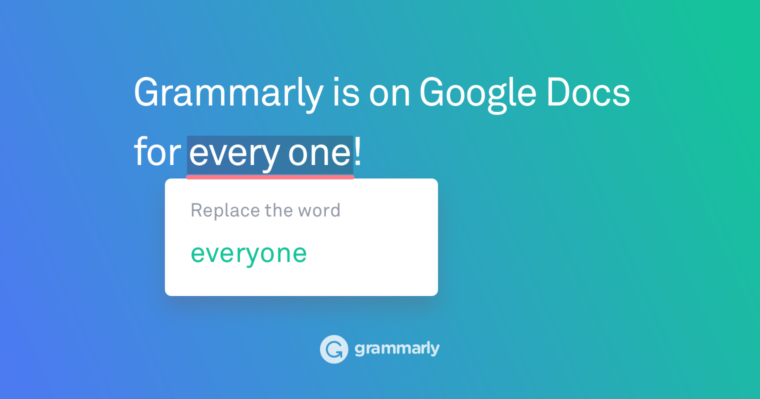
5. Grammarly

Grammarly has changed the game for me. I’m not naturally what you would call “detail-oriented,” so if it weren’t for talented editors, you’d be tearing me apart right now for the multitude of grammar mistakes littering my articles.

Grammarly, however, reduces my error rate by probably 50-80%. I still have some mistakes slip through, but to a large extent, Grammarly saves me from embarrassment (not just when writing articles, by the way - it also works for social media and forum comments).

Image Source

6. Yoast

Yoast is one of my favorite tools for writing SEO-focused content.

It’s a sort of “all-in-one” WordPress plugin for SEO that helps do pretty much everything, including optimizing content for a keyword, previewing and editing meta-descriptions and URL slugs, abstracting away technical SEO tasks, and suggesting relevant internal links.

Image Source

They have over 9,000,000 downloads, 4.9 out of 5 stars in the WordPress marketplace, and just anecdotally, everyone I know who uses WordPress uses Yoast. It’s just a great plugin.

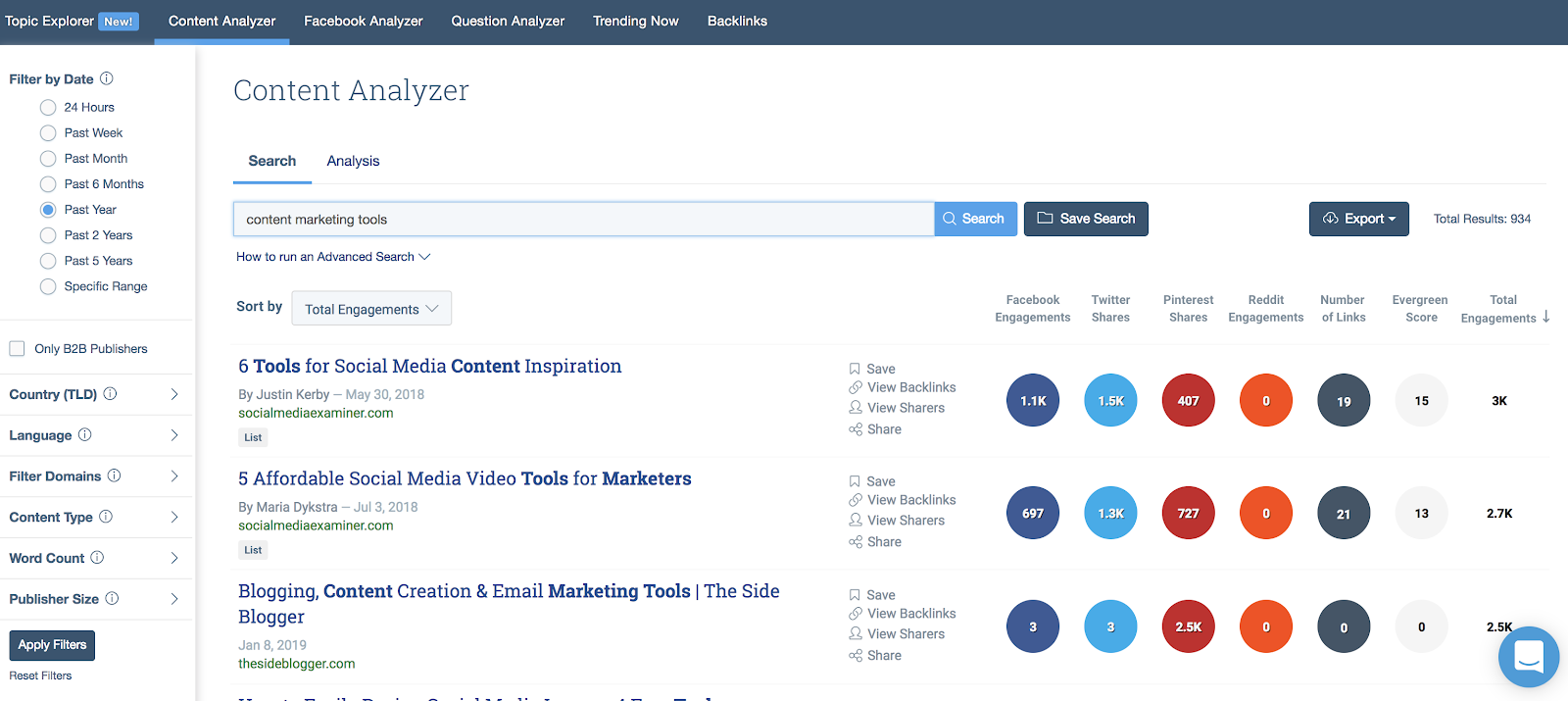
7. Buzzsumo

Buzzsumo is a great multi-purpose content marketing research tool.

One of the main things it can do is help you analyze what content performs best for any topic or competitor. You can see metrics like social shares, backlinks, and which influencers are sharing as given piece of content.

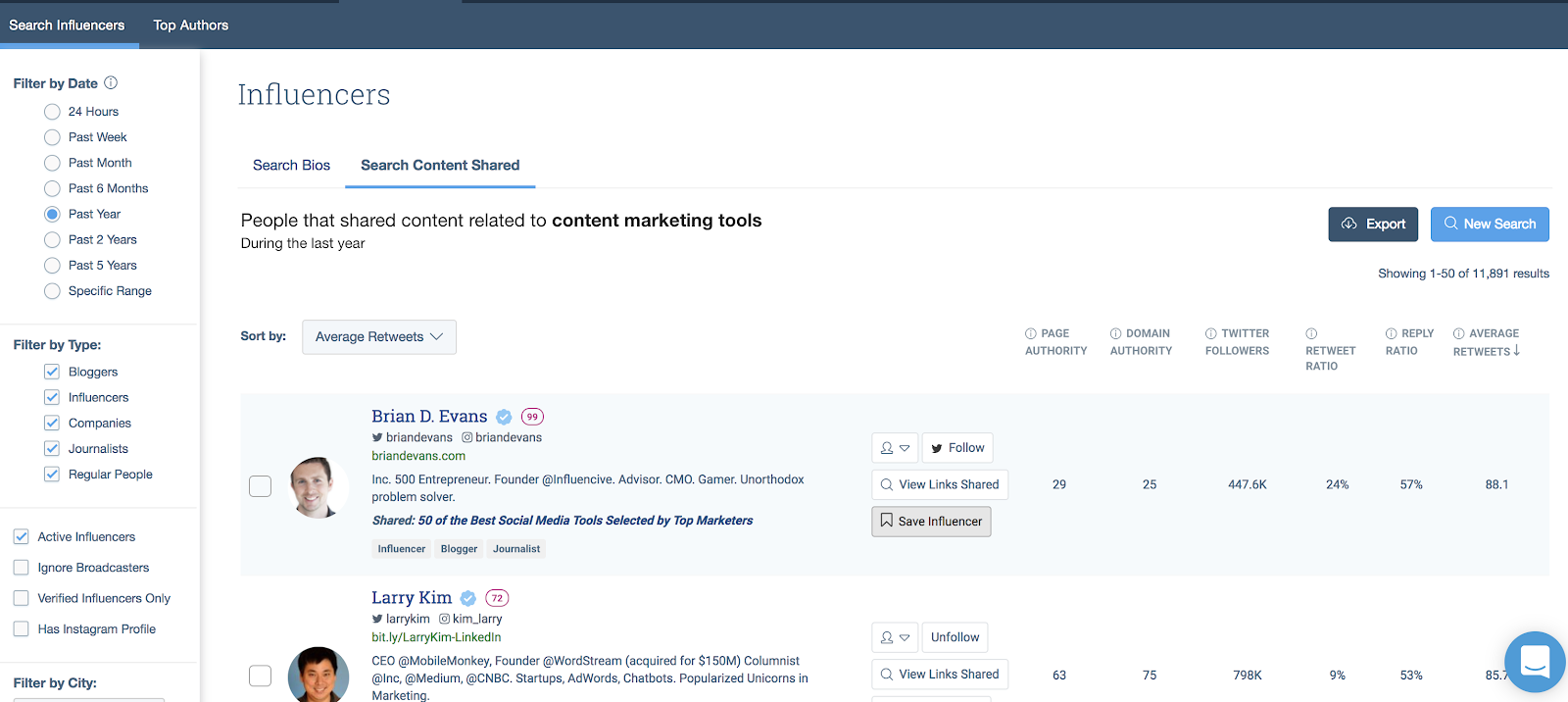
They also have great influencer reports so you can see who the thought leaders are for a given topic area.


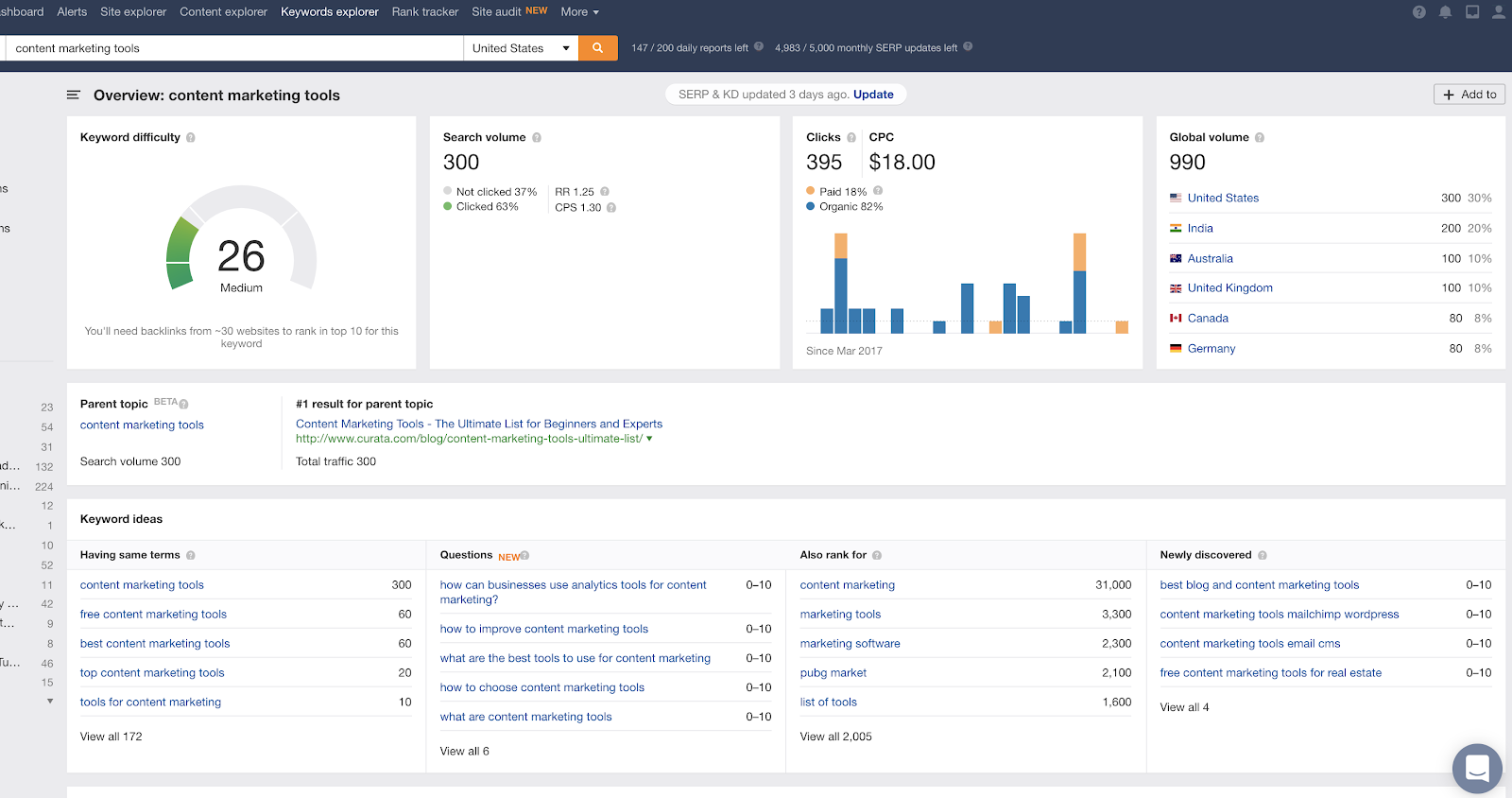
8. Ahrefs

Ahrefs is my personal favorite SEO tool, and I use it just about every day. It’s great for everything from tracking the rankings of your keywords to analyzing your competitors’ keywords and traffic and much more.

Everytime I think I’ve mastered the full functionality of Ahrefs, I find a new feature that surprises and delights me. The basics, such as keyword research or site analyzer, are wonderful. But I also love reports like “top pages” (where you can analyze the most valuable pages on a website), or “content gap” (where you can see what competitors rank for that you don’t).


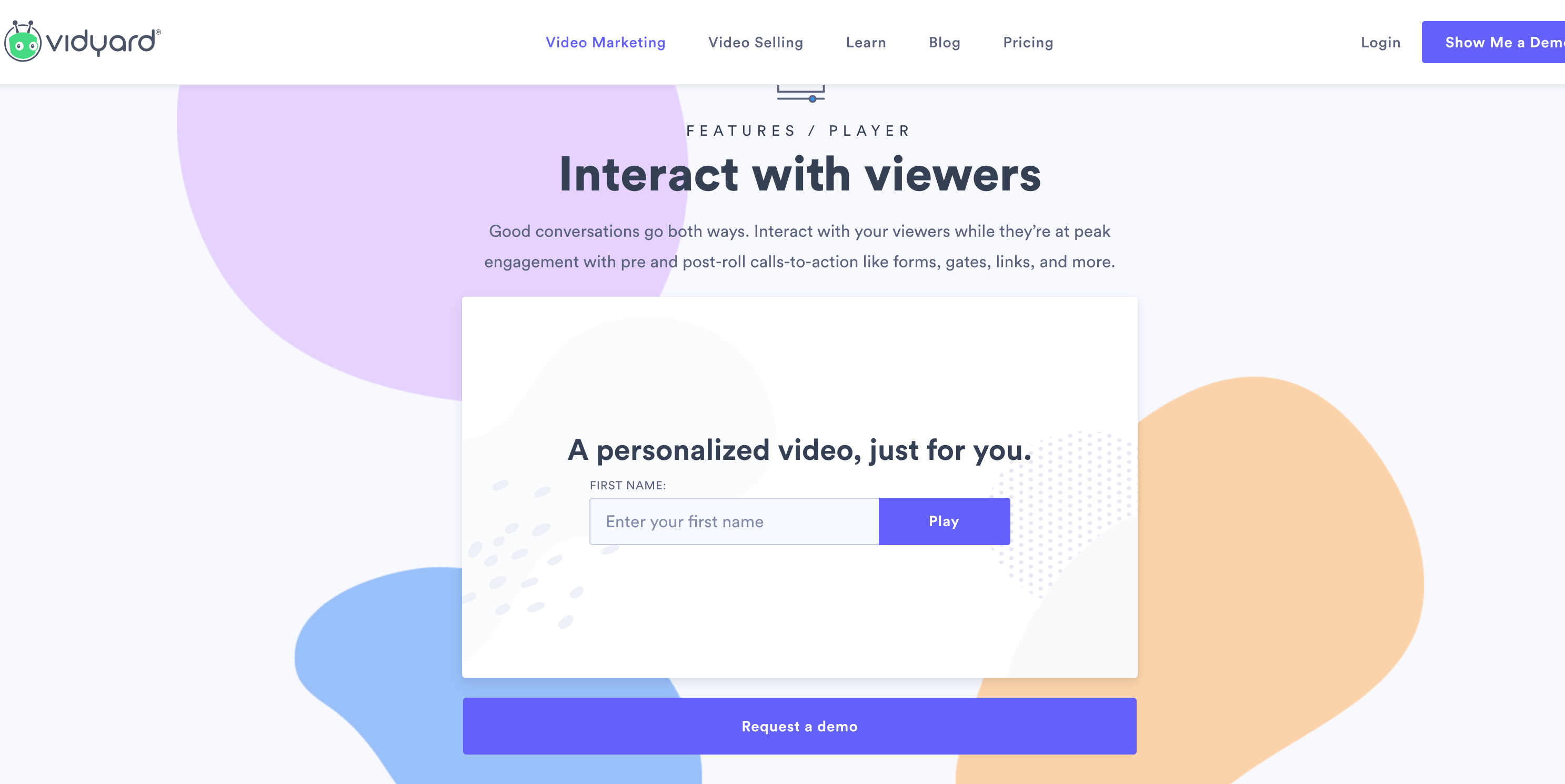
9. Vidyard

Vidyard is a video marketing platform that helps you host, share, and promote video content on your website.

They have a sales solution as well to help you close more accounts, but the marketing solution is what I’m most used to. Vidyard’s video analytics are robust, you can run A/B tests and personalize videos, and you can even gate videos at a certain time length to help capture leads.

Screen Shot 2019-03-01 at 12.57.34 PM

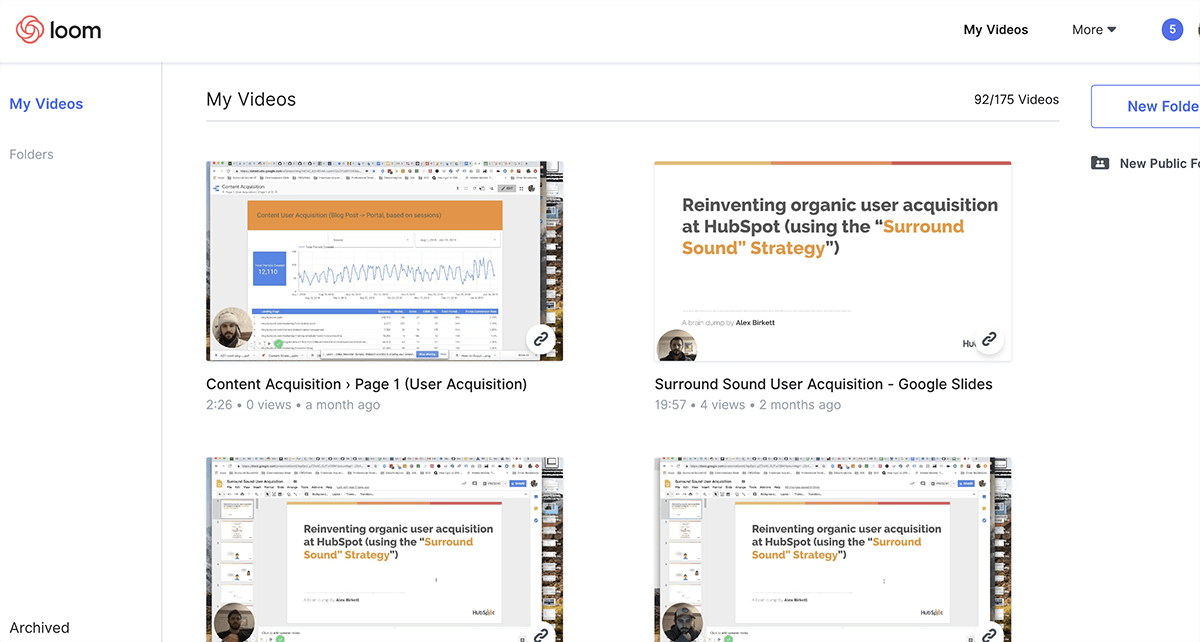
10. Loom

Loom is a tool that I’ve more recently begun using, but at this point it’s a staple for me.

It’s a simple tool, but one with powerful use cases, even beyond content marketing. What it does is allow you to create, edit, and share screen share videos. For content marketing, I love this, because I can create and embed tutorials for technical walkthroughs.

Organizationally, I love it as well. It’s great for communicating quick questions or explaining concepts to other team members (without requiring a full, synchronous meeting).

Screen Shot 2019-03-01 at 12.52.07 PM

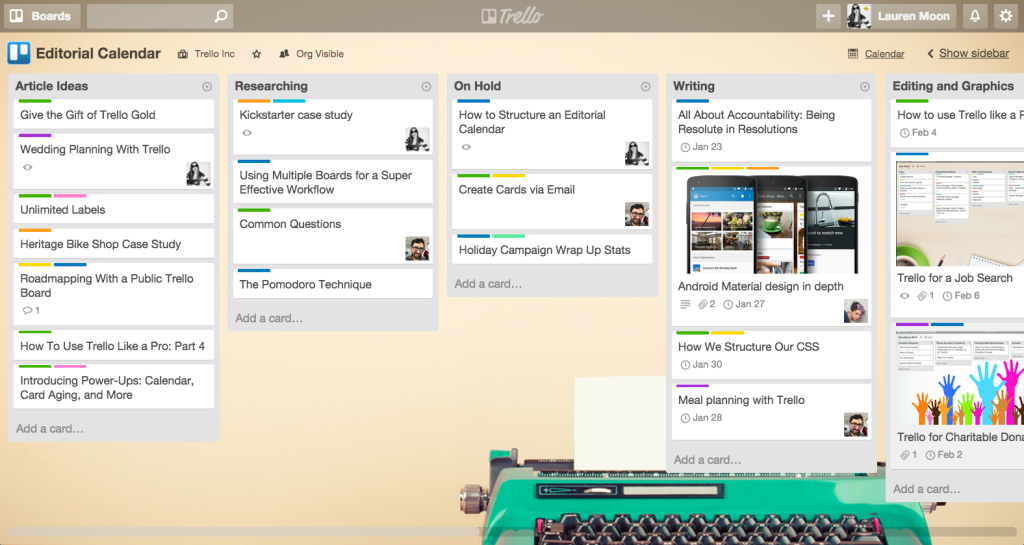
11. Trello

When you really start producing content, you’ll need some way to manage the process. This is particularly true if you’re working with many staff writers or guest writers.

My favorite tool for this is Trello.

Trello is a simple kanban and project management tool, which means it can be used for many purposes. In fact, I’ve used it for tons of things, like growth experiments, sales pipelines, and product feature roadmaps.

But I really like it as an editorial calendar tool.

 Image Source

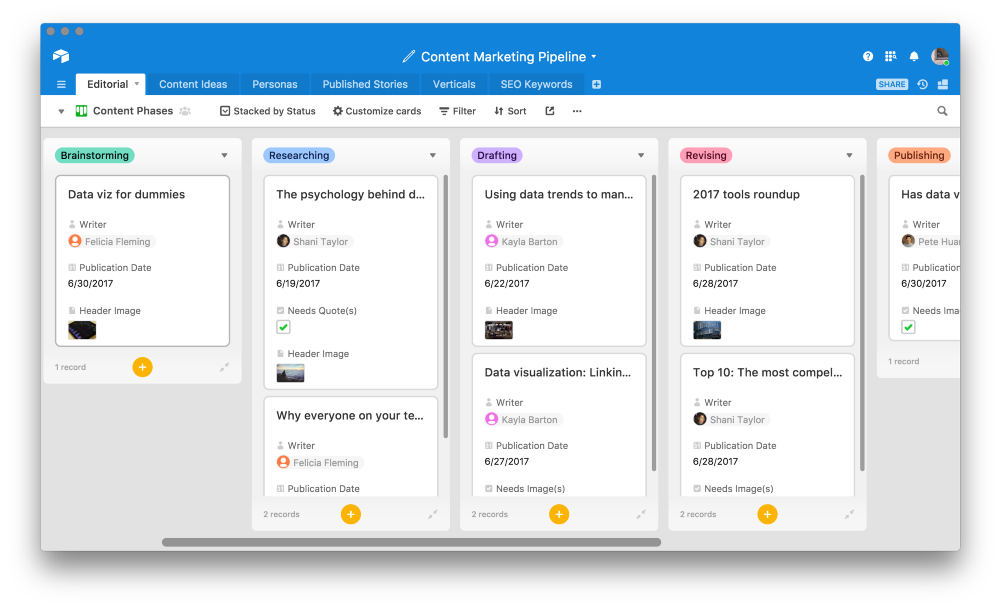
12. Airtable

Airtable is another project management tool, though it’s a little more complicated (though also customizable). It’s kind of like a mixture between spreadsheets and Trello. Again, with Airtable, the use cases are many, but I really like it for two content marketing purposes:

  • Editorial calendars
  • Influencer/writer management

I’ve also used Airtable for several other things in the past, including growth experiments and general team operating documents.

Image Source

13. Google Analytics

When talking about content marketing tools, you can’t leave measurement out of the discussion.

Surely, you can get some good insights from SEO tools like Google Search Console as well as previously listed tools like Ahrefs. But you’ll also want a digital analytics platform so you can track business metrics.

Google Analytics is one of the most widely used platforms online. It’s easy-to-use (at least the basic configurations), and it’s free. Two big benefits.

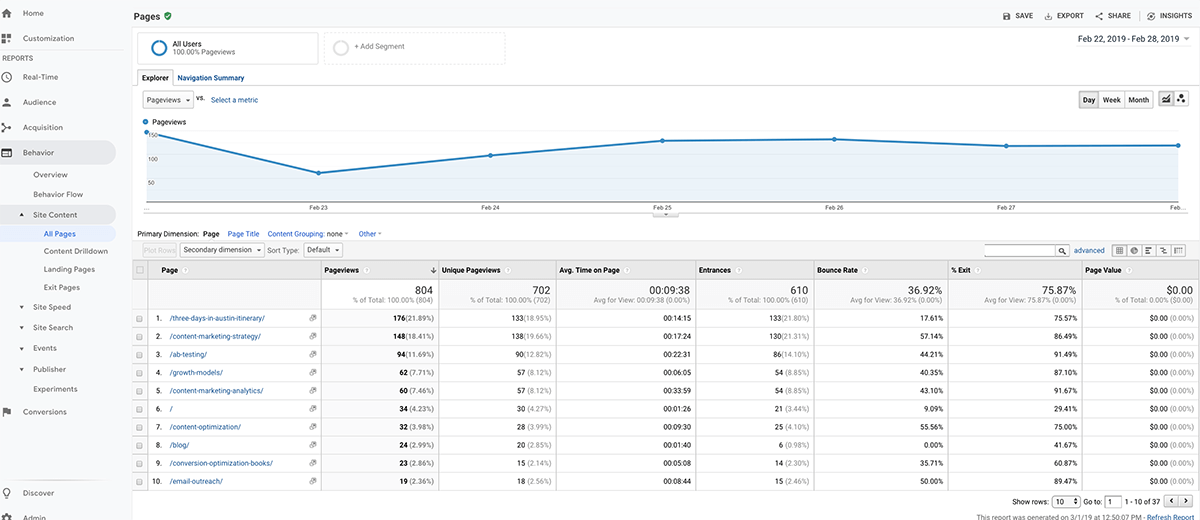
However, it’s also very powerful if you’re technical and know how to setup a proper configuration. You can not only track goals, like form submissions or product purchases, but you can also set up behavioral events, like scroll-depth.

Screen Shot 2019-03-01 at 12.46.09 PM

14. HotJar

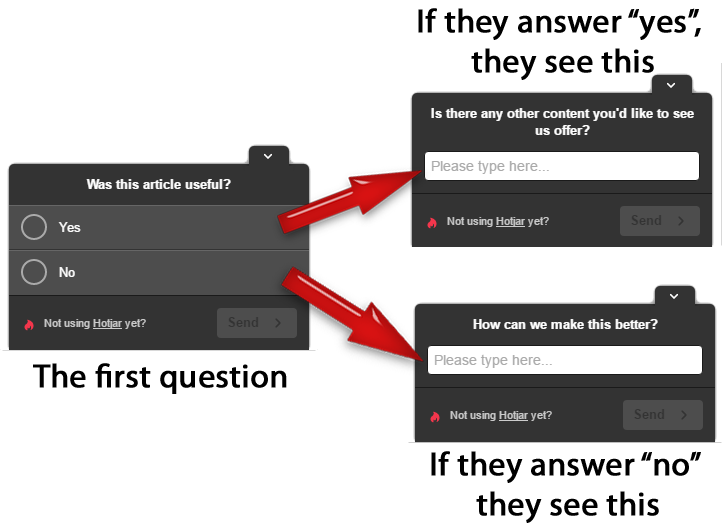
HotJar is my favorite user experience analytics tool. It’s got some qualitative tools, such as on-site poll, surveys, and session replays. Where Google Analytics can help you uncover the “what” and “where” of user behavior, these tools can help you start to tiptoe into the “why.”

In addition, they also provide some quantitative tools such as heat maps. These allow you to get a good visual picture of where you visitors are clicking and scrolling.

One use case I love HotJar (outside of CRO) for is to source interesting content ideas:

Image Source

15. Google Optimize

We’ve got a quantitative digital analytics tool (Google Analytics) and a qualitative insights platform (HotJar), so we presumably can know a lot about our readers and our website at this point. But what if we want to make a change to our blog or landing pages?

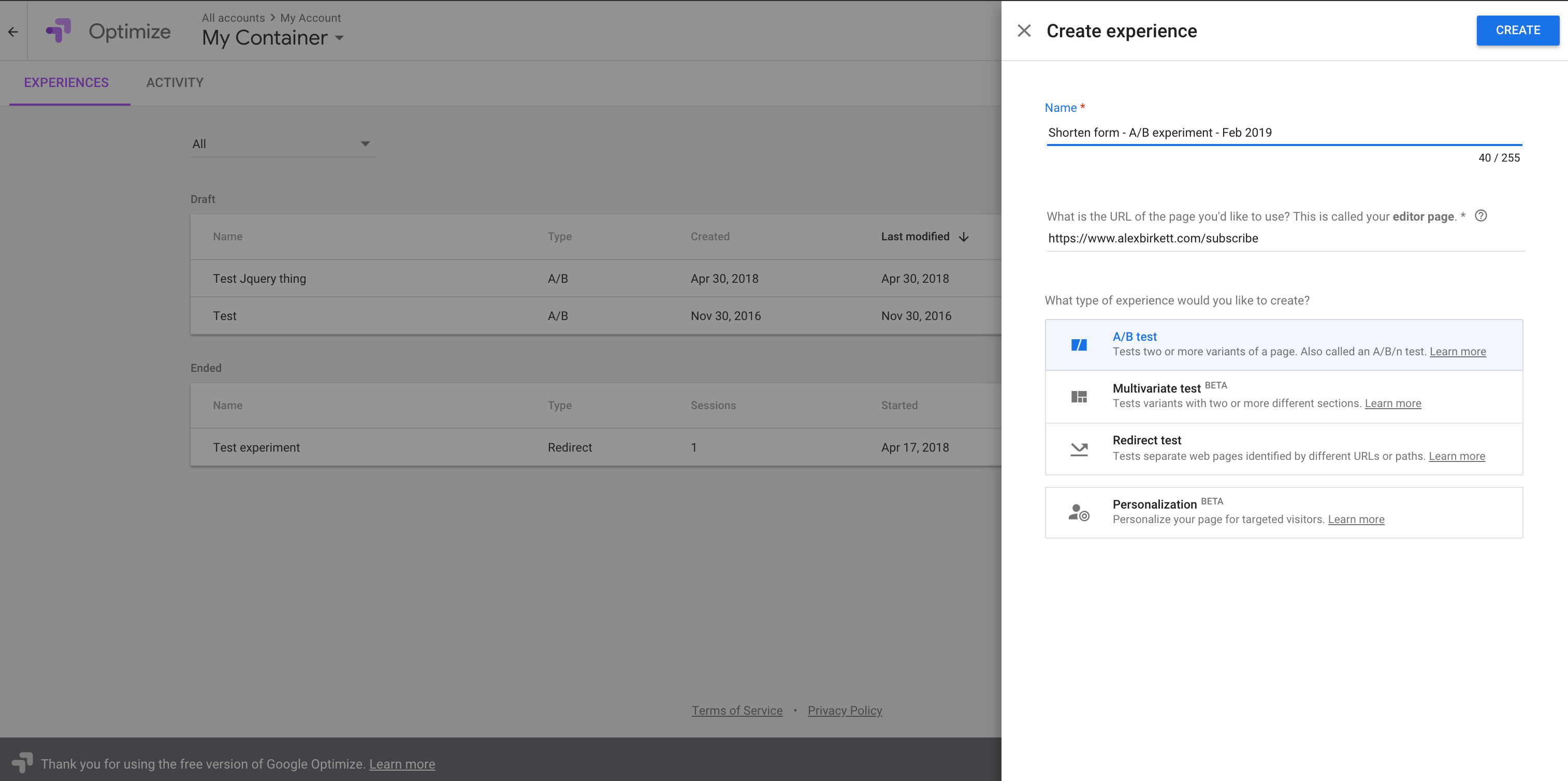
My background is in optimization, so if there’s sufficient traffic, I like to set up A/B tests for site changes.

There are many tools out there for this, but I wanted to list Google Optimize because it’s free. It’s also a good starter option to get used to. If you do want to explore other options, here’s a good article comparing the market solutions. But Google Optimize is a great start.

Screen Shot 2019-03-01 at 12.48.18 PM

16. Mutiny

A/B testing is one thing; personalization is also an interesting avenue to explore.

Where A/B testing is a controlled experiment with a limited time-horizon, personalization allows you to deliver different unique experiences to subsets of your overall audience.

For example, you could target mobile users with different popup forms. Or you could target visitors who have read three blog posts with an offer for a specific e-book. Or you could target people who scroll 75% of the way down a certain blog post with an in-text CTA.

The options are endless, only limited by your time, resources, creativity, and prioritization.

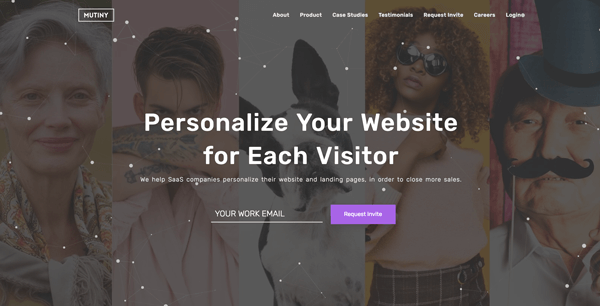
Anyway, Mutiny is my favorite platform in this space. It’s designed for B2B, so if you’re in ecommerce you may want to look at another tool like Evergage. But Mutiny is a good and promising newer player with lots of functionality.

Screen Shot 2019-03-01 at 12.49.37 PM

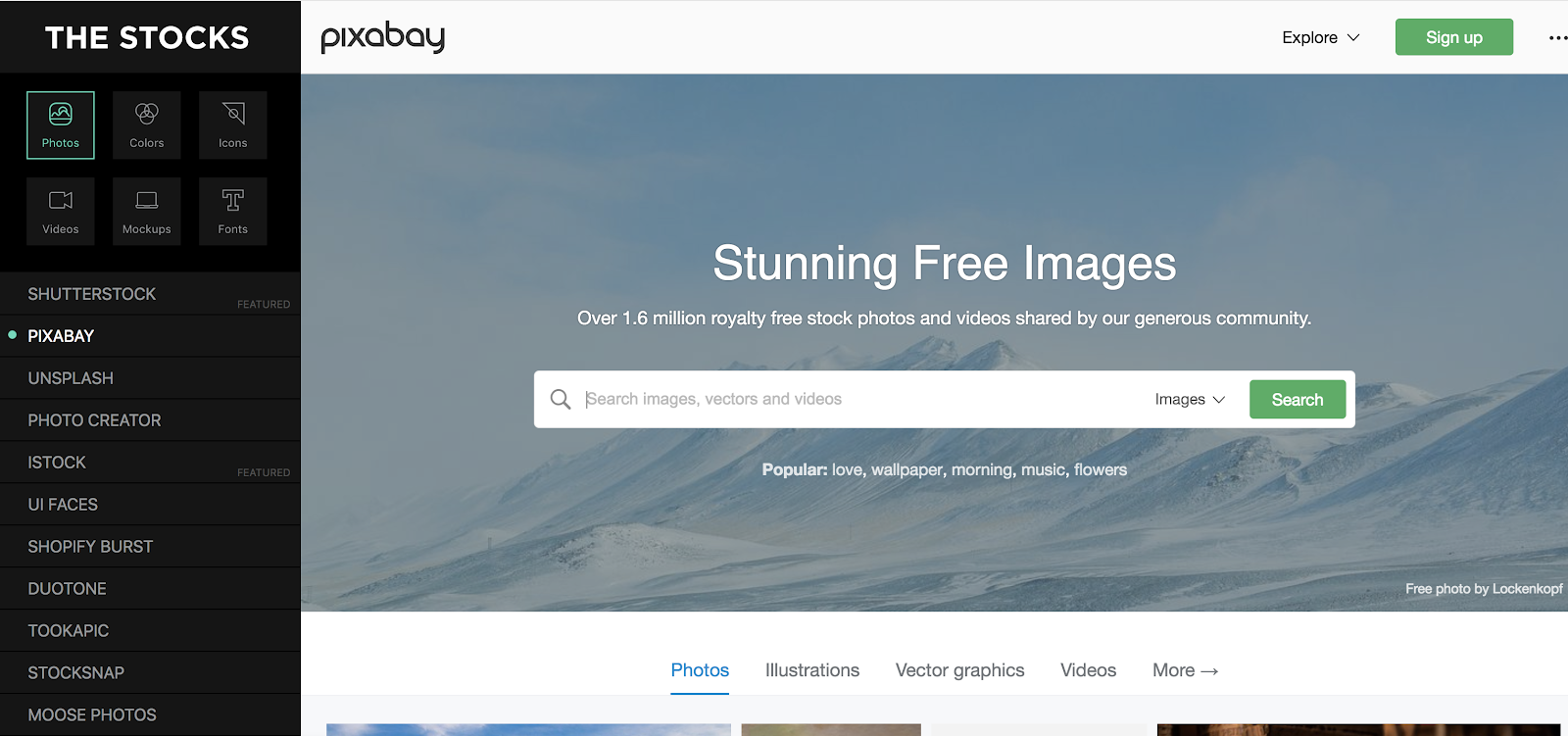
17. TheStocks.IM

Most good content marketing includes imagery, so it only makes sense to include a stock photo site here in our list of content marketing tools.

I like TheStocks.IM because it aggregates several free stock photo sites, including Unsplash (my favorite) and Pixabay.


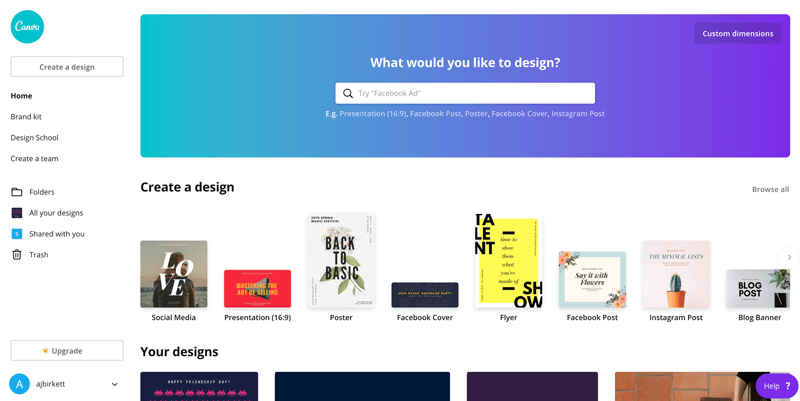
18. Canva

What about when a stock image doesn’t cut it, and you want to make your own imagery?

Canva is a great option here.

With Canva, you really don’t need to have excellent graphic design skills. I’m a horrible designer, and I can make decent looking graphics with Canva. It’s really designed for the layperson.

This tool is great for all kinds of content marketing imagery, like social media images, blog cover photos, Twitter cover photos, etc. It’s pretty all-purpose.

Screen Shot 2019-03-01 at 12.44.20 PM

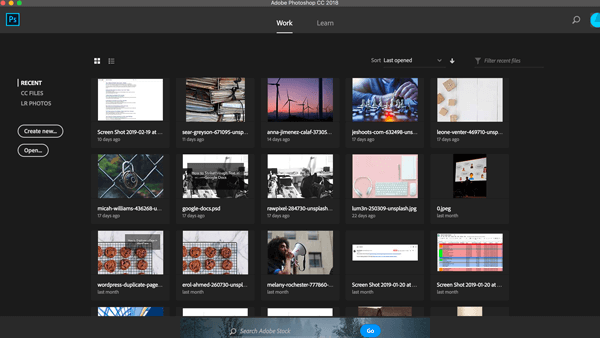
19. Adobe Photoshop

Now, what if you want to make your own imagery, but you actually are good at graphic design?

Well, in this case, Photoshop is the gold standard. It’s great for editing photographs as well as creating images such as Facebook photos, blog cover photos, and even screenshot tutorials.

I find that, just as with SQL, little bit of skill with Photoshop goes a long way.

Screen Shot 2019-03-01 at 12.42.09 PMNot all of the content marketing tools on this list are free, though many of them are. 

As such, if you're a content marketer on a budget, look into the following tools, which can all be used or at least tested out for free. 

Content marketing tools won’t save a bad content strategy or a bad product

... but they’ll certainly help you get the job done faster and more effectively.

Obviously there are many more content marketing tools out there, but for this list, I tried to only list those that you really need as well as the tools that I like the most.


from Marketing https://blog.hubspot.com/marketing/content-marketing-tools

18 Quotes About Networking That'll Help You Connect With People

Science has shown the most successful people are often also those who rely heavily on the power of networking.

Ultimately, pursuing opportunities to connect with industry leaders or professionals with varying interests and perspectives is critical to your own career growth.

However, networking can be exhausting -- and, at the end of a long work day, it might be the last thing you want to do.

When you're sitting at your desk unsure if you're actually going to go to the networking event you've had penciled on your calendar, it's important you muster up both the energy and the motivation to power through and channel the confidence you need to make authentic connections.

Here, we've cultivated a list of 18 networking quotes to help you connect with people -- and remember why it matters.

1. "The currency of real networking is not greed but generosity." -- Keith Ferrazzi


2. "Networking is a lot like nutrition and fitness: we know what to do, the hard part is making it a top priority." -- Herminia Ibarra

network-quotes-zig-zaglar
3. "Networking is an investment in your business. It takes time and when done correctly can yield great results for years to come." -- Diane Helbig


4. "The successful networkers I know, the ones receiving tons of referrals and feeling truly happy about themselves, continually put the other person's needs ahead of their own." -- Bob Burg


5. "I'm convinced that about half of what separates successful entrepreneurs from the non-successful ones is pure perseverance." -- Steve Jobs


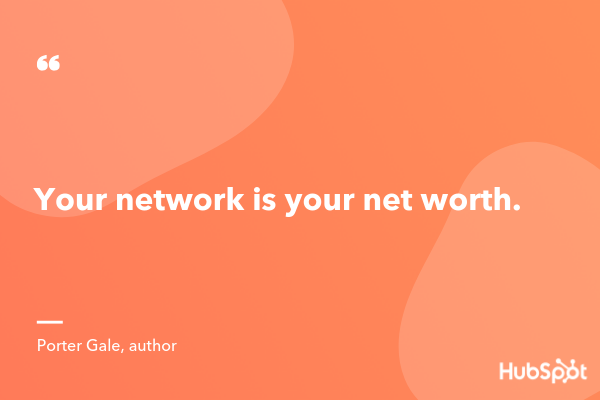
6. "Your network is your net worth." -- Porter Gale

network-quotes-porter-gale
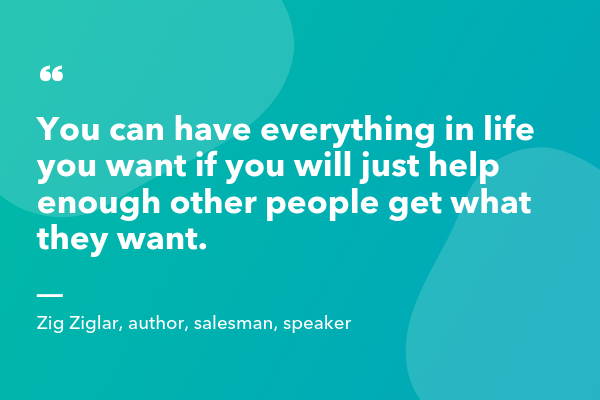
7. "You can have everything in life you want if you will just help enough other people get what they want" -- Zig Ziglar


8. "My Golden Rule of Networking is simple: Don't keep score." -- Harvey Mackay


9. "Courage starts with showing up and letting ourselves be seen." -- Brene Brown


10. "Instead of better glasses, your network gives you better eyes." -- Ronald Burt

networking-quotes-steve-jobs
11. "Networking is marketing. Marketing yourself, your uniqueness, what you stand for." -- Christine Comaford-Lynch


12. "Networking is not about just connecting people. It's about connecting people with people, people with ideas, and people with opportunities." -- Michele Jennae


13. "Pulling a good network together takes effort, sincerity and time." -- Alan Collins


14. "Networking is an enrichment program, not an entitlement program." -- Susan RoAne


15. "The single greatest 'people skill' is a highly developed and authentic interest in the other person." -- Bob Burg

networking-quotes-michelle-obama-1
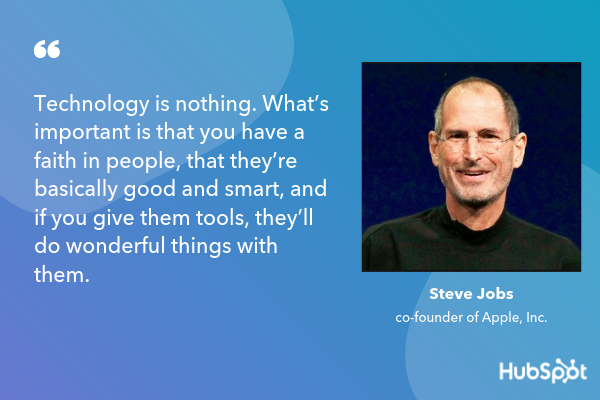
16. "Technology is nothing. What’s important is that you have a faith in people, that they’re basically good and smart, and if you give them tools, they’ll do wonderful things with them." -- Steve Jobs


17. "Know where you want to go and make sure the right people know about it." -- Meredith Mahoney


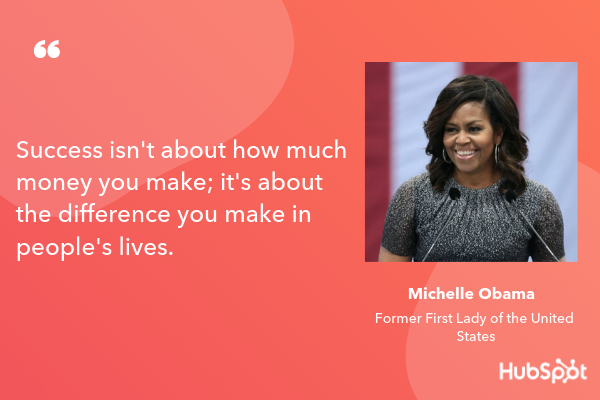
18. "Success isn't about how much money you make; it's about the difference you make in people's lives." -- Michelle Obama


from Marketing https://blog.hubspot.com/marketing/networking-quotes

How to advertise your business using promotional mugs

There are many ways to increase the outreach of your business. For instance, you can make use of promotional mugs which can be branded with the artwork of your preference.

Printed mugs are one of the best ways to enhance the growth of your business because your logo can be presented to each of your clients’ desks through these mugs.

Your clients will always remember about your brand through these mugs. When you are ready to embark on a promotional campaign, you can opt for the branded mugs since they will ensure that many people are knowledgeable about the products and services that you are offering.

In this context, you will learn more about how promotional mugs help to promote your business.

Promotional Mugs are suited to every consumer.

The mugs can be used to consume tea, coffee, or any other beverage. You can also use the mug as a pen pot. When most of the desks have a branded mug within your region of operation, many people will learn more about your brand.

Researchers have also noted that people are likely to consume two to three cups of coffee or tea daily. As a result, a printed, branded, or promotional mug will come in handy when trying to promote your business by improving brand awareness.

The promotional mugs can have your logo or the artwork that you prefer; this is a low-cost advertising opportunity that will ensure that prospective clients are knowledgeable about your company. There are also many different styles and colours that can be used as in the case of these promotional mugs. As a result, you can choose the styles and colours that suit your business model or brand.

The cheap promotional mugs come about in many forms, and the most popular form is the Cambridge mugs, and they are categorized as the most efficient form of offline marketing that is currently in use. Such mugs also ensure that you have value for your money and they can easily align with the marketing strategy within your company.

There is also the Bell Mug that is mostly used by corporates. It has gained popularity over the years since it has a large branding area that allows you to present all the necessary details such as the company name, logo, brand, contact details, as well as the mission statement of your company.

When you have a unique promotional mug, your brand advertisement will be unrivalled since it will be endless.

The ability to choose the colour and style gives you a chance to make sure that the colours present within the printed area will help to reflect your brand’s image. Furthermore, such a form of advertisement is affordable.

The companies that offer such services strive to ensure that they can serve you depending on your price range among other factors. The promotional dye-sublimation mugs will also enhance the colourful marketing.

In business, the main factors that you should consider are such as advertising your company accordingly for the right price. It is good to ensure that you have gotten value for your money.

The post How to advertise your business using promotional mugs appeared first on TheMarketingblog.


from TheMarketingblog http://www.themarketingblog.co.uk/2019/03/how-to-advertise-your-business-using-promotional-mugs/

Tips to hiring the best SEO services in UK : What to look for

When choosing a trusted and reputable SEO or Search Engine Optimization services in the UK, there are important things that you have to consider.



Search engine optimization or SEO is a critical aspect of your digital marketing, which creates a huge impact on your ranking, traffic, conversion rate, and sales.

Be smart in choosing and avoid the common pitfalls of hiring SEO services in the UK with these helpful tips:


Don’t Use Google as a Filter

Google is a good source of reliable information, but using it as a filter to check the best SEO companies is not a good idea. Most often than not, the best SEO services in UK don’t spend on working to optimize their website, like the Ocean One SEO website. Good SEO agencies consistently do great work, get referrals, and are in-demand but aren’t necessarily top-ranking.

Here are the reasons why:

  • Good SEO companies are overwhelmed with clients which means more work and referrals.

  • No need to optimize their websites because they have high retention and high satisfaction rates.

  • These trusted and reputable SEO agencies are incredibly busy, and they make a lot of money because of a job well done.

  • SEO insiders and influencers recommend good SEO agencies to potential clients without spending much on marketing or advertising their SEO services.

Note: Do not trust sites offering ‘Top SEO’ lists except for trusted and reputable sites such as Getcredo.com and Moz. It’s because SEO companies can’t pay these trustworthy sites to be listed.


Always Look for the Portfolio

SEO specialists are experts at getting websites on top of the search engines, helping you generate targeted web traffic through effective content marketing and other applicable marketing strategies. One way to prove the promised results is by checking their credentials and portfolio, which showcases their abilities and skills.

Here are the things that you need to check in the portfolio of your prospective SEO company:

  • Ask about samples or proof of optimized search phrases or keywords. Screenshots are good, but you also need to check the top ranking sites yourself.

  • Know the exact number of websites that appear on search engine results with a specific search phrase. Choose a search phrase similar to yours.

  • While your goal is to be on the number one spot, page ranks on the first page is a significant accomplishment for an SEO company. Make sure to have realistic expectations as well.


Look for the Good Qualities

All SEO companies want to look good to potential clients by promising the best results in the soonest time possible using a ‘secret strategy.’ However, there’s no secret sauce in SEO. Don’t believe in proprietary methodology because SEO is an open field. Instead, look for the qualities of a good SEO company.

Here are the qualities you need to look for when hiring SEO services in the UK:

  • Open Communication

    Listens to your SEO concerns and goals, and provide several communication options for a smoother implementation of the SEO process. Choose one with 24/7 client support so you can always contact the company for any query or issues.

  • Flexibility

    Willing to sit down and answer all your questions to figure out the objective you want to achieve. A good SEO company can make revisions or changes with minimal disruption on the overall process and original timeline.

  • Technical Expertise

    SEO is a complex process which involves not only content management but also ensuring that a website is optimized for SEO voice searches and AI-based platforms. All of these things would require in-depth technical SEO expertise.

  • Integrity

    Ask how the SEO company will achieve the best results and make sure that the strategies presented will nott hurt your website in the long run. White Hat SEO strategies are preferred than manipulating the SEO algorithm through Black Hat methods or dirty tactics.

  • Reliability

    Search engine optimization is a great way to boost your sales. That is why you need a reliable agency that provides organic traffic for a long-term solution and engagement with your visitors and customers, to keep them coming back to avail your products and services.


Conclusion

Hiring the best SEO services in the UK is somehow similar to hiring SEO companies in different places. The only difference relies on the cultural boundaries that may affect the effectiveness of SEO strategies.

That’s why hiring an SEO company from the UK is your best option if your target audience is from the UK to ensure you’re both on the same page in goal setting.

The post Tips to hiring the best SEO services in UK : What to look for appeared first on TheMarketingblog.


from TheMarketingblog http://www.themarketingblog.co.uk/2019/03/tips-to-hiring-the-best-seo-services-in-uk-what-to-look-for/

Sunday, 3 March 2019

17 Email Newsletter Examples We Love Getting in Our Inboxes

When people first start doing email marketing, they often assume they need an email newsletter.

"It'll have everything our customers care about, all in one place," they rationalize. "Our list will be different -- people will actually look forward to getting our newsletter," they argue. "Since we're only sending it once a month, it'll be a breeze to put together," they say.

Click here to download our free lookbook that's packed with our favorite email newsletters.

And while all of those things may become true for a few lucky individuals, lots of email newsletters flop. They become an uninteresting mush of content people automatically ignore, archive, delete, or straight up unsubscribe from. And this isn't great for you, your metrics, or your company's success.

So if you're thinking about creating an email newsletter, read this blog post and think really hard about whether that's the right move for you in terms of your marketing strategy.

If you've decided that you want to start an email newsletter, or you want to revamp one that's not performing well, keep on reading. We've compiled some of our absolute favorite email newsletters to inspire you to make the best email newsletter for your company possible.

Each newsletter on this list is fabulous for different reasons. Some have exceptional design, some have exceptional copy, some have exceptional calls-to-action ... but all are exceptional at solving for their subscribers' needs. Check 'em out.

1. NextDraft

NextDraft is a daily email written by a man named Dave Pell, which is a curation of the best web content of the day. As Pell describes it, "Each morning I visit about fifty news sites and from that swirling nightmare of information quicksand, I pluck the top ten most fascinating items of the day, which I deliver with a fast, pithy wit that will make your computer device vibrate with delight."

You can tell he's a great writer. His copywriting is one of my favorite things about the newsletter. It starts with the subject line, which is usually a play on words or a clever one-liner on the top news of the day. It then extends to the body of the email itself, which is always descriptive, accurate, and clever. Finally, the minimalist design is fantastic.

Not only is content delivery is clear, organized, and digestible, but also the inclusion of social share buttons underneath each story is brilliant. Rather than assuming that the reader is going to make it to a social sharing option at the bottom of the newsletter, Pell provides them with multiple opportunities throughout. Social engagement can play a big role in growing your newsletter, as every share on social opens up a valuable opportunity to attract more subscribers.

For those who'd rather read news like this in a mobile app, the NextDraft app is free in Apple's app store.

Email newsletter example design for news copy by NextDraft

[Click here to see the entire email.]

2. REI

REI, the recreational sports outfitter, is a model of success in several areas of content marketing -- and their membership email is no exception.

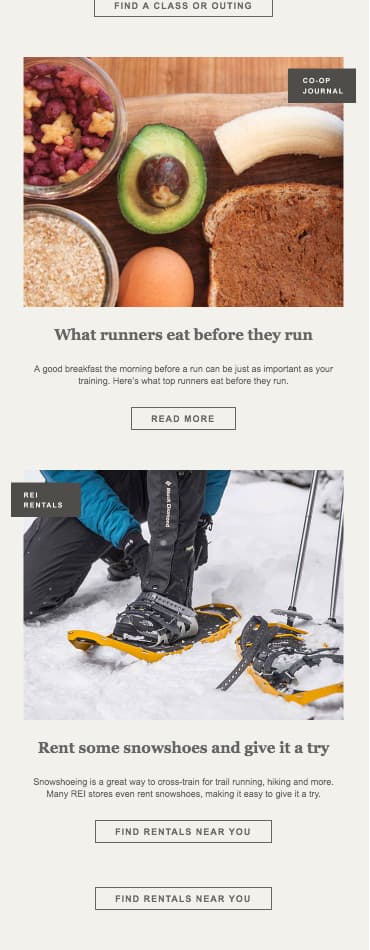
We included this email newsletter on our list because it does what many ecommerce and consumer product vendors find challenging: promote good products with good content. In the newsletter example below, you'll see how REI delivers many different types of material to its subscribers, and each type relates to one another. Following the seasonal product offerings at the top of the email, the company offers trainings to help educate readers on its new products and blog posts for even more insight into the outdoor lifestyle.

Did you notice something else about this newsletter? It's dedicated entirely to runners. Catering your email newsletter to a single audience -- even if that audience belongs to an even bigger buyer persona -- can help you tell a story in your email that resonates with the recipient from start to finish.

rei-email-newsletter-2 rei-email-newsletter-1

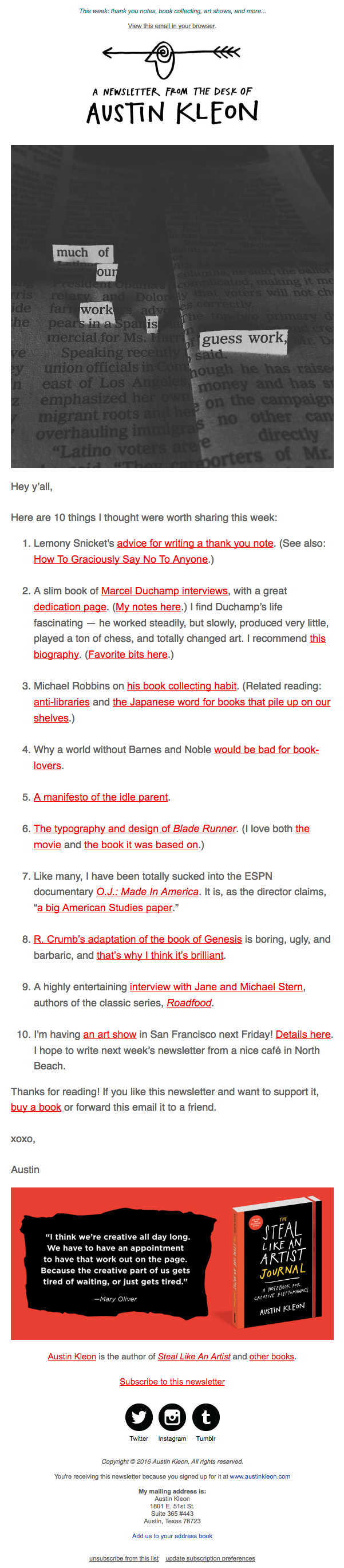
3. Austin Kleon

Not to play favorites, but this newsletter from Austin Kleon is one I really look forward to. First, I love the simplicity. It's not flashy, nor is it overly promotional. That's the hallmark of a successful email newsletter: The most effective newsletters aim to educate, not sell.

I also love the overall informal tone he takes, as it makes it feel as though you're hearing from a friend. If you're looking to lower the barrier between your company and your audience, consider using language that is friendly and inviting, not buttoned-up and jargony.

Email newsletter example design with recommendations by Austin Kleon

[Click here to see the entire email.]

4. FandangoNOW

FandangoNOW is a movie streaming app that allows you to build a library of purchased and rented movies around your interests. And it uses the below email newsletter as part of its customer retention strategy.

The email below offers movie suggestions for the weekend, making it a well-timed newsletter if it lands in your inbox on Friday afternoon. In addition, its design is easy to digest, despite being so graphic-intense. Using numbered icons and consistent "Buy" and "Rent" CTAs in corners of each movie tile, the email compartmentalizes a lot of content while still connecting each movie to the FandangoNOW brand.

fandangonow-email-newsletter

5. InVision

InVision's newsletter is a weekly digest of their best blog content, a roundup of their favorite design links from the week, and a new opportunity to win a free t-shirt.

Not only is their newsletter a great mix of content, but I also love the nice balance between images and text, making it easy to read and mobile-friendly. They make great use of animated GIFs in their emails (which you can see when viewing the whole email here). I also love the clever copy on their call-to-action buttons:

  • "Cat GIFs on Every Page"
  • "Set Your Sights"
  • "Why So Serious?"

In addition to classic CTA buttons, they engage their audience at the bottom of every newsletter with a "You tell us!" text CTA.

Email newsletter example design with blog posts by InVision

[Click here to see the entire email.]

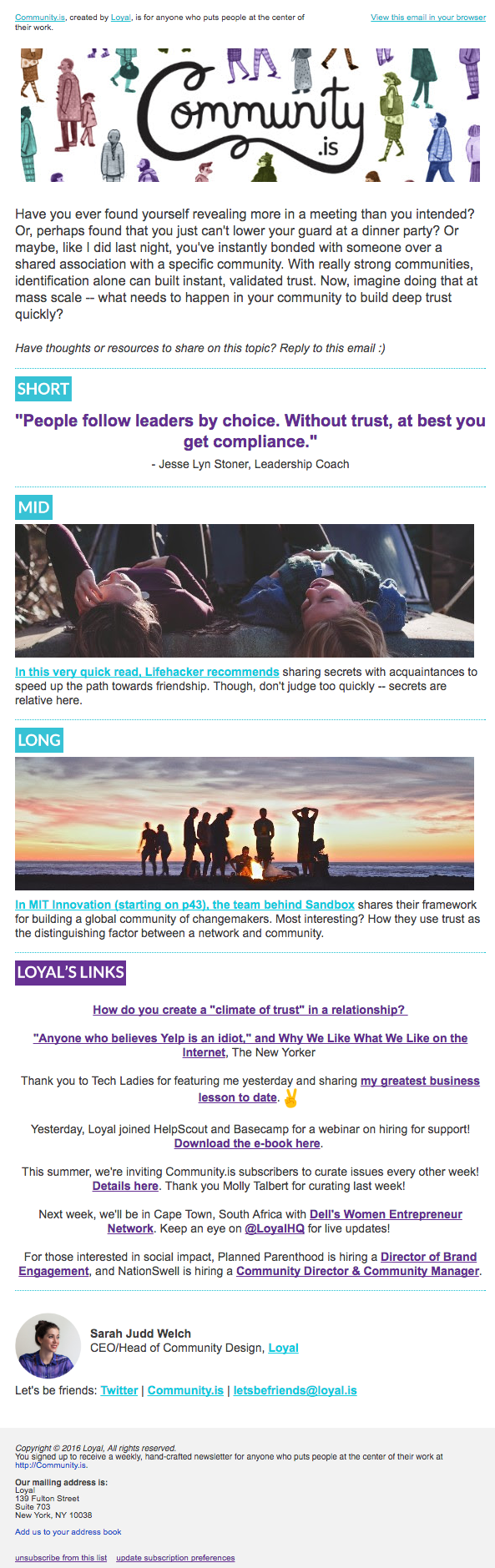
6. Community.is

Community.is is a handcrafted newsletter created for people who "put people at the center of their work." This unique concept attracts a variety of readers from executives at ad agencies, to community managers at startups, to marketers and creatives of all shapes and sizes.

In an effort to cater to their melting pot of subscribers, Community.is adopted a three-tier format: Short, Mid, and Long. While an executive may only have time to skim the short stuff, a marketer might be looking for a more in-depth read to spark some inspiration for their next campaign. Organizing a newsletter in this way helps ensure that you're serving the distinct needs of your audience without it being too confusing.

Email newsletter example design with articles by Community.is

[Click here to see the entire email.]

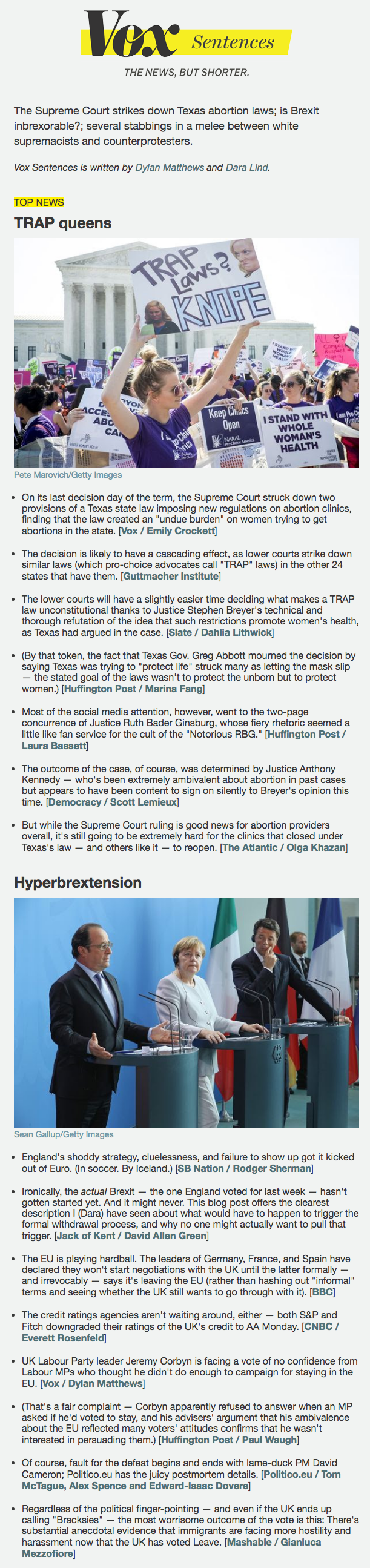
7. Vox Sentences

Vox Sentences is a nightly email meant to quickly get its readers up to speed on the best stories from the day. The content ranges from the day's top news to fun stories from all over the web. They do a great job balancing their own content with external sources, and the stories they choose are always really high quality.

You can read Vox's entire newsletter from start to finish and get a great sense of the stories they're covering -- but you can also click through to any of the linked stories to get a more in-depth approach.

Email newsletter example design with news clips by Vox Sentences

8. Fizzle

Fizzle's newsletter is aimed at entrepreneurs who want weekly tips on building a business sent directly to their inbox and all in the email itself. Although they have a business blog and a podcast, what makes Fizzle's newsletter unique is that the email content is independent from those other content assets. In other words, it's written entirely for their subscribers.

The copywriting style makes the newsletter unique and appealing, too: It's casual, honest, and written like the author is writing to a friend. The writing gives off the vibe of real, down-to-earth business advice -- without the fluffy stuff. At the same time, it's written with clear headers and sub-headers to break it up, and the important stuff is bolded, making for easy skimming.

Email newsletter example design with entrepreneurship tips by Fizzle

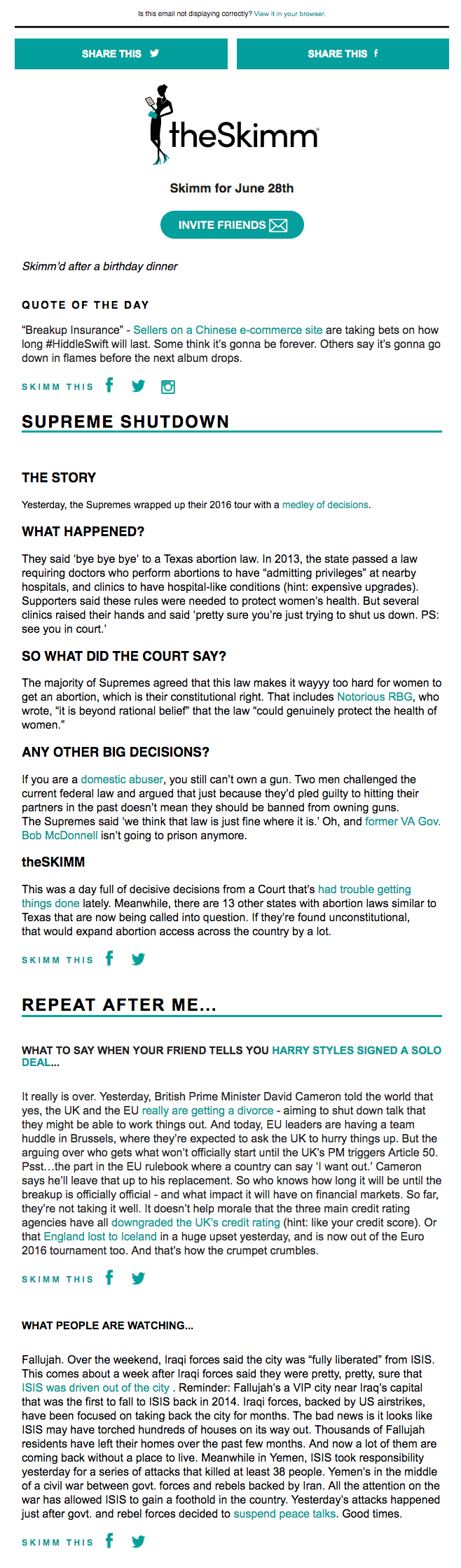
9. TheSkimm

If you want to stay up on what's happening in the world and have some delightful writing delivered to your inbox first thing in the morning, look no further than TheSkimm. It's a daily roundup of what's happened in the news in short, punch paragraphs.

The best part? You don't have to click out of the email to read the news if you don't want to -- although they do link to their sources if you want to read further. And when it comes to more complex news topics (think: Brexit or the Cannes Film Festival), they'll cover the most recent updates but link to their Skimm Guides, located on their website. These guides provide context for larger topics, and are written in the same style as the emails.

For your own email marketing, TheSkimm is the place to go if you're looking for writing inspiration or for emails without much visual content.

Email newsletter example design with news by theSkimm

[Click here to see the entire email.]

10. Medium

Medium is a blog-publishing platform that has been continuously building momentum since its launch in 2012. Publishing on the site has really picked up in the past few years, and nowadays, there are a ton of people publishing posts on the site every day.

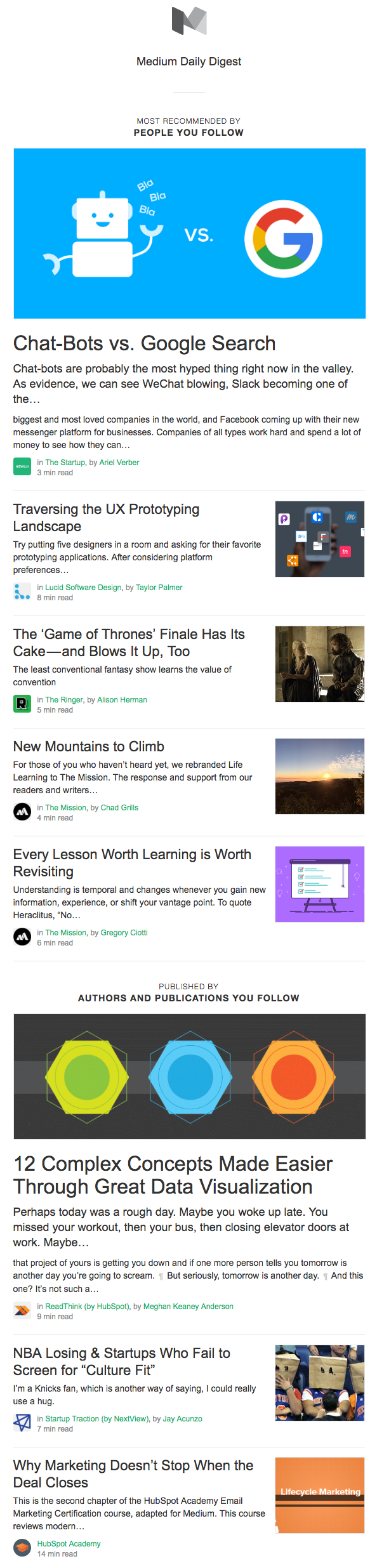
Of course, that means there's a lot of content for the average person to filter through. To help bring great content to the surface, Medium uses email newsletters. And after I open this newsletter every day, I end up going to visit several Medium posts without fail. (Mission accomplished for Medium, right?)

Here's why: The newsletter feels pretty minimal. Because of the way that Medium uses colors and section dividers, they're able to give you a ton of content in one email without it feeling overwhelming. Plus, they offer both a daily and a weekly version of the digest, allowing users to opt in for the email frequency they feel most comfortable with.

Email newsletter example design with blog posts by Medium

11. BrainPickings

BrainPickings is one of the most interesting newsletters out there. In fact, the folks who write it call it an "interestingness digest." Every Sunday morning, subscribers get the past week's most unmissable articles about creativity, psychology, art, science, design, and philosophy -- topics that are really appealing to a wide audience. At its core, it explores what it means to live a good life.

This is one of the longest newsletters I've ever read, but what makes it still work well is how high quality and well packaged the content is.

(Bonus: Check out the delightful microcopy in the top right-hand corner.)

Email newsletter example design with links, clips, and images by BrainPickings

[Click here to see the entire email.]

12. Litmus

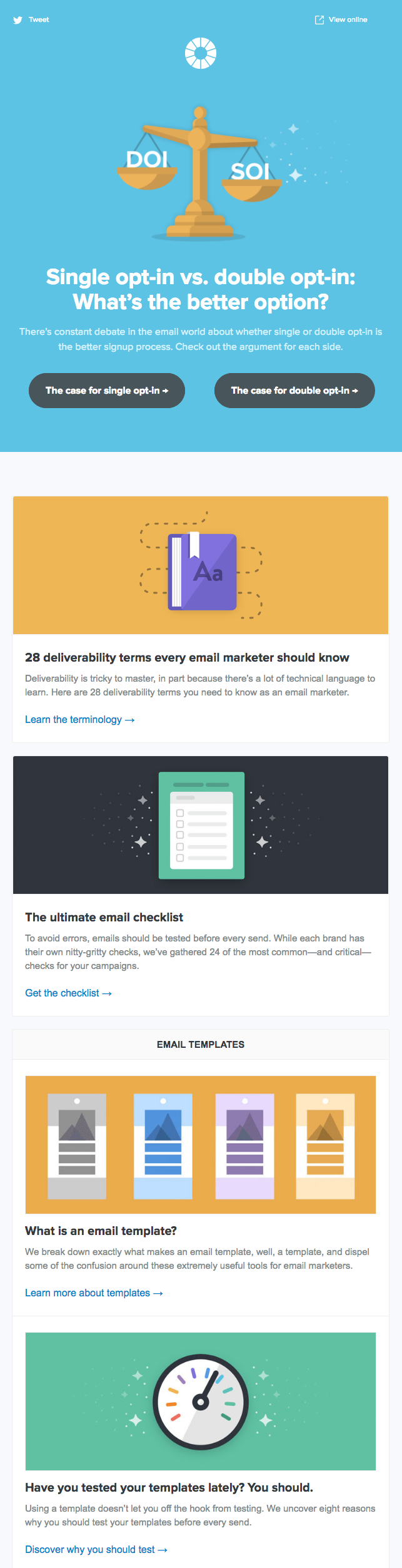
You'd hope that an email marketing testing company would have great emails ... and Litmus definitely does. While the content of the emails is certainly interesting, I'm especially digging the design. The blocks of color help break up the newsletter into sections that are easy to differentiate.

I also like that the text calls-to-action at the end of each post's description don't just say something generic, like "Read this post." Instead, they are matched with specific actions related to the post's content, like "Get the checklist" and "Discover why you should test."

Email newsletter example design with blogs and templates by Litmus

[Click here to see the entire email.]

13. General Assembly

There are a lot of creative things you can do with images in your emails, from designing your own custom graphics to creating animated GIFs. General Assembly, an organization that helps expand professionals' skill sets, likes to employ tactics like these in their newsletter.

From their attractive and minimal layout to their concise copy and helpful information, this is a great example of a newsletter that gives subscribers quick information in an easily scannable format.

Email newsletter example design with events by General Assembly

[Click here to see the entire email.]

14. This.

This. (yes, the full stop is part of the brand name) is another great newsletter for finding -- and sharing -- the best and most entertaining content on the web. What makes their newsletter unique is that it isn't just content curated by one person or one team; it's content curated by a community of people on the internet.

Members are allowed to share one, single link every day -- presumably the best content they find the entire day. The result? "We’ve built something we hope will connect you to the best the web has to offer -- all its weirdness and beauty and diversity and ambition," reads the website.

The newsletter consists of the editor's picks from all the amazing content their community members have shared. Subscribers also have the option of signing up for a custom newsletter, which includes the editor's picks and a custom feed from curators they can pick and choose. That's some pretty cool personalization.

Email newsletter example design with articles by This.

15. SaaS Weekly

This is the ultimate SaaS newsletter, from a guy that kind of knows a thing or two about SaaS. (Hiten Shah is the co-founder of and ).

While his approach is simple, this roundup is packed with value and organized in a way that makes it easy to discover content around your specific interests. Shah does this by breaking the list of curated posts into different sections -- Business, Product, Marketing Growth, Tip of the Week, etc. -- which makes it easily scannable.

Email newsletter example design with articles by SaaS Weekly

[Click here to see the entire email.]

16. The Ringer

Remember Grantland, the sports and pop culture blog owned by ESPN that was started by sports journalist Bill Simmons? In October 2015, ESPN announced it would be ending the publication of Grantland. Shortly thereafter, Simmons formed Bill Simmon Media Group and recruited a whole bunch of former Grantland staffers to launch a brand new newsletter in March 2016 called The Ringer.

Although The Ringer is written and run by many former Grantland employees it's a different project than Grantland was. Where Grantland focused on sports and pop culture, The Ringer branches out into other areas like tech and politics. Jon Favreau, a former speechwriter for President Barack Obama, is among the contributors. I like how focused they are on experimentation: "We want to have fun, take chances, analyze, theorize, obsess, and try not to take ourselves too seriously," said Editor-in-Chief Sean Fennessey.

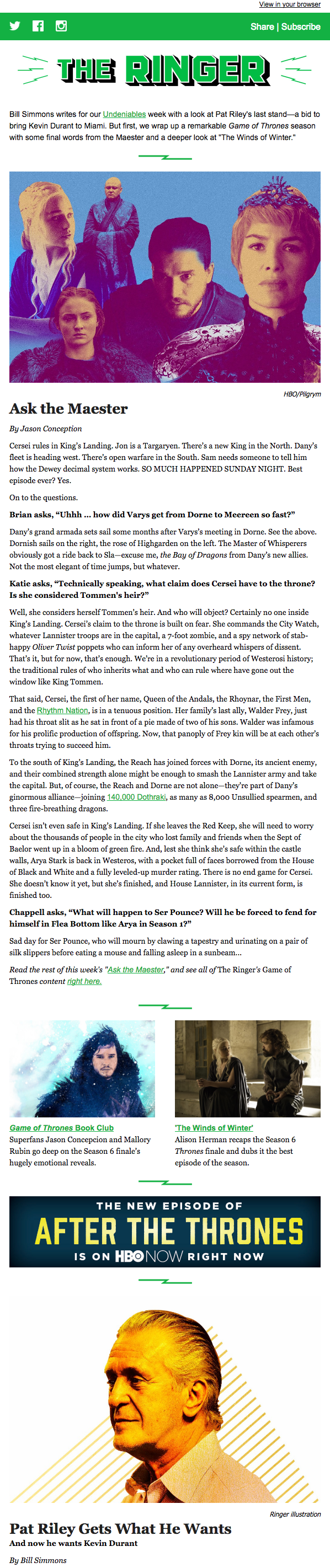
Another differentiator? The Ringer's website was developed in partnership with publishing platform Medium -- which means the newsletter reflects that clean, minimal design.

Email newsletter example design with article preview by The Ringer

[Click here to see the entire email.]

17. Hacker Newsletter

Many marketers don't frequent Hacker News, but they should still check out this hand-picked curation of the social network's top stories of the day.

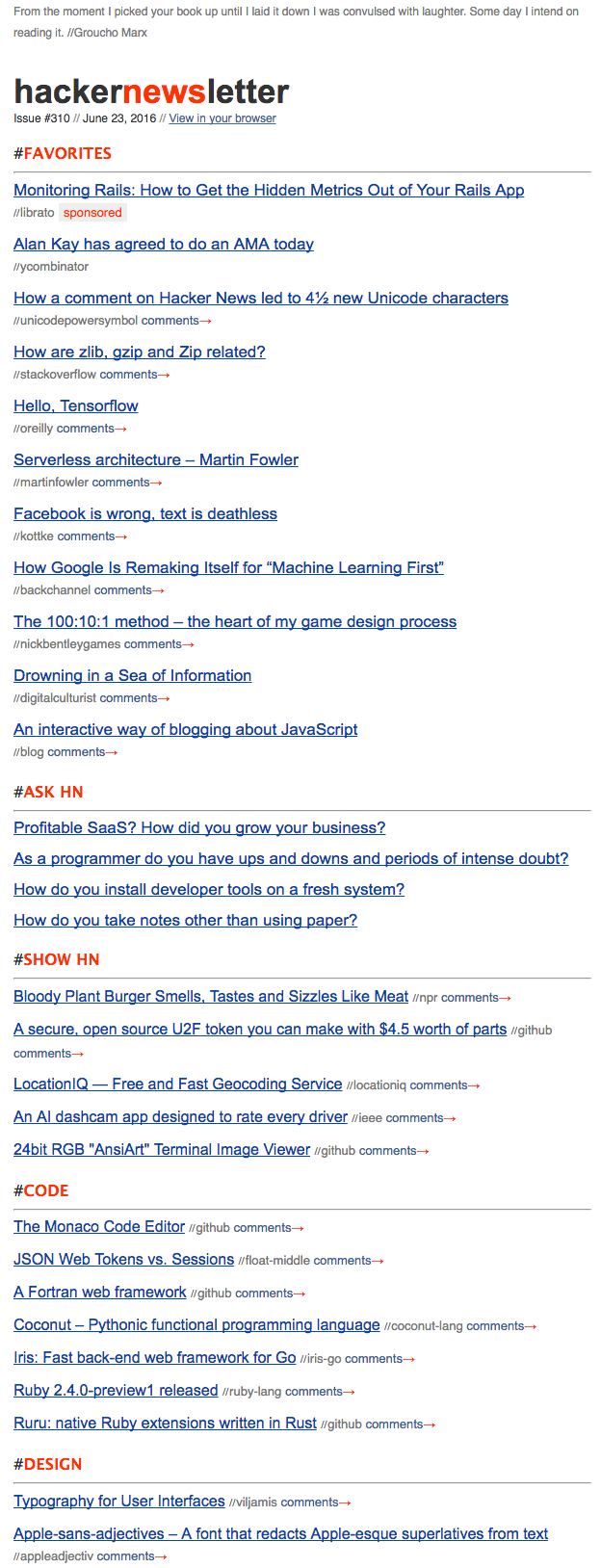
Why? The newsletter is clean and minimal, but still sends a ton of really great content its subscribers' way. The way it distills potentially overwhelming information is by bucketing content into sections. The newsletter also looks very similar to the site, so for those who love the site and how it's laid out, the newsletter feels like a comforting, familiar way to consume content.

hacker-newsletter-example.png

[Click here to see the entire email.]

Even though newsletters are one of the most common types of emails to send, they are actually some of the hardest to do right. We hope these examples gave you some quality inspiration so you can create newsletters your subscribers love to get in their inboxes.

Free Download Email Newsletter Lookbook

Free Download Email Newsletter Lookbook


from Marketing https://blog.hubspot.com/marketing/email-newsletter-examples-list