Friday, 1 March 2019

The Unexpected Pros & Cons of Sign-On Bonuses

Negotiating salary with candidates can sometimes be tricky -- particularly if you're extremely excited about a potential candidate, but she's asking for salary well-above the set salary range for the role.

When this is the case, there are a number of elements of an offer outside of salary that a candidate may place significant value on, and could carry more weight when deciding to join your team. For instance, you might offer more vacation time, higher bonus potential, or commuting reimbursement.

Alternatively, you might consider offering a sign-on bonus, which is a one-time increased payment to help you reach a total compensation package that is attractive to the candidate and offers a (sometimes significant) short-term financial incentive.

Of course, like with anything, there are pros and cons to sign-on bonuses. Keep reading to figure out whether a sign-on bonus is really the best tactic for your recruitment team or HR department.

Pros and Cons of Sign-On Bonuses

Pros

1. A sign-on bonus is a one time payment.

Let's say your candidate asks for 100K, but you're only able to offer 90K for the role. In a case like this, you might consider including a sign-on bonus to make the total compensation package more attractive to the candidate.

While your compensation expense as an employer in the first year is the 10K sign-on plus the prorated total salary, in subsequent years you are only paying the base salary.

This has less of a financial burden for your company in the long run.

2. A sign-on bonus can help you attract a candidate who might have competing offers.

If you know your candidate is in high demand or might be considering alternative offers, you might want to include an additional incentive to demonstrate your interest in her as a candidate. For instance, let's say you want to hire a highly-skilled engineer, but she's been given offers from other top firms in the city, as well.

The sign-on bonus could be your opportunity to persuade her to join your company -- additionally, it shows you recognize her worth and want to be considered as a serious option.

3. A sign-on bonus can help you bridge the gap between the candidate's desired compensation package and what you're able to offer.

Simply put, a sign-on bonus enables you to bridge the gap between the candidate's desired compensation package, and the compensation package your business is able to offer. While you might not be able to afford to pay her 5K more over the next couple years, you could find the funds to make the offer more appealing to her.

It's important to note, a sign-on bonus often comes with fine print that ensures a candidate will stay with your company for a certain length of time -- likely 6 months to a year, minimum.

Cons

1. Year two, the candidate might feel underpaid or under-appreciated when she returns to a base salary without the sign-on bonus.

Year two, when your candidate sees her total cash compensation comprised only of the base salary in the absence of the sign-on bonus, she might feel underpaid or under-appreciated -- or like she just received a pay cut. Even if she understood the agreement when she made it, it's difficult to mitigate feelings of frustration when that sign-on bonus goes away and the employee is making less than she was making year one.

Over the long-haul, she's likely going to seek out opportunities to close the gap and receive what she initially expected, either through a salary increase, performance bonus, or long-term compensation -- and, if she can't find that opportunity at your company, she might look elsewhere.

To ensure sustained employee satisfaction, it's critical you're able to pull other levers such as options, RSUs, bonuses, or annual compensation increases to cover the expectation.

2. You'll need to ensure your company can offer it immediately.

It might be tricky to locate the funds to offer a sign-on bonus. Additionally, a sign-on bonus is expected to be paid in-full in the candidate's first or second paychecks. So, while it might seem simple, it's worth noting -- you'll want to make sure you have the funds immediately ready to give to your candidate once she accepts your offer.

Alternatively, you might choose to pay 50/50 at the start date and then midway through the year, with a one year clawback clause.


from Marketing https://blog.hubspot.com/marketing/sign-on-bonus

Unstructured Data Vs. Structured Data: A 3-Minute Rundown

Most marketers think being data-driven means using web metrics to inform every decision they make. But that’s not actually being data-driven. That’s being Google Analytics-driven. To truly be data-driven, we must remind ourselves of the actual definition of data -- all types of information.

One of the most insightful types of information is qualitative data or unstructured data. It can reveal your customers’ true opinions and feelings toward your brand, which is challenging to extract from quantitative data or structured data.

Even Jeff Bezos, the CEO of Amazon, is a passionate proponent of using qualitative data to drive strategy. “The thing I have noticed is when the anecdotes and the data disagree, the anecdotes are usually right. And there's something wrong with the way you are measuring (your data)," he explained during an onstage interview at George Bush Presidential Center last April.

Bezos' love for customer feedback shouldn’t compel you to supplant quantitative data with qualitative data when strategizing your next marketing campaign, though. It should compel you to inform your strategy with both sources of data. By combining the insights pulled from web metrics and customer feedback, you can get a full understanding of your marketing program’s effectiveness.

If you want a deeper explanation of what qualitative or unstructured data and quantitative or structured data is, check out this quick rundown of what both data sources exactly are and which tools you can use to store and analyze them.

Since you can’t store and organize unstructured data in typical databases, you need to store them in Word documents or non-relational (NoSQL) databases, like Elasticsearch or Solr, which can perform search queries for words and phrases.

Additionally, since you can’t use standard data analysis methods and tools to pull insights from unstructured data, you can either manually analyze or use the analysis tools in a NoSQL database to examine unstructured data. However, to use these tools effectively, you need a high level of technical expertise.

If you can successfully extract insights from unstructured data, though, you can develop a deep understanding of your customer’s preferences and their sentiment toward your brand.

Be Data-Driven, Not Just Google-Analytics Driven

In a world where Google Analytics can spit out every metric under the sun, you must remember that qualitative data, like customer feedback, is just as crucial for informing your marketing strategy as web metrics. Without unstructured data, you won’t have a clear understanding of how your customers actually feel about your brand. And that’s crucial for every marketer to know.


from Marketing https://blog.hubspot.com/marketing/unstructured-data

7 Red Flags to Watch Out For When Auditing Your Link Profile - Whiteboard Friday

Thursday, 28 February 2019

How to Craft a Brand Manifesto [Guide + Examples]

In Simon Sinek’s famous Ted Talk “How great leaders inspire action”, he fleshes out a concept that some of the most inspiring leaders and organizations -- specifically Apple, Martin Luther King Jr., and the Wright Brothers -- leveraged to build loyal followings. It’s called Start With Why.

Start With Why suggests that if your brand truly wants to inspire an audience to follow you, your core message should focus on your organization’s purpose -- not how you make your product or what your product is. Spotlighting why people should care about your organization is how Apple, Martin Luther King Jr., and the Wright Brothers ultimately built a body of support for their causes, even though they all faced fierce competitors.

Simon Sinek’s notion that people buy the “why” behind your organization, not the “what” or “how”, isn’t some idealistic trend catching fire in the business world today. It’s actually rooted in human biology. To explain further, the most primal part of the brain is called the limbic system, and it controls all decision making. It also happens to control all of our emotions and feelings.

So, resonating with your audience will also appeal to the part of the brain that’s responsible for action. In other words, if you can evoke emotion, you can drive behavior. If you can’t do the former, though, you’ll struggle to build a loyal following, let alone sell them anything.

But how do you discover the “why” behind your organization? How do you actually connect with an audience and inspire them to follow you? One of the best places to start is by writing a brand manifesto.

5 of the Best Brand Manifesto Examples

1. Nike

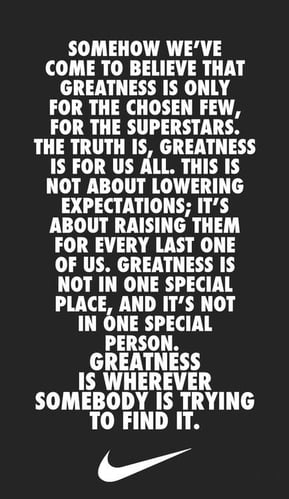
Nike Brand Manifesto

Image Credit: Pinterest

Even though Nike endorses some of the biggest names in sports, like LeBron James, Cristiano Ronaldo, and Serena Williams, they never boast about how the best athletes in the world use their equipment. Instead, they stick to what has skyrocketed them to the top of the sports equipment industry -- emotional resonance.

Nike wants people to understand that success doesn’t mean becoming the greatest of all time. It means you did everything you could to become the best possible version of yourself. And that’s the “why” behind their brand -- to empower every athlete, regardless of their talent or ability, to reach their potential and achieve their own greatness.

2. Fiat

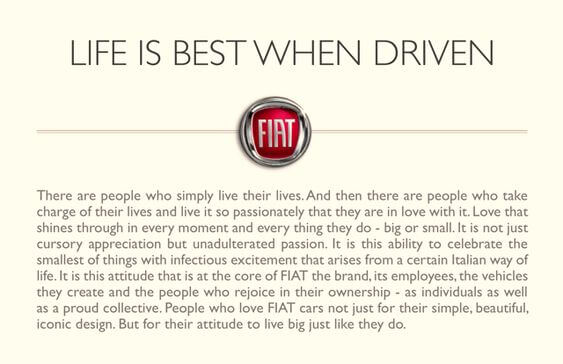
Fiat Brand Manifesto

Image Credit: Pinterest

Fiat isn’t just selling a sleek, Italian car. They’re selling a lifestyle. In their brand manifesto, you get a glimpse of the life they want to offer to their customers -- a life that they can live with burning passion and thrilling excitement.

However, Fiat doesn’t want its customers to live recklessly. They actually want them to treasure the little things in life just as much as the big things. So the “why” behind Fiat’s brand isn’t really changing their customers’ lifestyle -- it’s changing their attitude toward life. And that’s a compelling mission to have.

3. The North Face

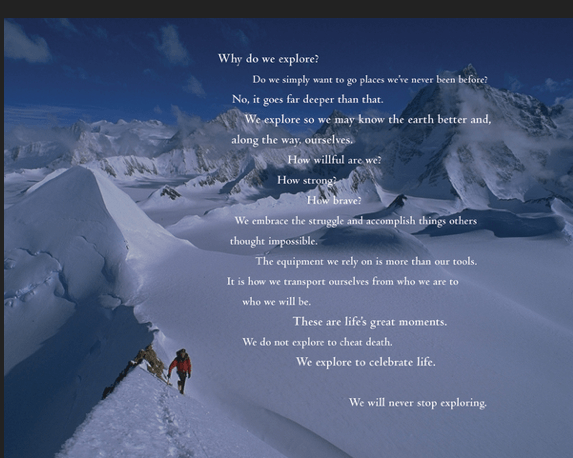
The North Face Brand Manifesto

Image Credit: Pinterest

Most travel equipment brands focus on how their products can enable you to travel and explore your surroundings, which is engaging on the surface. But, in The North Face’s brand manifesto, they go another layer deeper by diving into why we explore.

By describing how exploring helps us understand ourselves better, The North Face’s purpose is crystal clear -- they not only want to help us explore more, but they also want to help us change for the better, lead more fulfilling lives, and cherish what we have.

4. Apple

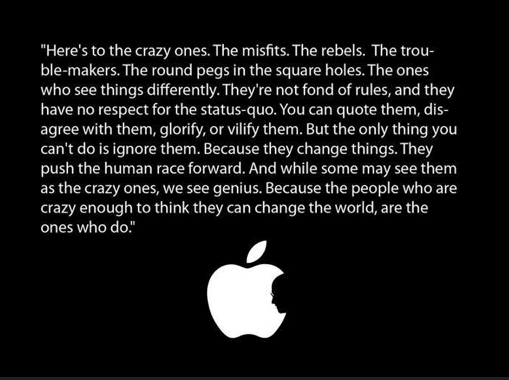
Apple Brand Manifesto

Image Credit: Pinterest

For almost his entire career, Steve Jobs was considered crazy. His bitter disdain for the status quo compelled him to shatter conventional wisdom whenever he could, driving such a large wedge between him and his colleagues that they forced him out of the company he founded.

Despite all his controversy, though, Steve Jobs’ ability to think differently was what fueled Apple’s innovation and transformed it into the most valuable brand in the world. Steve Jobs’ story is the driving force behind Apple’s purpose. If they can inspire people to think differently and challenge the status quo, then they can help propel society forward and change the world -- just like Steve Jobs did.

5. Levi’s

Levi's Brand Manifesto

Image Credit: Pinterest

No one wants to coast through life. But, a lot of times, we drift away -- and we don’t even notice it happening. To help catch yourself settling in life before it’s too late, Levi’s crafted a brand manifesto overflowing with so much purpose that it could convince Eeoyre from Winnie-the-Pooh to go make his mark on the world.

By asking their audience whether they’ve made the world any better and telling them that all they need is their gut instinct and the clothes on their back to make that impact, Levi's conveys a brand purpose almost everyone would passionately follow for the rest of their lives -- don’t ever settle.

1. Identify your organization’s "why”.

Your brand’s purpose drives your entire brand manifesto. Without presenting a clear and convincing purpose, your manifesto will seem like an inauthentic, emotionally manipulative sales pitch. Your audience wants to know why they should care about you -- and your product’s “best-in-class” features has never been a compelling enough reason to support a business.

To uncover your organization’s "why”, consider asking your founders why they started the company. What problem were they trying to solve? Why did it bug them so much? And why do they want to keep growing the company? You’ll most likely find your organization’s purpose within those answers.

2. Write in second- or third-person to place your audience into the story you’re telling.

In each of the brand manifestos above, you’ll notice that the copy pulls you in by including the words "we” or "people”. That’s because Nike, Fiat, and The North Face all know that their audience primarily cares about how the brands can help them, so using pronouns like "you”, "we", and "them” (when referring to their own customer base) can engage people on a personal level and place them in the narrative the brands are crafting.

3. Describe how your brand’s purpose will improve people’s lives.

Most people aspire to transcend their current identity and lives. Self-actualization is a universal goal that almost everyone wants to achieve. And the smartest brand marketers understand this about the human condition.

For instance, did you notice how each of the brand manifestos above is essentially a life mantra that can improve your life? Nike -- define and meet your own greatness. Fiat -- enjoy life to the fullest. The North Face -- never stop exploring. Apple -- think differently and challenge the status quo. Levi’s -- don't ever settle in life.

By describing each brand's purpose in a such genuinely selfless fashion, each company's brand manifesto can prompt their audience to imagine a future with their product or service bettering their lives.

Start With Why

Your brand’s purpose is one of the most challenging things to pinpoint and communicate. But if you want to craft a compelling brand manifesto that will engage an audience and persuade them to support your brand, you must be able to clearly convey the reason you exist and why anyone should care. Only then will you be able to build the loyal following that every brand craves.


from Marketing https://blog.hubspot.com/marketing/brand-manifesto

Online sponsorship marketplace, Connexi, finds the perfect match between Middlesex Cricket and JMAN Group

Connexi – the award-winning online sponsorship marketplace – today announces the partnership between Middlesex Cricket and Management Consultants, JMAN Group, that was secured via the platform. The partnership was sourced using the real-time data, fan behaviour insight and detailed search functionality that Connexi offers brands looking to source the best partnership opportunities for them.

Middlesex’s Royal London One-Day Cup shirts will, from this season, be sporting the JMAN logo on the front, and it will also appear on the back of the club’s Vitality Blast shirt and on the collar of the County Championship shirt. JMAN Group will also benefit from in-ground pitch-side advertising at the Home of Cricket and corporate hospitality with Middlesex at Lord’s and will be working in close partnership with the club on a number of sales and marketing initiatives throughout the coming year.

Having launched in October 2018, Connexi boasts an exclusive partnership with SMG Insight, the sports sponsorship research arm of YouGov which allows the platform to provide actionable insights to create winning commercially relevant partnerships to help brands grow, alongside giving rights holders and sponsors the ability to constantly assess performance, partnerships and strategies.

The business has gone from strength to strength since launch and in terms of users has seen a heavy uplift in sign-ups. Since December 2019 the company has seen a 420% increase in users, across a wide range of leading global brands and rights holders, which has led to a total brief value on the platform of over £72m.

The EIS qualified business is going through its first round of fundraising currently and with the increase in users has meant Connexi has hired a Managing Director, Charl Malan who joins from Imperial Brands, with a strong international FMCG background. Charl will take responsibility for building and executing successful business and marketing strategies, whilst focusing on implementing new ways of working and driving growth.

The business has also appointed Dan Cresta to the board as a Non-Exec. Dan brings more than 20 years-experience across the communications, media and advertising industry. He’s worked in senior strategy roles at agencies including WCRS, PHD, Naked and the7stars. His wealth of experience and understanding coupled with his entrepreneurial attitude and connections make him a perfect fit to help guide the Connexi team.

Anush Newamn, Co-Founder and Managing Partner of JMAN Group adds: “Connexi’s data driven platform played an important role in finding our sponsorship partner in Middlesex Cricket. It was quick, commercially relevant and very easy to interact with potential partners.”

Rob Lynch, Middlesex Cricket’s Commercial Director added: “Connexi played a pivotal role in linking us with JMAN, based on our values and consumer profile. It was quick and easy to use, and ultimately ended in us forming a commercially relevant partnership”

Rory Stewart-Richardson, CEO and founder of Connexi comments: “I am delighted at the successes Connexi has seen since we launched last year. It’s great to see the coming together of Brands and Rights Holders through our data driven approach, with over 200% increase in conversations through our platform. The JMAN, Middlesex deal is the fruition of this, and I am delighted to see our unique approach is being put to valuable use.”

The post Online sponsorship marketplace, Connexi, finds the perfect match between Middlesex Cricket and JMAN Group appeared first on TheMarketingblog.


from TheMarketingblog http://www.themarketingblog.co.uk/2019/02/online-sponsorship-marketplace-connexi-finds-the-perfect-match-between-middlesex-cricket-and-jman-group/

Pregnant Laughter Spot : “I couldn’t help but notice her condition”

A lady about 8 months pregnant got on a bus. She noticed the man opposite her was smiling at her. She immediately moved to another seat. This time the smile turned into a grin, so she moved again.

He seemed more amused. When on the fourth move, the man burst out laughing, she complained to the driver and he had the man arrested.

The case came up in court.

The Judge asked the man (about 20 years old) what he had to say for himself. The man replied…”Well your Honor, it was like this: When the lady got on the bus, I couldn’t help but notice her condition. She sat under a sweets sign that said, “The Double Mint Twins are Coming” and I grinned.

Then she moved and sat under a sign that said “Logan’s Liniment will reduce the swelling”, and I had to smile.

Then she placed herself under a deodorant sign that said “William’s Big Stick Did the Trick”, and I could hardly contain myself.

But, your Honor, when she moved for the fourth time and sat under the sign that said “Goodyear Rubber could have prevented this Accident”..

 ..I just lost it…….”

More great ‘Laughter Spots’ >>>>>

The post Pregnant Laughter Spot : “I couldn’t help but notice her condition” appeared first on TheMarketingblog.


from TheMarketingblog http://www.themarketingblog.co.uk/2019/02/pregnant-laughter-spot-i-couldnt-help-but-notice-her-condition/

Affordable, Stat-Based Retail Strategy For Your Agency’s Clients